
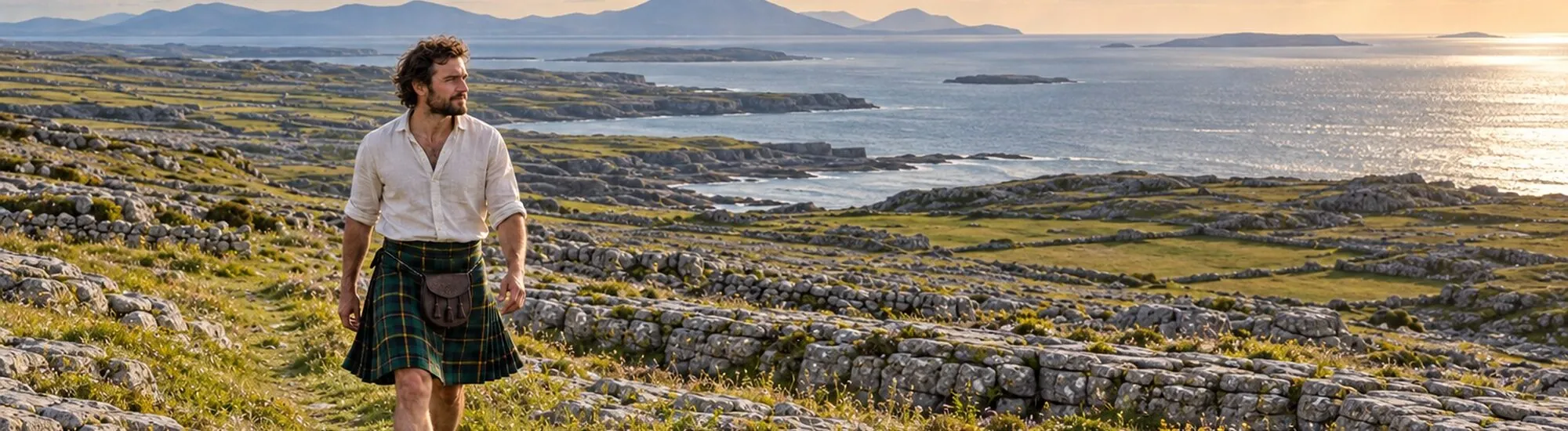
Contrary to popular belief, kilts are not found only in Scotland. They are also worn proudly in Ireland by people keen to preserve their cultural heritage… Let us be clear: the kilt is one of the traditional symbols of the Emerald Isle. Irish people wear it with pride, although you are unlikely to spot one except on St Patrick’s Day! To help you understand it better, here is a brief guide to the Irish kilt and its particularities!
An Irish kilt – Go to Ireland.com
Who would have thought it? Many specialists believe that the kilt may first have been worn by the Irish before spreading to Scotland!
Although the Scottish kilt is now far better known than the Irish kilt, this traditional garment appears to have first been mentioned in Ireland during the 11th century… while evidence of the Scottish kilt is thought to date only from the 17th century.
Enough to spark a real debate!
In the 11th century, the Irish wore the kilt, or “feileadh mor“: a garment made from six metres of woollen cloth, wrapped around the waist and secured with a belt.
One length of fabric was always left hanging at the waist, so that it could be brought up over the shoulder for greater protection.
At the time, each “feileadh mor” bore the colours of a particular clan (with each pattern known as a tartan), serving as a means of identification. Wearing this garment was an honour in itself and was seen as a rite of passage into manhood. (No women wore kilts at that time.)
This garment was reputed to be extremely heavy and uncomfortable. Very warm, however, it offered protection against Ireland’s harshest weather conditions.
Around the 16th century, the “feileadh mor” changed somewhat. The upper section, which could be draped over the shoulder, was removed, leaving only a skirt and a belt. Following these changes, the kilt became known as the “feileadh beg” (or small kilt).
Today, the kilt is still worn in Ireland. It takes the form of a large six-metre length of woollen cloth wrapped around the waist, creating a succession of deep pleats. Lighter and more “ergonomic” than those of the past, it has become more comfortable.
Each kilt displays specific colours denoting membership of a clan. These colours are known as “tartans” and each has its own meanings and symbols, according to the family with which it is associated, sometimes for centuries.
So be careful not to wear a kilt without permission from the clan concerned: many families may disapprove… while others will kindly allow it…
In terms of colour, Ireland has far fewer tartans than Scotland. The Irish kilt also features colours very different from those of its Scottish cousin, favouring patterns in shades of green and ochre. There are virtually no Irish tartans using shades of red and blue… with the exception of Northern Irish kilts… Some kilts even have no pattern at all, featuring solid colours only…
Although it is not worn every day in Ireland, the kilt is brought out for special occasions, including weddings and happy or solemn events. But you are clearly more likely to see one during St Patrick’s Day celebrations on 17 March, Ireland’s national holiday!
From its origins to the present day, here are the main elements that make up this traditional garment:
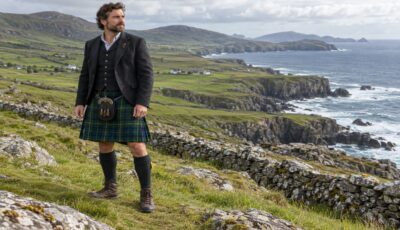
Man wearing an Irish tartan kilt on the Atlantic coast – Guide-Irlande.com
It is the inevitable question whenever kilts are mentioned: are men naked underneath, or do they wear underwear?
Without prolonging the suspense, the answer is simple: it depends!
In the past, it was probably too hot under the kilt to wear anything underneath… Yet many historians believe that some wore a light fabric to avoid the repeated chafing of the wool.
Today, both approaches exist: some wear a kilt without underwear, while others prefer boxers or briefs to avoid any mishaps (all it takes is a gust of wind… especially in Ireland!).
Buying a kilt is not easy, and first and foremost, you need a healthy budget. The main kilt makers are few and create made-to-measure garments, resulting in high production costs.
The price depends on the quality of the fabric (and the tartan, as some are available only in very small quantities) as well as the pleating (the best known include Kilt Hire, Harris Kilt…), but on average, expect to pay €600 if the kilt maker handles everything.
Alternatively, you can provide the fabric, in which case the kilt maker will charge only €300. The price per metre can vary, averaging €70 for double-width fabric and more than €90 for single-width fabric!
Do not forget to find out about your tartan, the family to which it is linked, and whether it is possible to obtain permission from them to wear those colours.
Finally, do not hesitate to wear it on special occasions: Irish people themselves wear it only on St Patrick’s Day or at weddings. They may well smile when they see you wearing such a traditional outfit, as it is sometimes considered a real cliché… even by local people themselves!