



On the Aran Islands, off Ireland’s west coast, the wind meets almost no resistance. It slips over dry-stone walls, crosses the pastures and whips up Atlantic spray before striking the low houses facing the sea. It was in this rocky landscape that one of the country’s most recognisable garments was born: the Irish sweater, more precisely known as the Aran sweater, Aran sweater or Aran jumper.
With its cream-coloured wool and intricate textured patterns, this knitwear seems to contain an entire geography. Its cables recall boat ropes; its diamonds, the walled plots of land; and its dense stitches, the need for protection from a damp, changeable climate. Yet behind this now-iconic image lies a history that is more recent and more nuanced than some legends would have us believe.
The Aran sweater is unlikely to be an ancient garment passed down unchanged since Celtic times. It appears instead to date from the late 19th century or the early decades of the 20th century. It then became an important source of income for island families, before reaching Dublin shop windows, American folk stages and international fashion collections.
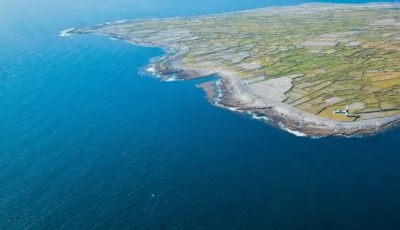
Inisheer – © Gabriela
The Aran sweater takes its name from the Aran Islands, a small archipelago at the entrance to Galway Bay. Inishmore, Inishmaan and Inisheer form an austere landscape shaped by limestone, sea spray and centuries of human adaptation.
Fishing once played a vital role here, but the earliest surviving knitted pieces do not allow us to state that the Aran sweater had been fishermen’s everyday uniform since time immemorial. Textile historians instead date the development of its distinctive stitches to between the late 19th and early 20th centuries.
At that time, people in Ireland’s coastal regions were already familiar with various forms of knitting. Techniques from other maritime communities in the British Isles probably made their way to western Ireland. Knitters on the Aran Islands are thought to have adapted, enriched and transformed them to create a far more elaborate style.
The development of this activity was also encouraged as a way of providing supplementary income for families living in poor rural areas. Knitting could be done at home, between farm work and everyday tasks. Each garment nevertheless required considerable skill: stitches had to be counted, several patterns combined and an even tension maintained over dozens of hours.
The earliest known Aran sweaters date from the early 20th century. Some examples held by the National Museum of Ireland show that the style was already well established in the 1930s and 1940s. The image of a garment thousands of years old, inherited directly from the Celts, therefore belongs more to romantic storytelling than documented history.
Its relatively recent origins do nothing to diminish its cultural value. Traditions are not necessarily fixed in a distant antiquity: they are created, shared and evolve. In just a few generations, Aran knitters created a textile language powerful enough to become one of Ireland’s visual symbols.
The sweater gained international prominence after the Second World War. Patterns were published in specialist magazines, while exports to Great Britain and the United States increased. In the 1950s and 1960s, the Clancy Brothers and Tommy Makem played a major part in its popularity by wearing white cable-knit sweaters on stage and on American television.
The thick Irish knit then became a sartorial expression of a rural, authentic and untamed Ireland. Actors, musicians and fashion designers in turn embraced it. Since then, the Aran sweater has regularly reappeared in popular culture, from photographs of Steve McQueen to contemporary collections, as well as in films and music albums.
The Aran sweater is recognisable by its raised patterns arranged in vertical bands. Cables, diamonds, chevrons, honeycombs and moss stitches follow one another like a sculpture made from a single thread.
These stitches now carry considerable symbolic meaning. Cables are often associated with fishermen’s ropes and the wish for a safe return. The diamond stitch is said to evoke the islands’ small fields, wrested from the rock and protected by low stone walls. The honeycomb is said to represent work, while trellis patterns symbolise fishing nets or family ties.
These interpretations are appealing, but they should be treated with caution. Much of this symbolic vocabulary was developed or popularised during the 20th century. The patterns also served an aesthetic and technical purpose: they gave the garment volume, trapped more air and allowed knitters to demonstrate their virtuosity.
A persistent legend claims that every family on the Aran Islands had a combination of stitches akin to a coat of arms. The pattern was even said to have made it possible to identify the bodies of fishermen recovered after a shipwreck.
No solid historical evidence confirms the existence of an official system linking each clan to a specific pattern. Families or knitters certainly had their own habits, favourite stitches and ways of assembling cables. However, it is unlikely that these variations formed a system of identification comparable to heraldic arms.
This story owes much to the evocative power of the garment, as well as to 20th-century literature and commercial narratives. It recalls in particular a passage from John Millington Synge’s play Riders to the Sea, in which a knitted garment helps identify a missing islander. Turning this literary episode into a widespread practice, however, is a myth.
The “family patterns” sold today are therefore above all a modern, decorative interpretation. They can make a lovely personalised gift, provided they are not presented as a historically proven genealogical tradition.
The traditional style is made from thick, undyed wool, ranging in colour from off-white to pale beige. This natural shade is sometimes referred to by the Irish word báinín, which evokes a white or ecru woollen cloth.
The crimped structure of wool fibres traps a layer of air that slows heat loss. The material can also absorb a considerable amount of water vapour without immediately feeling damp. It therefore regulates the microclimate around the body better than many synthetic fibres.
Older wool was less processed and could retain some of its lanolin, the natural grease found in fleece. This helped repel droplets, without making the garment waterproof. An Aran sweater provides effective protection against cold and light damp, but it is no substitute for a waterproof jacket in driving rain.
Its dense knit can also become heavy when soaked through. The image of a fisherman perfectly protected in the midst of a storm therefore needs qualifying: wool provides excellent insulation, even when slightly damp, but it is neither lightweight nor waterproof.
Not all Aran sweaters are made with wool from sheep raised on the archipelago. This claim, often repeated in souvenir shops, no longer reflects the reality of production, nor has it been established for all older garments.
The islands have limited grazing land and could never have supplied on their own the raw material needed for production that has become international. Manufacturers now use different wools from Ireland and other countries. Some styles are made from finer, softer merino wool; others use lambswool, more traditional rustic wool or fibre blends.
The term “Aran sweater” primarily describes a knitting style. It guarantees neither Irish wool, nor manufacture on the Aran Islands, nor even production in Ireland. To know the garment’s true origin, its label must be examined carefully.
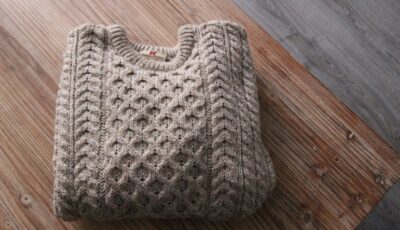
An Irish sweater – Guide Irlande.com
A cable-knit sweater sold in Ireland has not necessarily been made in the country. The wording “Irish design”, “Aran style” or “designed in Ireland” may simply indicate that the item was designed by an Irish company before being produced elsewhere.
To favour local manufacture, look specifically for the words “Made in Ireland”. If the origin of the wool also matters to you, ask the seller where it was spun and where the fibres come from. A reputable manufacturer should be able to explain the different stages of production clearly.
The composition deserves the same attention. A pure wool style will generally be warmer and more breathable, but also more demanding to care for. Merino wool is softer. A blend containing cashmere can be particularly pleasant, while a small proportion of synthetic fibres can sometimes improve durability and make care easier.
A garment containing acrylic is not necessarily poor quality, but it should not be sold as a pure wool sweater. Transparency on the label matters more than the seller’s sales pitch.
The term “authentic Aran sweater” does not automatically mean that the garment was knitted entirely by hand. A large part of today’s production is made on mechanical or electronic knitting machines, including in Ireland.
Some sweaters are machine-knitted and then assembled or hand-linked. Others come almost entirely from a production line. Truly hand-knitted pieces still exist, but they are rarer, take longer to make and are therefore more expensive.
Check the evenness of the seams, the density of the stitches and the finishing at the neckline, cuffs and shoulders. The patterns should be crisp, with no pulled threads or visible breaks. Turn the garment inside out too: a neat reverse side and sturdy seams are often the best signs of careful workmanship.
Prices vary according to the wool, country of manufacture, complexity of the patterns and amount of handwork involved. A high price alone is no guarantee of origin or quality.
These price ranges are indicative only. Cardigans, knitted coats and designer pieces may cost more than a classic crew-neck sweater. Before buying, always compare the composition, place of manufacture and production method.
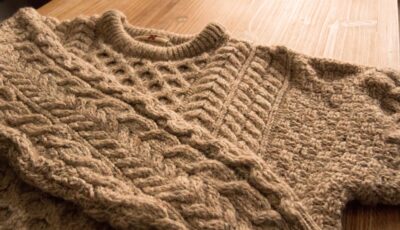
An Irish sweater – Guide Irlande.com
The Aran Islands are naturally the most evocative place to discover this garment. Inishmore, Inishmaan and Inisheer have shops and workshops offering knitwear inspired by local tradition. Buying on the archipelago can sometimes offer an opportunity to speak with sellers about patterns, materials and manufacturing methods.
Galway also offers a particularly wide choice. The city is the main gateway to the islands and maintains close ties with their culture. You will find both large specialist retailers and independent shops showcasing the work of designers from western Ireland.
In Dublin, shops on Grafton Street, Nassau Street and in the central districts offer many collections. Travellers in a hurry will easily find a style there, but should pay especially close attention to labels: a shop’s location in Ireland does not guarantee Irish manufacture.
Donegal has a remarkable textile tradition, particularly associated with tweed, spinning mills and flecked yarns. Excellent woollen pieces can be found there, but the Aran sweater remains historically linked to the islands of the same name and the Galway coast. These are therefore two distinct Irish textile traditions that should not be confused.
Many Irish manufacturers now have online shops and ship their products to France. This option makes it possible to check the composition and place of manufacture at leisure, but prevents you from trying on the garment before buying.
Check the size guide carefully, as traditional Irish cuts can be quite generous. Also review the return conditions, delivery costs and the address from which the parcel is sent.
From Ireland, a member of the European Union, a buyer living in France will not normally have to pay additional customs duties. The situation is different for an order dispatched from Northern Ireland or a country outside the European Union: VAT, formalities and possible handling charges may then apply.
In France, some specialist shops, including the Comptoir Irlandais, also offer styles inspired by the Aran tradition. Here too, it is best to judge each garment by its label rather than its name alone.
The traditional sweater has a straight cut, crew neck and ecru colour. Today’s collections, however, offer a much wider range: polo necks, cardigans, buttoned waistcoats, long jackets, knitted dresses and fitted styles sit alongside the great classics.
For everyday wear, a merino or lambswool sweater will often be softer and lighter. More rustic wool is better suited to those looking for a thick, durable piece close to the traditional aesthetic.
If possible, try the garment on with a T-shirt or shirt. Some wools can feel itchy on sensitive skin and are more comfortable when not worn directly against the body. Also check that the shoulders sit correctly and that the sleeves are not excessively long.
Ecru styles show off cable patterns particularly well, but are more prone to stains. Shades of grey, green, navy or charcoal offer a discreet, easy-to-wear alternative. Contemporary creations also explore bolder colours without losing the richness of their texture.
The first rule is to follow the care label. Some modern wools can withstand a specific machine programme, while others strictly require hand washing. When in doubt, hand washing remains the safest method.
Turn the sweater inside out and immerse it in clean, lukewarm water at around 30°C, with a small amount of detergent designed for wool. Leave it to soak for a few minutes without rubbing, twisting or roughly kneading it. Then rinse it in water at a similar temperature to avoid thermal shock that could felt the fibres.
To remove excess water, gently press the garment between your hands without wringing it out. You can then place it on a clean towel, roll it up carefully and apply light pressure.
Dry the sweater flat, away from radiators and direct sunlight. Do not hang it while wet: the weight of the water could distort the shoulders and stretch the sleeves. Tumble drying should be avoided unless explicitly recommended by the manufacturer.
Wool does not need to be washed after every wear. It naturally resists odours and often benefits from simply being aired flat in a dry room.
Store the sweater folded rather than hung on a hanger. Before storing it for a long period, make sure it is perfectly clean and dry: moths are attracted to fibres carrying traces of perspiration, food or organic matter.
A breathable cover or airtight box can protect it over the summer. Cedar and lavender provide a pleasant scent, but are no substitute for clean storage and regular checks. If small pills appear, remove them gently with a wool comb without pulling on the stitches.
The Irish sweater has long since left the shores of Connemara alone. It now moves through the decades with singular ease, by turns workwear, travel souvenir, musical emblem and designer piece.
Its appearance in films such as Knives Out and The Banshees of Inisherin has revived public interest in thick knits and rural silhouettes. For the latter film, several sweaters were specially hand-knitted by Irishwoman Delia Barry, based on research into historic clothing.
Contemporary designers are now reinterpreting the Aran sweater through volume, colour and materials. On Inishmaan, in Galway and in Donegal, workshops and fashion houses bring inherited techniques into dialogue with more contemporary fashion.
At a time when travellers are increasingly questioning the origins of the objects they bring home, the Aran sweater is also regaining particular value. Well chosen and properly cared for, it can be worn for decades, far removed from the fast pace of throwaway fashion.