Dún Conor
Dún Conor (also known as“Dún Conchuir” in Irish Gaelic) is a prehistoric Irish fort, located on the island of Inishmaan in the…


 Tourist attractions
 Irish Restaurants and Pubs
 Partner Accommodations
 Campgrounds and Lodging
Dún Conor (also known as“Dún Conchuir” in Irish Gaelic) is a prehistoric Irish fort, located on the island of Inishmaan in the…
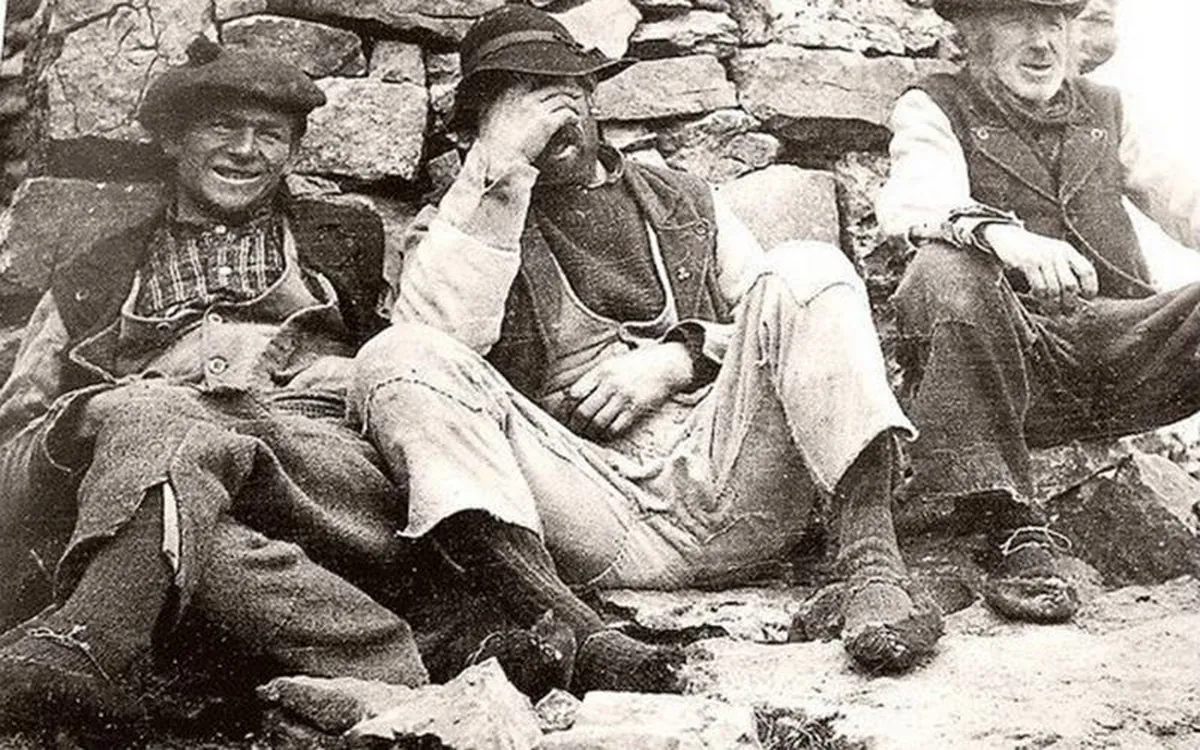
Did you know? The Aran Islands not only created the Irish sweater, but also pampooties, handcrafted leather shoes from the 1800s!
Inis Meáin, also known as Inishmaan, is the quietest and least visited of the three Aran Islands. Set in the middle of Galway Bay, between Inis Mór and Inis Oírr, it reveals a mineral landscape shaped by limestone, Atlantic winds and miles of dry-stone walls. Here, Irish remains an everyday language and silence is fully part of the journey.
Inishmaan has neither the bustle of Inis Mór nor the immediately visible small beach of Inis Oírr. Its charm is more understated. It unfolds slowly, along stone-lined paths, scattered houses and cliffs open to the ocean. The island is primarily for travellers who want to walk, observe and discover an island culture that is still deeply alive.
The Irish name Inis Meáin simply means “the middle island”. The English name Inishmaan, still frequently used in guidebooks and online searches, is an anglicisation of this Irish name.
The island is the second largest of the Aran Islands, yet remains the least visited. Its permanent population is fewer than 200 inhabitants. It is also part of the Gaeltacht, the group of areas where Irish is still spoken as a community language.
English naturally makes it possible to communicate with residents, but conversations in Irish, signs and place names are reminders that the Irish language is not merely a folkloric element here. It accompanies everyday life, school, culture and relations between families.
Like the other Aran Islands, Inis Meáin is a geological extension of the Burren. Its ground is made up of large limestone slabs cut through by fissures in which particularly resilient plants grow.
In spring and early summer, small colourful flowers appear between the stones. The delicacy of this vegetation contrasts with the harshness of the landscape, constantly exposed to wind, sea spray and rapid changes in Atlantic weather.
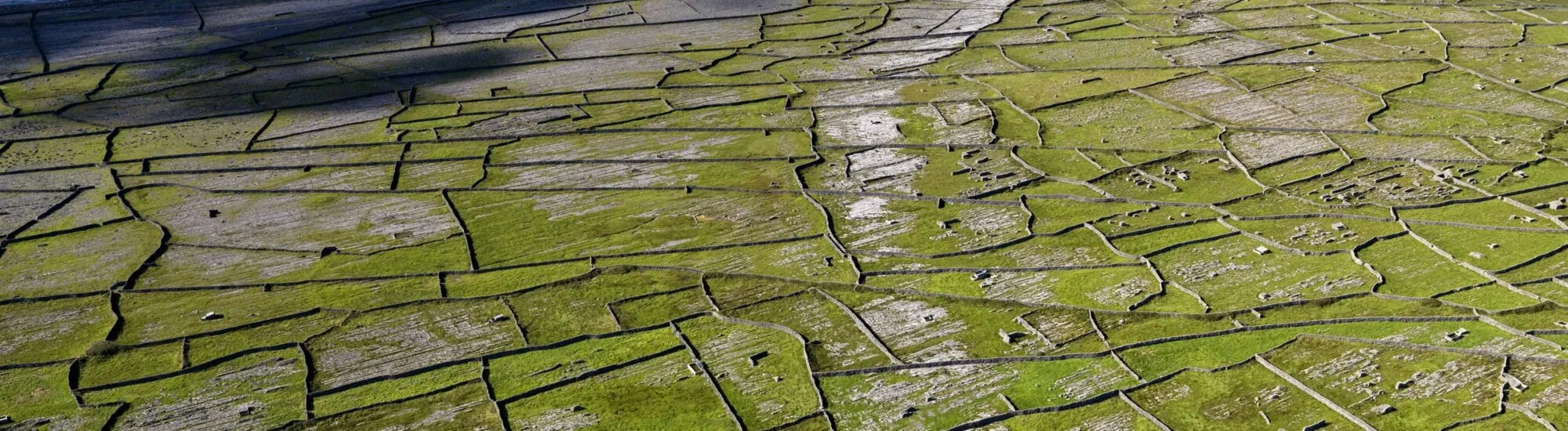
Thousands of dry-stone walls criss-cross the island and create a mosaic of plots. Built without mortar, they were used to mark land boundaries, protect crops and clear the most cumbersome stones from fields. Their succession gives the landscape of Inis Meáin its distinctive visual identity.
Walking is the best way to discover this environment. The roads remain quiet, but distances, terrain and wind can make getting around more demanding than it seems. Good shoes and waterproof clothing are essential, even when the sky looks clear at the outset.
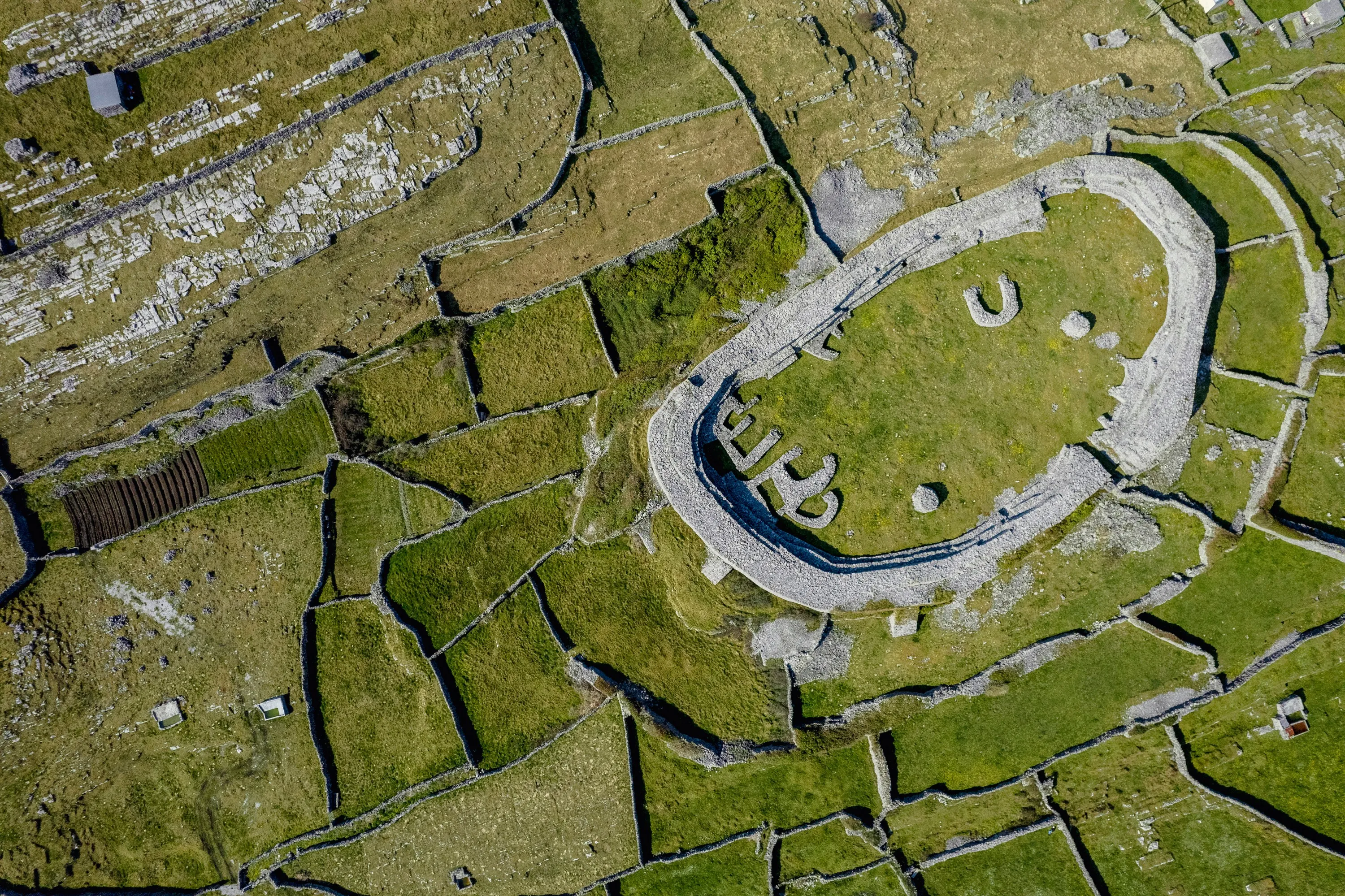
Set on one of the island’s highest points, Dún Chonchúir, sometimes called Dun Conor, is Inis Meáin’s main archaeological site. This vast stone fort is oval in shape and has walls more than eight metres thick in places.
More than 14,000 tonnes of stone are said to have been needed to build its inner rampart alone. Its exact date remains difficult to establish, but the site bears witness to ancient settlement and to the architectural skill of the communities established on the Aran Islands.
From the fort, the view takes in limestone fields, the network of stone walls and the ocean. In clear weather, visitors can make out the other two islands as well as the coasts of Connemara and County Clare.
Dún Chonchúir is a national monument accessible without a guided tour. The ground is uneven and lacks the facilities of a developed tourist site, so care is needed, particularly when the stones are wet or the wind is strong.
Less imposing than Dún Chonchúir, Dún Fearbhaí is nonetheless worth a detour. Its almost rectangular shape sets it apart from the majority of circular or oval forts found in western Ireland.
The site occupies an elevated position offering a fine view over the northern part of the island. Its relative isolation and limited visitor numbers make it possible to explore it in a particularly peaceful atmosphere.
Inis Meáin also preserves several religious ruins, former enclosures, tombs and remains of island dwellings. Some are poorly signposted: a local map or the island’s walking route makes them easier to locate.
Inis Meáin holds an important place in Ireland’s literary history thanks to playwright John Millington Synge. Encouraged by W. B. Yeats to discover the Aran Islands, the writer stayed on the island several times between 1898 and 1902.
Synge learned Irish from residents and collected stories, expressions, legends and accounts of island life. These stays inspired his book The Aran Islands, published in 1907, as well as the world of several of his plays.
The small house where he stayed has been restored and turned into a museum. Known as Teach Synge, it contains photographs, letters, drawings and various documents relating to the writer. A former outbuilding also houses a small library devoted to Synge, W. B. Yeats and Lady Gregory.
Teach Synge is mainly open during the summer season. As days and opening hours may vary, it is best to check that it is open before travelling to the island.
On the western coast lies Cathaoir Synge, or Synge’s Chair, a rock formation overlooking the Atlantic. According to local tradition, the playwright liked to sit there to contemplate the sea and let the stories of residents echo in his imagination.
The place is far from a spectacular monument. Its power comes precisely from its simplicity: bare rock, the crash of the waves and an unobstructed view towards the horizon. When visibility is good, the Cliffs of Moher can be seen across the water.
The path crosses uneven limestone terrain and approaches unprotected cliffs. Keep away from the edge, particularly in strong winds or when the ground is wet.
Inis Meáin is not a setting frozen in the past. The island has a school, businesses, craftspeople and a community that adapts its way of life to the constraints of the Atlantic.
Maritime traditions remain very present. Currachs, light boats once covered in tarred canvas, and Galway Hookers recall the era when the sea was the main link between the islands and the mainland. Regattas still offer the chance to see these emblematic boats of Galway Bay under sail.
The island is also known for its knitwear. Inis Meáin Knitwear has developed a contemporary interpretation of the famous Aran sweater, combining island patterns and techniques with more modern designs.
Inis Meáin can be explored on foot in a day, but staying overnight makes it easier to feel its atmosphere. Once day visitors have left, the island returns to a profound calm, broken only by the wind and the sound of the ocean.
The Dún Chonchúir walking loop is around eight kilometres long and links several of the main places of interest. It is also possible to hire a bicycle or book local transport, subject to the services available at the time of your stay.
Facilities are much more limited than on Inis Mór. The island has a small grocery shop and a few places to eat or stay, some of which operate seasonally. It is wise to bring water, a snack and some cash.
Inis Mór is better suited to visitors who want a wide choice of sites, restaurants and activities. Inis Oírr appeals through its small size, beach and friendly atmosphere. Inis Meáin offers a different experience, more restrained and quieter.
People come here to walk without encountering crowds, hear Irish being spoken, watch the light change on the limestone slabs and take the time to understand how a community continues to live in the middle of the Atlantic.
Inis Meáin does not seek to charm visitors immediately. It reveals itself in the details: a flower growing in a fissure, a colourful door between two grey walls, an almost invisible ruin or a path ending at the ocean. It is precisely this restraint that makes it one of the most distinctive destinations on Ireland’s west coast.