

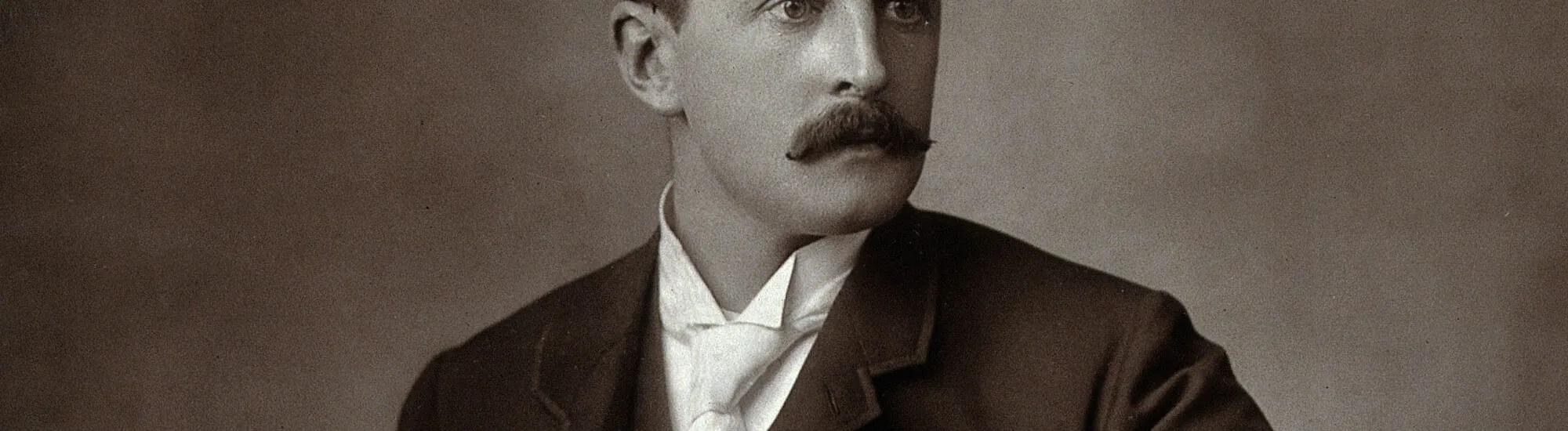
Thomas Heazle Parke, an Irish doctor and explorer of the 19th century, left a significant mark on history through his key role in major expeditions across Central Africa. Although his name is less known than contemporaries like Stanley or Livingstone, Parke stood out for his bravery, medical expertise, and contribution to the discovery and understanding of vast African territories. This article traces the life, work, and achievements of this Irish adventurer, often described as a humanitarian pioneer in extreme conditions.
Thomas Heazle Parke was born on November 27, 1857, in Drumsna, County Leitrim, Ireland. The son of a lawyer, he grew up in an environment that valued education and developed an early fascination with medicine and natural sciences.
He pursued medical studies at the Royal College of Surgeons in Ireland, Dublin, graduating in 1878. Seeking adventure and eager to apply his medical skills to help the less fortunate, he joined the British Army as a military surgeon. His postings in distant colonies quickly led him onto the path of exploration, a field where his talents would prove essential.
The most defining moment of Parke’s career was his participation in the Emin Pasha expedition, led by Henry Morton Stanley. The mission aimed to rescue Emin Pasha, governor of the Equatorial Province of Sudan, who was surrounded by Mahdist forces.
Recruited as the expedition’s doctor, Parke found himself plunged into a perilous journey through the jungles and swamps of Central Africa. The expedition members faced harsh conditions: tropical diseases, food shortages, attacks from hostile tribes, and major logistical challenges.
As the medical officer, Parke played a crucial role in the group’s survival. He treated hundreds, including Stanley himself, who fell seriously ill multiple times. His medical knowledge, combined with his calmness and humanity, made him a respected and admired figure within the expedition.
Parke was not just a doctor; he was also a curious explorer and keen observer. During the expedition, he documented the customs, traditions, and lifestyles of local populations, contributing to a richer cultural understanding of the region.
He also stood out for his innovative approach to medicine under extreme conditions. Without access to modern resources, he improvised treatments and procedures, laying the groundwork for what could be considered field medicine.
Parke showed a strong interest in African flora, studying its medicinal properties. His scientific curiosity led him to collect samples and write detailed observations, enriching the medical and botanical knowledge of his time.
Thomas Heazle Parke is often described as a man of great compassion. Unlike many European explorers of his era, he showed deep respect for African peoples. He learned their languages, observed their practices with curiosity, and sought to build relationships based on trust and mutual aid.
A famous anecdote illustrates this quality: when a young African boy was dying and abandoned by his group, Parke did not hesitate to take him in, care for him, and save his life. This act of kindness is immortalized in a statue in Dublin, depicting Parke holding the child in his arms—a symbol of his humanitarian dedication.
Back in Ireland after the Emin Pasha expedition, Parke was celebrated as a hero. He published his memoirs, titled “My Personal Experiences in Equatorial Africa“, where he detailed the challenges and discoveries of the expedition. The book quickly became a key reference in African exploration literature.
Unfortunately, his health, weakened by years spent in extreme conditions, declined rapidly. Parke died prematurely on September 11, 1893, at the age of 35, at his home in London.
His legacy, however, remains alive. As a doctor and humanitarian, he inspired future generations to combine exploration, science, and compassion. His statue in Merrion Square Park, Dublin, stands as a reminder of his role as an ambassador of humanity in a world still marked by colonial inequalities.