Ireland has also given birth to explorers and adventurers who have traversed seas and continents. Some contributed to the discovery of new lands, others distinguished themselves in scientific expeditions or perilous journeys to the poles. Their courage and thirst for discovery reveal another facet of Irish history: that of a small island that has produced great explorers for the world.
Saint Brendan the Navigator
The legendary monk who may have reached America
One of the most mythical figures is Saint Brendan of Clonfert, a 6th-century Irish monk. According to legend, he undertook an epic voyage westward aboard a leather boat called a currach. His account, recorded in the Navigatio Sancti Brendani, tells of his discoveries of strange and distant islands, sometimes interpreted as an early description of America.
Although it is difficult to separate myth from reality, Brendan remains a foundational figure in the Irish exploratory imagination. His story embodies the curiosity and daring of the monk navigators who sailed the Atlantic long before the Age of Discovery.
William Lamport (Guillén de Lampart)
An Irish adventurer in Mexico
Born in Wexford in the 17th century, William Lamport led a life of adventure that took him to Mexico. He entered the service of the Spanish crown, then plotted to free indigenous peoples and establish an independent monarchy.
Captured by the Inquisition, he was executed in 1659. His legend later inspired the figure of Zorro. Though less known than the great navigators, Lamport represents a type of political and cultural explorer willing to risk his life for his ideals.
Robert McClure
The discoverer of the Northwest Passage
Originally from Wexford, Robert McClure (1807–1873) joined the British Royal Navy and took part in major 19th-century Arctic expeditions. In 1850, he was sent to search for the lost Franklin expedition.
During this journey, he became the first explorer to traverse the Northwest Passage, linking the Atlantic to the Pacific through the Canadian Arctic. His achievement was hailed as a major advance in polar navigation.
Ernest Shackleton
The hero of Antarctica
Born in Kilkea, County Kildare, Ernest Shackleton (1874–1922) is arguably the most famous Irish explorer. He participated in several Antarctic expeditions, the most famous being the Endurance (1914–1916).
Trapped in ice, his ship was destroyed. Shackleton nevertheless managed to save his entire crew after an incredible journey by sea and ice. His leadership, courage, and tenacity made him a living legend. Even today, Shackleton is cited as a model of leadership in crisis situations.
Francis Crozier
A sailor from Armagh lost in the Arctic
Born in Banbridge (County Armagh) in 1796, Francis Crozier was a Royal Navy officer who took part in several polar expeditions. In 1845, he embarked alongside John Franklin on the famous expedition to find the Northwest Passage.
When Franklin died, Crozier took command, but the expedition ended in tragedy: the ships became trapped in ice and no men survived. Crozier’s fate, long mysterious, has fueled stories and hypotheses, but his courage remains unquestioned.
Tom Crean
The forgotten sailor of Antarctic expeditions
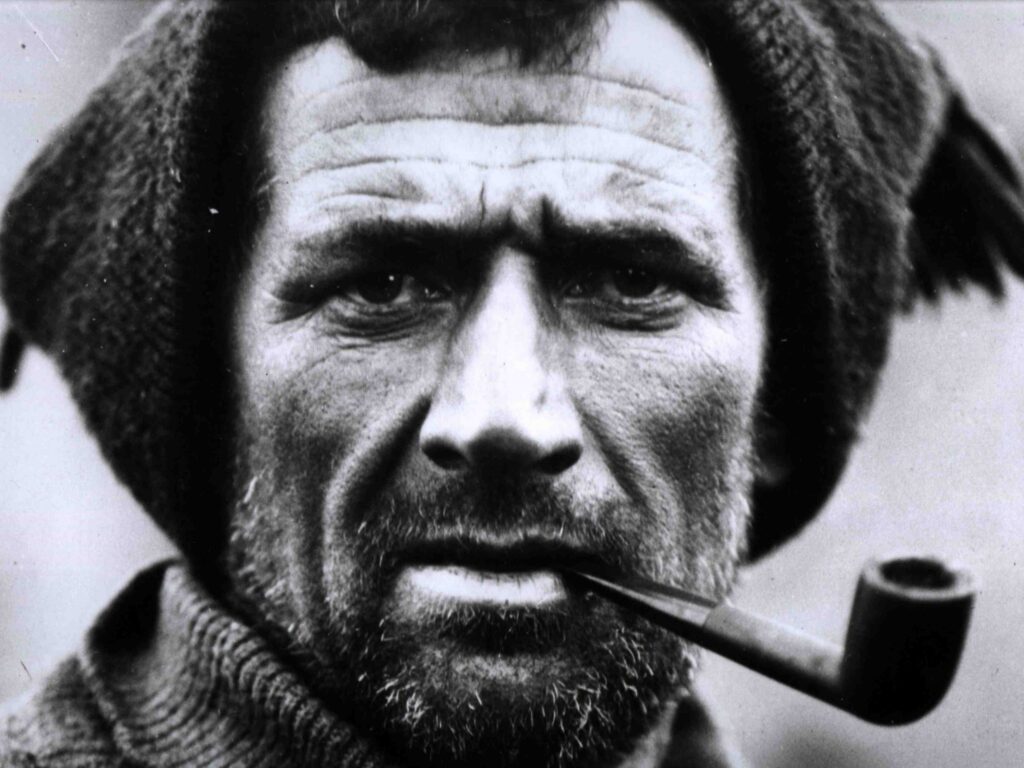
From Kerry, Tom Crean (1877–1938) was an indispensable member of early 20th-century Antarctic expeditions. He took part in three major missions: Scott’s (Discovery, 1901–1904 and Terra Nova, 1910–1913) and Shackleton’s (Endurance, 1914–1916).
Crean was noted for his physical strength and loyalty. His most famous feat is a solitary march of over 50 kilometers in extreme conditions to save his companions. Long overshadowed by Scott and Shackleton, he is now recognized as a quiet but essential hero.
Other lesser-known figures
Between distant voyages and scientific contributions
Beyond these great names, several Irish explorers have distinguished themselves over the centuries:
- Richard Bourke (1777–1855), governor of New South Wales, who played a role in colonial development in Australia.
- Edward Bransfield (1785–1852), a sailor from Cork, who explored Antarctic coasts and was among the first Europeans to map the continent.
- Arthur Dobbs (1689–1765), born in Antrim, passionate about the search for the Northwest Passage, financed several expeditions.
These lesser-known figures show that Ireland played a role in the great maritime and colonial explorations of the modern era.
The legacy of Irish explorers
Memory and inspiration
Irish explorers were not only travelers: they were also symbols of endurance and openness to the world. Their legacy is found in museums, monuments, and popular stories. In Dublin and elsewhere, statues and exhibitions celebrate Shackleton, Crean, and Crozier.
Their memory continues to inspire current generations, whether researchers, sailors, or simple travel enthusiasts. In a country marked by emigration, these figures remind us that Ireland has always crossed horizons, not only out of necessity but also out of curiosity and boldness.

 +
+