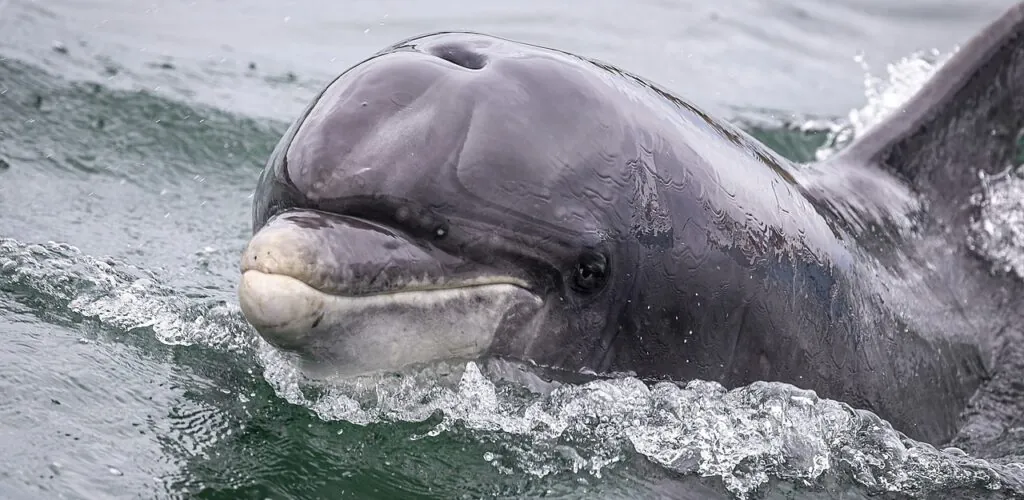
He had become a true legend in Dingle. For nearly four decades, Fungie swam in the waters of County Kerry, accompanying boats and spontaneously approaching people. After disappearing in October 2020, the celebrated dolphin seemed to have taken some of his secrets with him. Yet nearly six years later, science has revealed a surprising detail about his origins.
A study published in August 2026 in the scientific journal Ecology and Evolution reveals that Fungie had a particularly unusual genetic ancestry. His DNA shows links both to the bottlenose dolphin population of the Shannon Estuary and to a major population living offshore of the Irish coast.
More remarkably still, the scientists did not use a sample taken directly from Fungie to reach this conclusion. Several years after his disappearance, his DNA was found on an old wetsuit worn by a man who had regularly swum with him.
Fungie was genetically different from the other solitary dolphins studied
An ancestry linked to two bottlenose dolphin populations
The research was conducted by scientists at Atlantic Technological University (ATU) in Galway as part of a study into the genetics of bottlenose dolphins in Irish waters.
The researchers examined samples from numerous individuals to gain a better understanding of the structure of the different populations found around Ireland.
Among other findings, their analyses distinguish genetic groups associated with offshore dolphins and certain coastal populations, including that of the Shannon Estuary.
Fungie, however, had a particularly interesting profile: his genetic heritage showed mixed ancestry between the Shannon Estuary population and the offshore population.
This result is unusual. The bottlenose dolphins analysed in Ireland can generally be genetically assigned to a specific population.
This was not, however, a cross between two different species. Fungie was indeed a bottlenose dolphin, or Tursiops truncatus. It was the populations to which his ancestors were connected that differed.
An old wetsuit made it possible to recover his DNA
A method worthy of a scientific investigation
The story behind this discovery is almost as surprising as the result itself.
When the scientific project on solitary dolphins began to take shape, Fungie had just disappeared. The dolphin was last seen in Dingle in October 2020, making it impossible to collect any further biological samples directly from the animal.
An unexpected solution emerged thanks to Denis O’Regan, a member of the Irish Whale and Dolphin Group. He had regularly swum with Fungie and wore the same wetsuit during their encounters.
The wetsuit had been kept after the last swims with the dolphin.
The researchers then considered that it might still carry biological traces left by Fungie. Several sections of the wetsuit were swabbed before being analysed in the laboratory.
The gamble paid off.
The analyses confirmed that genetic material from a dolphin was indeed present on the wetsuit. The scientists were then able to use this DNA to study Fungie’s genetic origins.
A wetsuit kept for several years had therefore made it possible to obtain unprecedented information about one of Ireland’s most famous animals.
Five famous solitary Irish dolphins studied
Fungie is the only one with this particular profile
The scientists did not focus solely on Dingle’s dolphin.
The study also covers several other well-known solitary bottlenose dolphins in Ireland: Nick, seen in Cork Harbour; Finn in Carlingford Lough; Dusty in north Clare; and Nimmo in Galway.
These five animals share one particularly intriguing feature: unlike the usual social behaviour of bottlenose dolphins, they lived alone for a significant part of their time in Irish waters, and some developed regular interactions with people.
Yet the genetic analyses reveal a striking difference.
Nick, Finn, Dusty and Nimmo were all genetically assigned to the offshore population. Fungie is the only one of the five to show mixed ancestry between this offshore population and that of the Shannon Estuary.
This characteristic alone cannot explain his behaviour. Nevertheless, it adds a new piece to the scientific puzzle surrounding solitary dolphins.
Why did Fungie live alone in Dingle?
The mystery remains unsolved
It is one of the key questions scientists would now like to answer.
Bottlenose dolphins are highly social animals. They generally live in groups and maintain complex relationships with their own kind. The existence of individuals that settle alone in a bay or harbour for long periods is therefore unusual behaviour.
Fungie was probably Ireland’s most spectacular example.
From 1983, the dolphin made Dingle’s waters his home and began interacting with boats, fishermen, swimmers and visitors. He remained in the area for around 37 years.
The researchers are particularly interested in the reasons why some bottlenose dolphins seek human company more readily than that of their own kind.
Several avenues are being explored, from ecological differences to mechanisms of communication between populations. Distinct groups can, in particular, develop different behaviours and acoustic repertoires.
However, the researchers do not claim to have demonstrated that Fungie’s particular ancestry directly explains his attachment to Dingle or his interactions with people.
His DNA therefore provides a new clue, but not yet the definitive answer to the Fungie mystery.
Who was Fungie, Dingle’s famous dolphin?
A presence that became inseparable from the Dingle Peninsula
Fungie appeared in Dingle Harbour in 1983. At the time, no one knew that he would become one of the country’s most famous animals.
The bottlenose dolphin quickly took to following boats and approaching people. His presence became regular enough to attract the curious, then travellers who came specially to Kerry in the hope of catching sight of him.
Over the years, boat trips centred on seeing him developed. Fungie gradually became one of Dingle’s symbols and contributed to the tourist renown of the small Kerry town.
His longevity in the bay made the phenomenon even more exceptional. Generations of visitors were able to see the same dolphin between the 1980s and 2020.
Then, in October 2020, Fungie suddenly disappeared.
Despite searches carried out in the area, he was never again confirmed to have been seen. His exact fate remains unknown. Given his presumed age and the exceptional length of his time in Dingle, his death is generally considered a plausible explanation, although it has never been formally established.
Fungie continues to leave his mark on Dingle six years after his disappearance
A story that now goes beyond tourism
In Dingle, Fungie was not merely a natural curiosity. Over 37 years, he had become a character in his own right in the town.
His story is also a reminder of the richness of the waters surrounding the Dingle Peninsula. Several cetacean species can be seen off Kerry, although an encounter with a wild animal can of course never be guaranteed.
The new study now gives Fungie added significance. His story contributes to scientific research into the bottlenose dolphin populations around Ireland and, more broadly, into the still mysterious behaviour of solitary dolphins.
The work also has a particular human dimension. The study was originally undertaken by researcher Lorenzo de Bonis as part of his studies. He died in a climbing accident in 2025 and did not live to see it published. His colleagues completed the work and published the results in his memory.
Nearly six years after leaving Dingle’s waters, Fungie continues to tell his story. This time, no longer by surfacing beside a boat in the bay, but through a few microscopic traces of DNA left on an old wetsuit.