

From the foothills of Cuilcagh to the open waters of the Atlantic, the Shannon traces a vast blue line through the heart of Ireland. At around 360 kilometres long, including its estuary, it is the island’s longest river. Its course passes through great lakes, runs alongside medieval monasteries and links towns as different as Carrick-on-Shannon, Athlone and Limerick.
The Shannon does not in fact cross Ireland from east to west. From its source in County Cavan, it flows mainly southwards before turning west from Limerick onwards. Pleasure boating, fishing, hiking, kayaking and dolphin watching now offer ways to explore this river, which has shaped Ireland’s landscapes, economy and stories for centuries.
The Shannon, known as An tSionainn in Irish, officially rises at Shannon Pot, a spring near Glangevlin in western County Cavan. It then crosses or borders eleven counties before reaching Limerick and its vast estuary.
Measurements vary according to the point chosen to mark the river’s end. The figure of 360 kilometres generally includes the estuary as far as the Atlantic Ocean. Some sources give shorter distances, ending the measurement further upstream or excluding part of the estuary.
The Shannon basin covers almost a fifth of Ireland’s land area. The river receives water from numerous tributaries, including the Boyle, Inny, Suck, Brosna and Mulkear. It has long formed a natural boundary between several regions of the island.
At Shannon Pot, Ireland’s largest river begins modestly in a dark pool surrounded by woodland and wetlands. Its water comes from a complex underground network formed in the limestone uplands of the Cuilcagh region.
The young Shannon then reaches Lough Allen in County Leitrim. It continues towards Carrick-on-Shannon, one of the country’s main river boating bases, before passing through several small lakes and villages.
Further south lies Lough Ree, a vast body of water separating the river’s upper and lower reaches. The Shannon then arrives in Athlone, passes through the town beneath its historic bridge, and broadens once again into Lough Derg.
From Killaloe, the river continues towards Limerick. Part of its water is diverted through a canal to the Ardnacrusha hydroelectric power station. Beyond Limerick, the Shannon becomes a huge tidal estuary before reaching the Atlantic between Loop Head in County Clare and Kerry Head.
Like many Irish landscapes, the Shannon has its own legend. Its name is said to be linked to Sionann, a young woman from Irish mythology who is sometimes described as the granddaughter of Manannán mac Lir, a deity associated with the sea.
Sionann is said to have sought knowledge at a wondrous well surrounded by sacred hazel trees. Their nuts fell into the water and were eaten by salmon, which became the keepers of all the wisdom in the world.
When the young woman approached the forbidden well, the waters surged forth and carried her away to the sea. The river born from this pursuit is said to have been given her name. Several versions of the story exist, but all associate the Shannon with knowledge, water and the power of the supernatural world.
The Shannon’s course is marked by three great lakes that profoundly change its landscape. Lough Allen, the northernmost, stretches between the mountains of County Leitrim. More rugged and more exposed to the wind, it attracts kayakers, anglers and lovers of secluded landscapes.
Lough Ree extends between Lanesborough and Athlone. Its bays, islands and reedbeds provide an important habitat for birds. Boaters must nevertheless remain alert to shallows and changing weather conditions.
Lough Derg, bordered by Counties Galway, Clare and Tipperary, is especially popular for boating holidays. The villages of Portumna, Mountshannon, Dromineer, Garrykennedy and Killaloe offer harbours, restaurants and various starting points for exploring the lake.
Carrick-on-Shannon is one of the most popular gateways to the upper reaches. Its quays, marina and numerous boat hire companies make it a favoured starting point for a cruise without a pleasure boating licence.
Clonmacnoise is one of the river’s most remarkable sites. Founded in the 6th century by Saint Ciarán, this monastery occupied a strategic location where the Shannon met an ancient overland route. Its ruined churches, high crosses and round towers now stand out against a landscape of meadows.
Athlone developed around a major crossing point on the river. Its castle overlooks the western bank, while the quays, pubs and cruise departures bring life to the town centre.
Shannonbridge retains an 18th-century stone bridge and fortifications built during the Napoleonic era. Further south, Portumna marks the entrance to Lough Derg and provides access to its castle, forest park and former abbey.
Killaloe and Ballina face one another on either side of the river, at the southern end of Lough Derg. This area is associated with Brian Boru, High King of Ireland, who was born nearby in the 10th century.
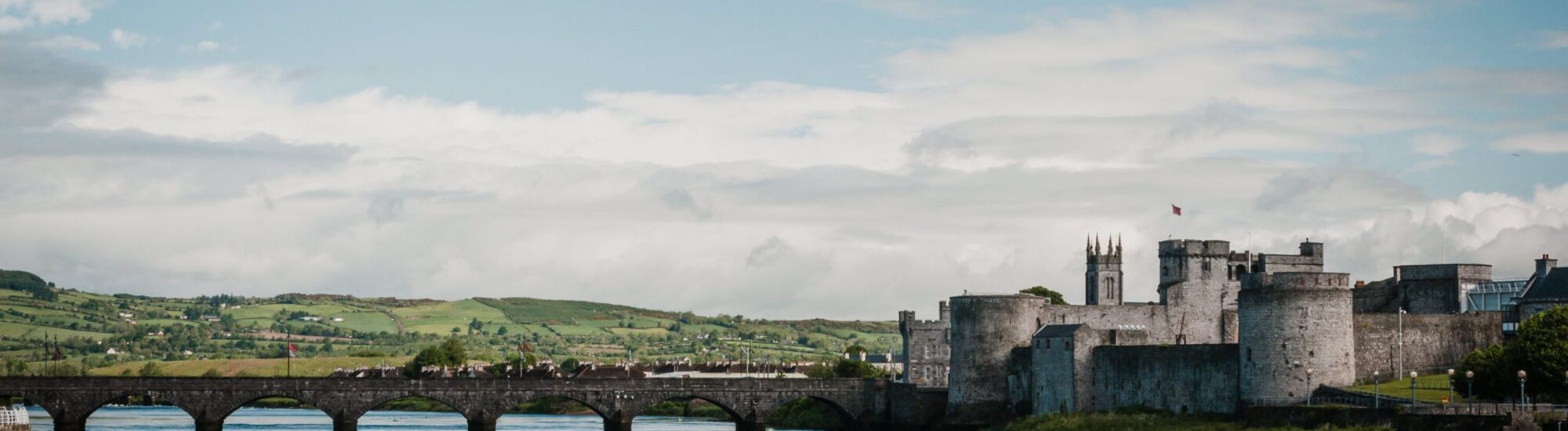
Finally, Limerick offers a more urban face of the Shannon. The river surrounds King’s Island, runs alongside King John’s Castle and passes through a city profoundly shaped by its port activity.
A river cruise is one of the best ways to discover the Shannon. Several companies hire out cruisers from Carrick-on-Shannon, Banagher, Portumna, Athlone and various bases along the network.
Most of these vessels can be driven without a pleasure boating licence. Before departure, the hire company provides an introduction, the necessary maps and safety instructions. Particular care is still essential on the large lakes, where winds can quickly raise waves.
The route is dotted with marinas, public jetties, locks and villages. You can arrange a getaway of a few days or a full week, alternating between boating, heritage visits and evenings in riverside pubs.
Navigation infrastructure is managed by Waterways Ireland. Before setting off, check its navigation notices for water levels, works, temporary restrictions and lock opening times.
The river is not navigable along all of its 360 kilometres. The main leisure boating area is the Shannon Navigation, a developed network linking the Carrick-on-Shannon area to Lough Derg.
To the north, the Shannon–Erne Waterway connects with the Erne lakes network in Northern Ireland. To the south, navigation towards Limerick becomes more technical because of dams, canals, locks and tidal influence.
Travellers hiring a boat must follow the route authorised by their company. Some areas are accessible only to suitable vessels or to boaters with sufficient experience.
There is no need to book a cruiser to enjoy the Shannon. Short guided cruises are available from several riverside towns and villages.
In Athlone, some excursions head out onto Lough Ree or visit Clonmacnoise. On Lough Derg, boat trips depart in particular from Killaloe and Mountshannon. In Limerick, outings allow visitors to see the city from the river when conditions permit.
These services are mainly seasonal and depend on water levels, the weather and participant numbers. Booking is recommended during the summer.
The Shannon and its lakes form one of Ireland’s main freshwater fishing areas. The waters are home to pike, bream, roach, perch, tench, eels and various trout populations.
Coarse fishing is particularly popular around Carrick-on-Shannon, Lanesborough, Shannonbridge, Banagher and Portumna. Shallow bays, channels and sheltered areas of the lakes offer a range of environments.
Pike can grow to a considerable size, but fishing for them is strictly regulated. National rules include catch limits and regulations on the bait used. Catch-and-release in good conditions is widely encouraged.
Salmon are present in the Shannon basin, but their populations are fragile and fishing conditions vary according to the watercourse and annual conservation decisions. It is therefore essential to check Inland Fisheries Ireland regulations before going out.
In the Republic of Ireland, no national licence is generally required to fish for trout, pike or coarse fish. However, a local permit or the permission of the fishing rights holder may be required in certain areas, tributaries and lakes.
A State licence is compulsory for salmon and sea trout fishing. It does not automatically grant access to all waters: an additional permit may be required by the relevant fishery.
Coarse fishing is free on several stretches of the main Shannon, but some tributaries in the basin belong to the Midlands controlled fisheries group. Regulations change according to stocks and seasons: always check the information published by Inland Fisheries Ireland.
The river can also be discovered by kayak or canoe. Sheltered stretches, small lakes and channels are suitable for guided outings, while the wide expanses of Lough Ree and Lough Derg require more experience.
The banks offer numerous walking trails and cycling routes. The Cavan Way passes close to Shannon Pot, while the forest parks at Lough Key and Portumna offer routes suitable for families.
Further south, paths around Clonmacnoise, Shannonbridge, Killaloe and the shores of Lough Derg allow visitors to view the river from land. However, there is no continuous trail following the Shannon from its source to its estuary.
The Shannon basin is home to remarkable biodiversity. Reedbeds, islands, floodplain meadows and lakes provide refuge for many water birds, including herons, kingfishers, grebes and various species of duck.
Otters also frequent the river, although their elusive nature makes them difficult to spot. Observant visitors may notice tracks, trails through vegetation or signs of their meals on the banks.
The estuary is home to a resident population of bottlenose dolphins. Dolphin-watching trips depart in particular from Carrigaholt and Kilrush in County Clare. Sightings are never guaranteed, but this area is among the best places in Ireland to see these marine mammals in their natural habitat.
The Shannon also holds a major place in Ireland’s industrial history. In the 1920s, the young Irish state launched the Shannon Scheme, a major hydroelectric project for its time.
Part of the river was diverted into a canal supplying the Ardnacrusha power station in County Clare. Commissioned in 1929, it contributed to the country’s electrification and economic modernisation.
The project profoundly transformed the landscapes and workings of the lower river. The dams and hydroelectric structures also affected the movements of migratory fish, particularly salmon and eels.
The period from April to October is the most favourable for boating, boat trips and outdoor activities. Days are longer, and most boat hire companies, excursions and tourist services operate as normal.
July and August offer the widest choice of activities, but marinas and villages can be busier. May, June and September often provide a good balance of daylight, boat availability and peace and quiet.
The Shannon remains accessible year-round from its towns, quays and trails. In winter, the landscapes become more secluded, but flooding, winds and the closure of certain services limit water-based activities.
From the murmur of Shannon Pot to the tides of the Atlantic, the Shannon tells the story of an inland Ireland where monasteries, villages and great lakes still live to the rhythm of the water.
Want to extend your visit without having to rush around? Here are a few well-located places to stay near the must-see attractions.
Essential information to help you plan your visit, including key landmarks, access information, and booking options.
comté de Limerick, comté de Clare, County Limerick, County Limerick
52.661419, -8.639448