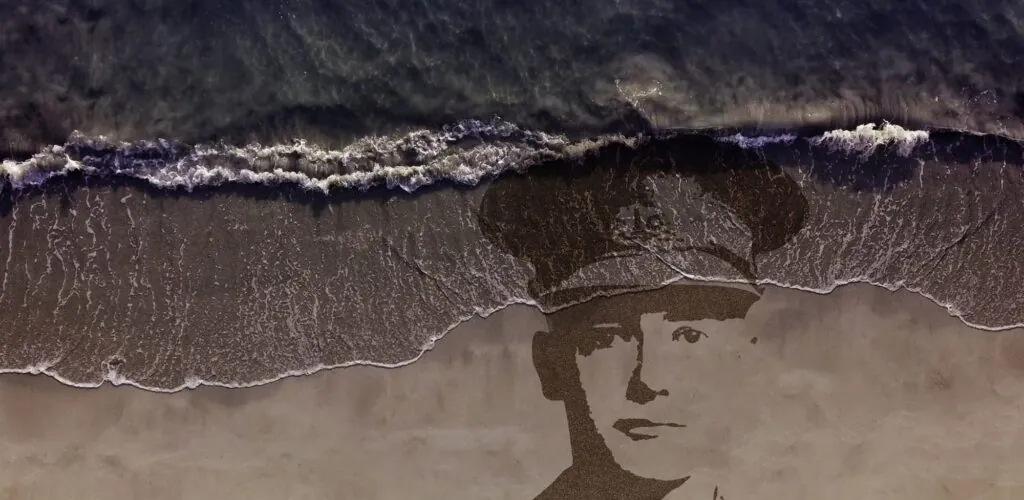
At low tide, the sand becomes an immense canvas. For more than a decade, artists have been transforming Irish beaches into monumental compositions: spirals, mandalas, portraits, maps and optical illusions. Some of these drawings stretch for more than 100 metres and only truly make sense when seen from the air. Then the sea returns, washing away every line. Behind these spectacular images are acclaimed creators, genuine drawing expertise and another way of telling the story of Ireland’s landscapes.
Sand art: an established artistic phenomenon since the 2010s
When sand replaces the canvas
Sand art, or beach art, involves drawing directly on the foreshore uncovered by the tide. Artists use rakes, sticks, ropes and geometric guides. The contrast between dark furrows and smoothed sand brings giant patterns to life. Seen from higher ground or by drone, the lines take on an unexpected dimension.
In Ireland, the practice is far from new. As early as 2013, Seán Corcoran was experimenting with beach drawing in Waterford, while Manuel Frölich created his first large-scale composition in 2014. Over the years, their aerially photographed works have appeared in the media, featured in tourism campaigns and inspired artistic events. Rather than a recent trend, this is an artistic movement that has gradually established itself along Ireland’s coastline.
An artwork that vanishes with every tide
The artist’s timetable is set by the ocean. They must choose a sufficiently low tide, find suitable sand and work before the water covers the beach again. Some creations require several hours of concentration. Their disappearance is anticipated from the very first line: photography and aerial video therefore become essential extensions of the work.
Seán Corcoran, a leading figure in Irish sand art
From Waterford beaches to viral images
An environmental artist based on the Copper Coast in County Waterford, Seán Corcoran is one of Ireland’s best-known sand artists. Alongside the artist Miranda Corcoran, he runs The Art Hand, an organisation founded in 2012 that combines artistic creation, community projects and interventions in the landscape. He creates many of his drawings freehand, using nothing more than a garden rake.
In 2021, on the beach at Kilmurrin Cove, he created a gigantic map of Ireland, complete with Celtic motifs and the message “Keep Discovering”, for a tourism campaign. Photographed from the air, this work, around 67 metres wide, brought his work to a much wider audience. In 2025, he also drew an hourglass measuring around 61 metres for a campaign raising awareness of the protection of Irish seas.
An artist who has also helped raise the profile of his peers
Corcoran says he studied the creations of Andres Amador, the Californian artist renowned for his large-scale sand compositions; French artist Samuel Dougados, whose designs play with geometry; and Andy Coutanche, an artist from Jersey. He even helped bring them together in Tramore for the Promenade Festival. The Irish story of sand art is therefore part of an international artistic movement, enriched by encounters and experimentation.
Manuel Frölich, master of ephemeral geometries
Rosettes, optical illusions and Celtic symbols
Another major name is Manuel Frölich, known as Manu. Born in Chile and long settled in County Waterford, this artist began drawing on beaches in 2014. His work blends Celtic figures, sacred geometry, abstract forms and optical illusions. His interest in technical drawing and architecture can be seen in the precision of his compositions.
In 2017, he took part in an international project centred on the Sri Yantra, a complex geometric motif recreated by artists across several continents. Depending on the beach, he has between four and seven hours to complete his creations before the tide returns. His tools include rakes, ropes, bamboo sticks and a tape measure.
Works designed for life’s special moments, too
His art can also take on an intimate dimension. In 2024, at Tullan Strand, near Bundoran in Donegal, Manu created a large compass rose in the sand to accompany a marriage proposal. Captured by drone, the drawing combined geometric rigour with a personal story. It is an example of how this art can go beyond mere visual performance.
Andres Amador and Samuel Dougados: international references
Artists who have influenced the Irish scene
While Ireland has talents of its own, the movement is international. Based in California, Andres Amador is known for his monumental beach drawings, often made up of organic and geometric patterns. In France, Samuel Dougados develops a beach art practice in which contours and lines create powerful graphic effects. Seán Corcoran explicitly mentions their influence when recounting his early days.
These connections show that Irish beaches are part of a wider artistic scene, where the artwork is not simply the finished image: the gesture, the weather, the light and the sea’s erasure are all part of the experience.
Where can you see these giant drawings in Ireland?
The Copper Coast and Kilmurrin Cove, the birthplace of many creations
The Copper Coast, between Tramore and Dungarvan, remains one of the areas most closely associated with Irish sand art. Its coves, cliffs and expanses of sand provide an ideal setting for the compositions of Corcoran and Frölich. Kilmurrin Cove is particularly well known for several spectacular works.
However, it is worth noting that these drawings are not permanent attractions. There is no guarantee of seeing one during a visit. To find out about announced projects, it is best to follow the artists’ communications, especially those of The Art Hand, and take the opportunity to explore Ireland’s landscapes and routes.
Tramore, Bundoran and beaches that host occasional projects
In Tramore, exchanges between artists have helped raise the profile of the discipline. Further north, Tullan Strand hosted Manu’s creation in 2024. Works may also accompany festivals, charity campaigns or private commissions. Their location depends on each project and the tidal conditions.
Why are these works so captivating?
A spectacle truly revealed from the sky
At ground level, you can see furrows, curves and sometimes part of the pattern. From the air, the whole composition is suddenly revealed. This change of scale is what makes the photographs so striking: an apparently abstract drawing becomes a perfect rosette, a map or a symbol spanning several dozen metres.
Sand art also has a deeply Irish dimension: a dialogue with the Atlantic, its tides and its ever-changing landscapes. The artists do not seek to impose a lasting work upon nature. They accept that it will reclaim its place. On these beaches, the country’s largest museum opens at low tide and closes a few hours later.