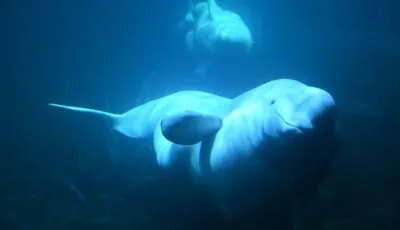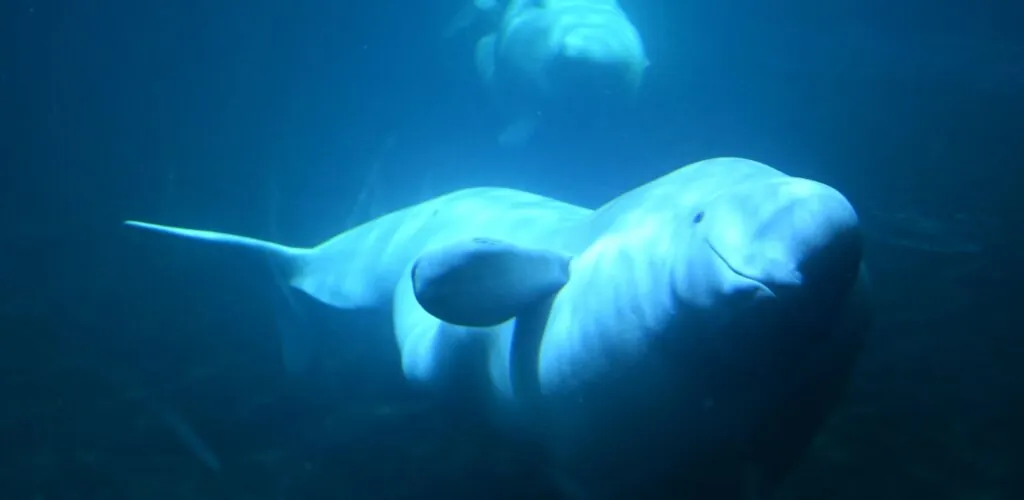
A white shape beneath the surface, just off the coast of Donegal: the image seems to belong to another world. One of cold seas and Arctic shores, rather than an autumn outing in Ireland. Yet a beluga was indeed filmed in Donegal Bay on 17 October 2026. Confirmed by the Irish Whale and Dolphin Group, the encounter is a reminder of how the Atlantic can still surprise those who take the time to watch it.
A rare encounter, confirmed by footage
At first, it looked like a very pale dolphin
RTÉ reports that Sebastian Szumlański was visiting a site in south-west Donegal known as Secret Waterfall with his family when he spotted the animal. He recorded footage using a drone, and the video later reached the Irish Whale and Dolphin Group, the Irish organisation specialising in cetacean research.
The sighting is more than a coastal outing anecdote: according to the IWDG, it is the second beluga report validated by the organisation in its 35-year history. This does not mean that only two belugas have been seen in Ireland. RTÉ refers to at least four reported sightings, not all of which received comparable validation.
A white whale from another marine world
An animal adapted to Arctic waters
The beluga, Delphinapterus leucas, is a toothed whale. NOAA Fisheries describes it as a species of Arctic and sub-Arctic waters, recognisable in adulthood by its white colour, rounded head and lack of a dorsal fin. A thick layer of blubber helps insulate it from the cold, while its shape also allows it to move beneath the ice.
This mammal has another fascinating characteristic: its world is one of sound. Its whistles, clicks and varied calls have earned it the nickname “canary of the sea”. These sounds play a role in communication as well as echolocation, which helps it navigate and locate prey. Behind the animal’s almost unreal whiteness lies an especially rich sensory life.
Shallow waters do not necessarily signal distress
In a note published on 19 October, Pádraig Whooley, sightings officer at the IWDG, stated that the footage shows an adult of unknown sex. Its swimming and breathing did not give particular cause for concern at the time of recording. This assessment applies to the footage examined and does not constitute a medical assessment of the animal.
Shallow coastal waters are not unusual for belugas. NOAA Fisheries notes that they also use estuaries and large deltas, particularly to feed. Seeing such an animal close to shore is therefore not, in itself, enough to conclude that it is stranded or in difficulty.
Why is it in Donegal? The question remains open
Its origins and journey remain unknown
The IWDG raises the possibility of a connection with a solitary beluga observed in northern Europe during the summer. However, its publication does not confirm that they are the same animal: it would be premature to assign it a specific route or source population.
Likewise, this sighting alone cannot explain the animal’s movement through climate change. The matter calls for data and monitoring, not a conclusion drawn from a few clips. The rarity of the encounter is precisely what makes the documentation valuable: it opens an investigation rather than closing one.
On the Irish coast, watch without pursuing
A sighting to report, not a guaranteed encounter
For travellers exploring Donegal, the story offers another reason to watch the sea from the coast. It does not, however, make an encounter predictable: the information cited documents the beluga’s presence on 17 October and does not guarantee its current location or that it remains in the bay.
In the event of a chance sighting, the IWDG encourages people to submit images and a report to help monitor its movements. The right approach is a discreet one: keep your distance, allow the animal to follow its own course and avoid any pursuit. A few seconds of attention from the shore may be more valuable than an attempt to get closer.
Donegal does not need to promise a white whale to justify the journey. But, for a moment, this encounter gives it an unexpected opening onto the northern seas — and a reminder that a shoreline is also a place of passage.