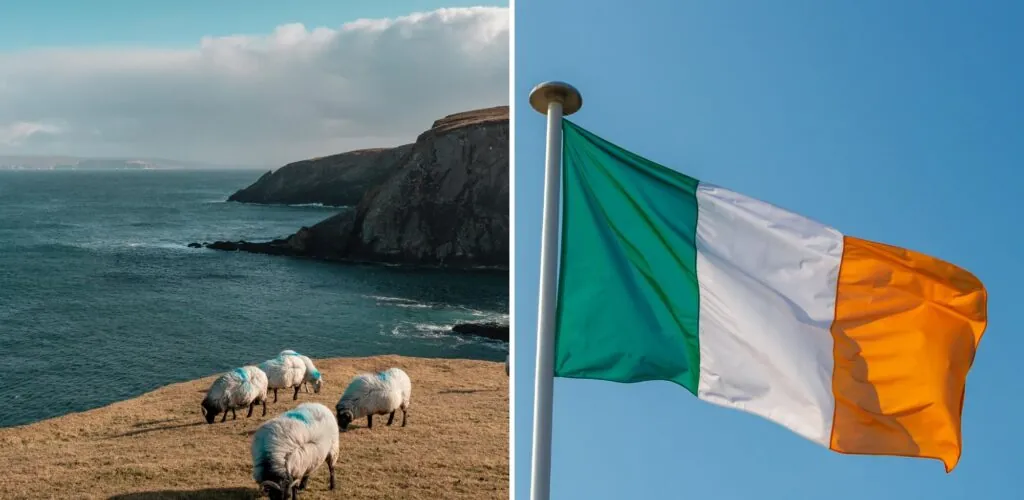
Ireland often conjures up images of rugged cliffs, colorful villages, and legendary hospitality. Yet behind this postcard-perfect scenery lies a much more discreet and pivotal role: that of a strategic crossroads for Europe. A recent report revealed that the country is one of the continent’s most vulnerable points in terms of security, due to its geographic position, neutral status, and particularly sensitive infrastructure.
A Historic Neutrality That Changes the Game
A Pacifist Tradition Facing New Threats
Did you know? Ireland is not a member of any military alliance like NATO. This neutrality, dating back to the 1930s, has long allowed the country to pursue a soft diplomacy focused on mediation and humanitarian missions. Today, this isolated stance can complicate collective decision-making in the face of modern threats.
When a state remains outside European military frameworks, its ability to react, monitor, and defend depends largely on its own resources. For Ireland, these resources remain limited: few patrol vessels, no real foreign intelligence service, and modest budgets compared to its neighbors. The result: the country finds itself in a grey area, difficult to protect at the continental level.
Submarine Cables: An Invisible Yet Fragile Treasure
A Vital Infrastructure for Europe… and Especially Exposed
Ireland’s seabed resembles a vast network of digital veins. Around 75% of transatlantic cables connecting Europe to North America converge on the Irish coast. Internet, financial communications, industrial data transfers—all pass through these cables lying on the ocean floor.
This makes Ireland a crucial technological hub, but also a prime target for espionage or sabotage. Experts believe that current maritime surveillance capabilities are insufficient to effectively protect these strategic installations. For curious travelers, this invisible detail reveals an Ireland far more connected to the world than one might imagine.
A Limited Fleet to Protect a Vast Territory
A Navy Doing Its Best With What It Has
The Irish Navy plays a vital role: monitoring territorial waters, controlling fishing activities, securing port facilities, and responding to maritime emergencies. The challenge lies in the ratio: just a handful of ships for one of Western Europe’s largest maritime zones.
This lack of resources creates a gap between the importance of the territory to defend and the actual capacity for action. The report noted that activities by third-party states—particularly those attributed to Russia—appear to have exploited this weakness to map the submarine network or conduct discreet operations near Irish shores.
Why This Situation Matters to Travelers
A Unique Context to Better Understand Contemporary Ireland
Discovering Ireland also means understanding the challenges it faces beyond the clichés. For visitors, this context enriches the experience, revealing an island that’s much more than its spectacular landscapes. The importance of submarine cables also explains why tech giants—Google, Meta, and Amazon—have set up their data centers here. The country’s neutrality sheds light on how Ireland shapes its foreign policy.
As you travel, you’ll notice it all: the weight of history, the territory’s unique diplomacy, the discretion of its armed forces, and that curious blend of insularity and hyper-connectivity.
An Issue That Could Transform the Island’s Future
Towards a Possible Repositioning in Europe
In response to the report’s findings, the Irish government has already begun discussions to modernize national defense, strengthen maritime surveillance, and collaborate more closely with European partners. Growing geopolitical pressure could accelerate this evolution, signaling that Ireland is quietly preparing to take on a more assertive role in protecting the continent.