Were you unable to watch the Perseids on the night of 12–13 August? The good news is that it is not too late to spot shooting stars in Ireland.
The famous meteor shower reached its peak on the night from Wednesday to Thursday, just a few hours after the spectacular solar eclipse of 12 August. But unlike an eclipse, the Perseids are not a phenomenon limited to a few minutes.
The meteor shower remains active for several weeks, and meteors can still be seen in Irish skies over the coming nights.
Can you still see the Perseids in Ireland tonight?
Yes, the night of 13–14 August is still worth watching
Yes, it will still be possible to see the Perseids on the night from Thursday 13 to Friday 14 August 2026.
The International Meteor Organization places the main peak of the 2026 Perseids between 2am and 4am UTC on 13 August. The peak has therefore now passed, but activity does not, of course, suddenly stop.
The Perseids are officially active from 17 July to 24 August. Their frequency gradually declines after the peak, but the nights immediately afterwards remain among the most interesting.
Observations during some previous years have even shown periods of sustained activity between around 17 and 36 hours after the main peak.
However, this phenomenon is not systematic, so it would be misleading to promise a second spectacular display on the night of 13–14 August.
2026 offers exceptional conditions thanks to the new moon
Almost no moonlight to obscure the meteors
Astronomical conditions are particularly favourable this year.
The new moon occurred on 12 August. Unlike some years, when a very bright moon washes out the fainter shooting stars, the night sky will this year be almost entirely free of moonlight.
For observers in a dark location, this is a considerable advantage. The fainter meteors are more likely to be visible to the naked eye.
The real challenge will therefore be less the moon than cloud cover and light pollution.
What time should you watch for the Perseids tonight?
Wait until night has properly fallen
It is possible to spot meteors as soon as the sky becomes sufficiently dark, but conditions improve as the night goes on.
From Ireland, the Perseid radiant gradually rises in the sky. The International Meteor Organization says that, at mid-northern latitudes, it already reaches a useful height from around 10pm to 11pm local time.
The best conditions are generally found later in the night and before dawn, when the radiant is higher in the sky.
However, there is no need to wait until 3 or 4am to try your luck. Watching between 11pm and 1am can already allow you to spot several shooting stars if the sky is clear and dark enough.
Where should you look in the sky?
There is no need to focus only on the constellation of Perseus
The Perseids appear to come from the direction of the constellation of Perseus, which explains their name.
But you should certainly not spend the whole evening looking only at that small area of sky.
Meteors can appear anywhere across the sky. The most spectacular trails are often seen quite far from the radiant.
The most effective approach is to find a place with a very open view, get comfortable and watch a large area of sky with the naked eye.
No telescope or binoculars are needed. These instruments greatly reduce your field of view and are therefore poorly suited to watching a meteor shower.
What are the best places in Ireland to watch the Perseids?
Above all, get away from city lights
Ireland has a considerable advantage for skywatching: often, all it takes is travelling a few kilometres away from major towns and cities to find remarkable darkness.
Particularly interesting regions include:
- Kerry, especially the more remote areas of the Iveragh Peninsula;
- Connemara, where wide-open landscapes offer numerous clear horizons;
- Mayo, particularly rural areas away from Castlebar and Westport;
- Donegal, especially away from the main towns;
- the Burren in County Clare;
- the Wicklow Mountains, which offer an appealing option for getting away from Dublin’s light pollution.
The west coast generally has the darkest areas, but the weather must remain the main consideration. A perfectly clear sky in Wicklow will naturally be preferable to an overcast one in Kerry.
Kerry has one of Ireland’s best night skies
A region especially renowned among astronomy enthusiasts
For those in the south-west, Kerry is particularly well placed for watching the Perseids.
Part of the Iveragh Peninsula benefits from a night sky exceptionally well preserved from light pollution. The rural areas around Cahersiveen, Waterville and the western coast, in particular, offer sweeping views of the sky.
However, there is no need to head to an official astronomy site: a quiet country lane or accommodation away from villages can already provide excellent conditions.
Can you see the Perseids from Dublin?
Yes, but it is best to leave the city centre
The brightest shooting stars can be seen from Dublin, but light pollution obscures a large proportion of the fainter meteors.
To greatly improve your chances, it is best to leave the centre and look for a darker area.
The Wicklow Mountains are an appealing option for travellers with a car. Some coastal areas away from urban lighting may also offer better conditions than Dublin city centre.
Whatever destination you choose, opt for a place that is safe and legally accessible at night. It is not advisable to park on a narrow road or enter private land in search of a darker sky.
How many shooting stars can you see after the peak?
Be wary of spectacular figures announced online
The Perseids are traditionally one of the year’s most active meteor showers. The theoretical zenithal hourly rate associated with the peak can reach high values.
But that does not mean an observer will automatically see a hundred shooting stars an hour.
That figure applies to very specific theoretical conditions: a perfectly dark sky, an ideally positioned radiant and an unobstructed horizon.
In reality, the number visible depends greatly on the time, cloud cover, light pollution and the quality of the observing site.
And since the main peak has now passed, activity can be expected to gradually decline over the coming nights.
Why do we see the Perseids every year?
Dust left behind by Comet Swift-Tuttle
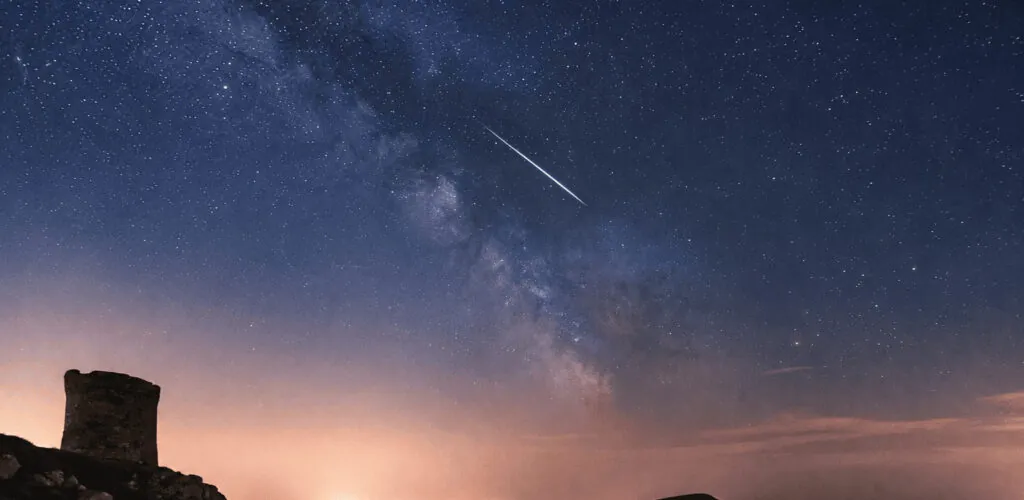
The Perseids appear when Earth passes through a vast stream of particles left along its orbit by the comet 109P/Swift-Tuttle.
When these tiny fragments enter Earth’s atmosphere at very high speed, they heat up suddenly and produce the streaks of light we commonly call shooting stars.
Perseid meteors arrive particularly quickly: their speed on entering the atmosphere reaches around 59 kilometres per second.
It is this speed, in particular, that explains the sometimes highly spectacular trails associated with this meteor shower.
How long will the Perseids be visible in 2026?
The phenomenon continues until 24 August
The Perseids will remain active until 24 August 2026.
It will therefore still be possible to spot a few meteors after this weekend, but their frequency will gradually decrease as Earth leaves the densest part of the dust stream.
For travellers currently in Ireland, the coming nights therefore remain the most interesting.
If the weather is unfavourable on Thursday evening, do not necessarily give up: a clear night on Friday or Saturday could still offer some fine sightings, even if the display will be less intense than at the peak.
How can you watch the Perseids in the best conditions?
A few minutes are not always enough
Once you are settled in a dark place, give your eyes time to adjust to the darkness. This adaptation can take around 20 minutes.
During that time, avoid regularly looking at the bright screen of a smartphone. If you need to check a map or the weather, reduce the screen brightness as much as possible.
Also bring warm clothing. Even after the exceptionally high temperatures recorded in Ireland this week, remaining still for an hour in the middle of the night can quickly feel chilly.
Finally, be patient. A meteor shower is not a firework display: several minutes may pass without anything happening before a particularly bright shooting star suddenly crosses a large part of the sky.