An overlooked tomb, a second monument that no one had yet identified and, underground, a tiny amethyst pendant with no known equivalent in Ireland. At Maree, in County Galway, an excavation campaign has just revealed an exceptional Neolithic funerary complex. The discoveries offer a fresh perspective on the first farmers who settled in the west of the island nearly 6,000 years ago.
A major archaeological discovery in County Galway
Two Neolithic tombs brought together at a single site in Maree
The Irish underground has clearly not finished telling its stories. At Prospecthill, in the Maree area, archaeologists from the University of Galway have uncovered two funerary monuments dating back to the beginning of the Neolithic.
The first was known from archival records but had almost disappeared from the landscape. The second stood right beside it without ever having been recorded as a funerary monument. Together, they form an extremely rare combination: a court tomb and a portal tomb built just a few metres apart.
According to the scientific team, this may be the only known combination in Ireland bringing together these two categories of megalithic tombs at the same site. The discovery could therefore help researchers better understand the funerary practices and beliefs of the first farming communities established in the west of the country.
The excavations are led by Dr Michelle Comber and Dr Noel McCarthy, both attached to the archaeology department at the University of Galway. They form part of the Maree – Land Use Through Time research project, dedicated to the evolution of human settlement and landscapes on the Maree peninsula.
A tomb forgotten since the 1960s
Archaeologists have found the foundations of a 30-metre monument
The excavation campaign initially aimed to locate a court tomb whose large stones had remained visible until the 1960s. They were subsequently removed, causing the monument to virtually disappear from the surface.
The archaeologists nevertheless had historical information confirming its existence. By studying the terrain, they were able to find the foundations and establish the dimensions of this lost tomb more precisely.
The monument is approximately 30 metres long, making it one of the largest court tombs discovered in Ireland. This category of structure is recognisable by its open space, generally laid out in front of the burial chambers. This court could accommodate gatherings and various ceremonial activities.
These structures were therefore not merely burial sites. They probably served as meeting places where a community maintained a symbolic connection with its dead and ancestors.
Building a monument of this size required considerable collective organisation. The stones had to be selected and extracted, transported, and the ground prepared before the whole structure could be assembled without modern machinery. The project demonstrated both technical skills and strong social cohesion.
A second unknown tomb appears just metres away
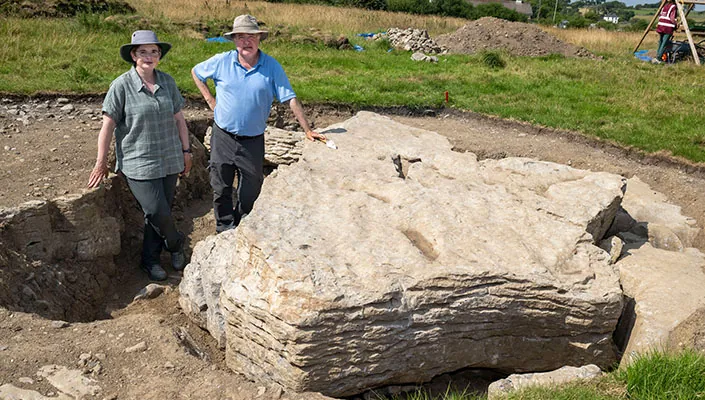
A 14-tonne capstone concealed a funerary monument
The real surprise emerged in the immediate vicinity of the court tomb. The researchers identified the remains of an imposing portal tomb that had never been recorded as a funerary monument.
Also known as dolmens, portal tombs consist of a stone chamber preceded by two large upright stones forming an entrance. A heavy slab, known as a capstone, rests on these supports.
At Maree, this slab is nearly four metres long and approximately one metre thick. Its weight is estimated at 14 tonnes. However impressive it may be, the stone had so far provided no way of understanding the exact nature of what lay beneath its mass.
The excavations revealed that the tomb had been built in a large pit dug directly into the bedrock. This arrangement protected some of the oldest funerary deposits, giving archaeologists a rare opportunity to study the monument’s earliest uses.
The side-by-side presence of a court tomb and a portal tomb now raises many questions. Were the two monuments built at the same time? Were they intended for different groups? Were they used successively or simultaneously? The analyses will have to try to establish their precise chronology.
An amethyst pendant unique in Ireland
A tiny object at the heart of a monumental discovery
The most spectacular item from the excavations is not, however, the 14-tonne slab. It fits in the hand: a small amethyst pendant found in the portal tomb.
Quartz beads have already been discovered in several Irish megalithic monuments. By contrast, according to the University of Galway, no comparable amethyst pendant is currently known from a tomb of this type in Ireland.
The object is intriguing both because of its material and its function. Was it worn as jewellery? Did it have symbolic value? Was it deposited with someone at the time of their burial? For now, the researchers are refraining from assigning it a precise meaning.
Further analyses could help clarify how it was made and, potentially, the origin of the stone. In archaeology, such an unobtrusive object can sometimes provide valuable clues about exchanges, the movement of materials and a community’s social practices.
The pendant should not, however, overshadow the other discoveries. Stone tools, prehistoric pottery and cremated human remains were also uncovered in the tombs.
Who lived in Galway nearly 6,000 years ago?
The first farmers profoundly transformed the landscape
The two monuments date from the beginning of the Neolithic, probably around 3700 to 3500 BCE. This period corresponds to a major transformation in Irish history.
The populations living on the island had long relied mainly on hunting, fishing and the gathering of wild resources. The arrival of agriculture gradually led to the emergence of more sedentary communities, able to cultivate the land, raise animals and occupy a territory on a long-term basis.
This development affected more than just food. It changed the landscapes, the organisation of human groups and their relationship with the dead. Megalithic monuments bear witness to societies capable of coordinating major collective works and placing their ancestors in visible locations for several generations.
The tombs may also have served as gathering places. Some ceremonies involved human remains that were moved, burned or deposited in the chambers. These practices should not be interpreted solely through our modern concept of a cemetery: the relationship between the living, the dead and the land was probably much closer.
A court tomb and a portal tomb: what is the difference?
Two funerary architectures of the Irish Neolithic
A court tomb generally consists of an elongated cairn containing one or more burial chambers. In front of them, stones outline an open or semi-enclosed space. This court could accommodate the community during ceremonies and rituals.
A portal tomb has a more compact form. Two upright stones mark the entrance to the chamber and support an imposing capstone. The Poulnabrone dolmen, in the Burren, is one of the most famous examples in Ireland.
These monuments belong to the large family of Irish megalithic tombs, alongside passage tombs and wedge tombs. Their architecture, distribution and chronology differ, although several of them may have been reused over very long periods.
At Prospecthill, the presence of the two architectural forms in the same place could reveal a particularly complex use of the funerary landscape. However, the results of the dating and analyses will have to be awaited before the relationship between the monuments can be determined precisely.
Why is this discovery so important?
A site that could shed light on the beginnings of agriculture in Ireland
Researchers do not discover well-preserved Neolithic funerary deposits of this kind every day. Many Irish monuments have been damaged over the centuries by erosion, stone removal, agricultural work or modern development.
Here, the pit dug into the rock beneath the portal tomb helped protect elements associated with the monument’s earliest phases of use. The bones, objects and different soil layers can be studied together, in their original context.
This preservation is essential. An isolated object provides limited information. Placed in a precisely documented layer, close to bones or other objects, it can help reconstruct a sequence of events.
Analysis of the cremated remains could in particular provide information about the number of people deposited in the tomb, their age or certain aspects of their funerary treatment. Radiocarbon dating should also help clarify the different periods during which the site was used.
Ultimately, the study could contribute to a broader question: how did the first farming communities in western Ireland organise their territory and maintain the memory of their dead?
An excavation carried out with the people of Maree
Archaeologists, students and volunteers brought together by the project
The research brings together specialists and students from the University of Galway with volunteers from the local community. The land belongs to the Burke family, who are hosting the excavation team.
The project also receives support from the Royal Irish Academy. The survey work was carried out with the assistance of the Discovery Programme, a national archaeological research organisation supported by the Heritage Council.
This local cooperation plays an important role in the study of Irish heritage. Many archaeological sites are located on private land, and their preservation depends largely on dialogue between landowners, researchers, institutions and local residents.
The large stones from the court tomb were moved in the 1960s, but the memory of the monument had not entirely disappeared. Several decades later, archives, local knowledge and modern methods made it possible to rediscover what remained underground.
Can Maree’s Neolithic tombs be visited?
A research site located on private property
The discovery does not involve the opening of a new tourist site. The Prospecthill tombs are located on private property and are the subject of an archaeological excavation programme. No permanent public opening has been announced.
It is therefore essential not to enter the land without permission and not to attempt to go directly to the excavation area. The location of an archaeological site does not automatically grant a right of access.
Travellers wishing to see an accessible portal tomb can visit Poulnabrone, in the Burren, County Clare. This Neolithic dolmen is among Ireland’s best-known prehistoric monuments. Other megalithic tombs can be seen at Creevykeel, in County Sligo, or at Brownshill, near Carlow.
For now, the Maree site will remain an open-air laboratory. The most important information may no longer come from spectacular new stones, but from dating, microscopic analyses and the painstaking study of the deposits recovered during the excavations.
Galway reveals a new page in Irish prehistory
A discovery that is only beginning to reveal its secrets
At Prospecthill, monumentality and the infinitely small answer one another. A 14-tonne slab tells of the collective effort required to build a tomb. An amethyst pendant evokes an individual, a gesture or a belief whose meaning still eludes us.
Between the two emerges the portrait of a community far more organised than one might imagine. These women and men cultivated the land, shaped stone, mastered pottery and built monuments intended to endure across generations.
Nearly six millennia later, their tombs have re-emerged in the Galway countryside. The first discoveries are already remarkable, but the researchers now have months, perhaps even years, of work ahead to understand what this site truly reveals about the first farmers of western Ireland.