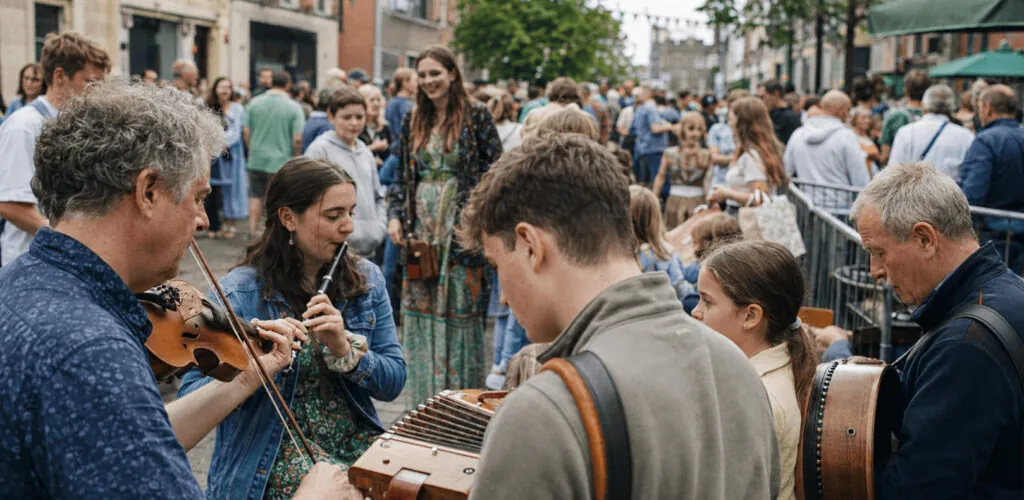
Belfast has just experienced an extraordinary week. For the first time in its history, the Northern Irish capital hosted the Fleadh Cheoil na hÉireann, a major celebration of Irish music and culture. The result far exceeded expectations: 1.65 million footfall counts were recorded in the city centre over eight days, more than double the initial estimates.
Fleadh Cheoil 2026 sends Belfast footfall soaring
1.65 million footfall counts recorded in just eight days
No one expected anything on this scale. Held in Belfast from 2 to 9 August 2026, the Fleadh Cheoil na hÉireann was initially expected to attract more than 800,000 people.
The figures released after the event ultimately surpassed all forecasts: 1,653,999 footfall counts were recorded in Belfast city centre during the festival week.
It is worth clarifying what this figure represents. It is a measure of city-centre pedestrian footfall, collected using Belfast One Business Improvement District counting devices, rather than a tally of 1.65 million individual visitors.
Comparison with the previous year nevertheless gives an idea of the festival’s impact. During the same period in 2025, 874,925 footfall counts were recorded. Footfall in Belfast city centre therefore rose by around 89%.
But what is the Fleadh Cheoil na hÉireann?
The world’s largest gathering dedicated to traditional Irish music
Its name may still be unfamiliar to many French travellers. Yet the Fleadh Cheoil na hÉireann is regarded by its organisers as the world’s largest celebration of traditional Irish music, song and dance.
The Fleadh has existed since 1951. Every year, musicians, dancers, singers, families and enthusiasts of Irish culture gather in a host city for several days of competitions and festivities.
Fiddles, flutes, accordions, bodhráns and uilleann pipes then fill the streets. Alongside the official competitions are concerts, impromptu sessions, céilís, street performances and cultural events.
The atmosphere goes far beyond that of a simple music competition: for one week, much of the host city moves to the rhythm of traditional Irish music.
A historic first for Belfast
The Northern Irish capital had never previously hosted the Fleadh
The 2026 edition had a particular significance. It was the first time Belfast had hosted the Fleadh Cheoil na hÉireann.
For eight days, the city centre was transformed into a vast musical stage. Concerts and events were held around City Hall and in different parts of Belfast, while the All-Ireland competitions brought together the leading qualified participants.
The festival was not confined to traditional music as it is usually imagined, either. Musicians from loyalist and unionist communities, as well as from different ethnic minorities, also took part in the festivities.
This diversity was one of the defining features of the Belfast edition, in a city whose cultural and political history provides a very different context from that of previous host cities.
Thousands of musicians from around the world
The Fleadh shows just how far Irish music has travelled beyond the island’s borders
The event’s popular success was matched by an impressive level of international participation.
Some 5,000 musicians and dancers took part in the competitions held during the Fleadh. Participants came from Ireland, as well as from many other countries where Irish musical culture remains particularly vibrant.
American competitors notably won several awards at the 2026 edition.
This international dimension illustrates the remarkable spread of traditional Irish music. Communities of musicians in the United States, Canada, Great Britain, Europe and Australia have maintained close links with the island’s musical traditions for several generations.
A record Saturday on Belfast’s streets
Nearly 290,000 footfall counts recorded in a single day
The week reached its peak on the Saturday before the festival closed.
Counting devices recorded 289,560 footfall counts in the city centre on that day alone, making it Belfast’s busiest day since the start of 2026.
The streets of the city centre were filled with musicians, visitors and spectators who had come to watch the competitions and the many performances held alongside the official programme.
A few days earlier, footfall had already exceeded the forecasts made for the festival as a whole.
Fleadh 2026 far exceeds forecasts
Belfast had expected around 800,000 people
Before the festivities began, organisers had forecast attendance of more than 800,000 people over the week.
The final figure of 1.65 million city-centre footfall counts therefore represents more than double that initial estimate.
The Belfast edition also comfortably surpasses the figures announced for the Fleadh held in Wexford in 2025, which welcomed around 750,000 people over its eight days of festivities.
For Belfast, the stakes went beyond the success of a festival alone. The event was intended to help strengthen the city’s cultural and tourism profile among Irish and international visitors.
Fleadh Cheoil will return to Belfast in 2027
A second edition is already scheduled from 1 to 8 August
Good news for those who missed the 2026 edition: the Fleadh is not leaving Belfast just yet.
The city has been selected to host the festival once again in 2027. The next Fleadh Cheoil na hÉireann will take place from 1 to 8 August 2027.
Belfast will then become the first city in Northern Ireland to host two successive editions of the major traditional Irish music gathering.
After the 2026 results, the next edition is naturally expected to draw large crowds. Travellers hoping to attend the Fleadh in 2027 would therefore be well advised to arrange accommodation early, particularly for the festival’s final weekend.
Why is the Fleadh an interesting time to visit Belfast?
A completely different way to discover the city
For travellers, the Fleadh offers an experience quite different from a typical stay in Belfast.
The city’s major sights are, of course, still there, from the Titanic Quarter and City Hall to the Cathedral Quarter, but the atmosphere changes completely when thousands of musicians take over the streets, pubs and stages set up in the city centre.
It is also an opportunity to hear traditional music beyond scheduled concerts alone. Chance encounters and spontaneous sessions are an important part of the Fleadh experience.
However, this popularity has an obvious consequence: Belfast is particularly busy during the event. For the 2027 edition, booking accommodation early enough and planning travel in advance will therefore be especially important.
Sources: Belfast City Council, Belfast One Business Improvement District, RTÉ and Comhaltas Ceoltóirí Éireann.