
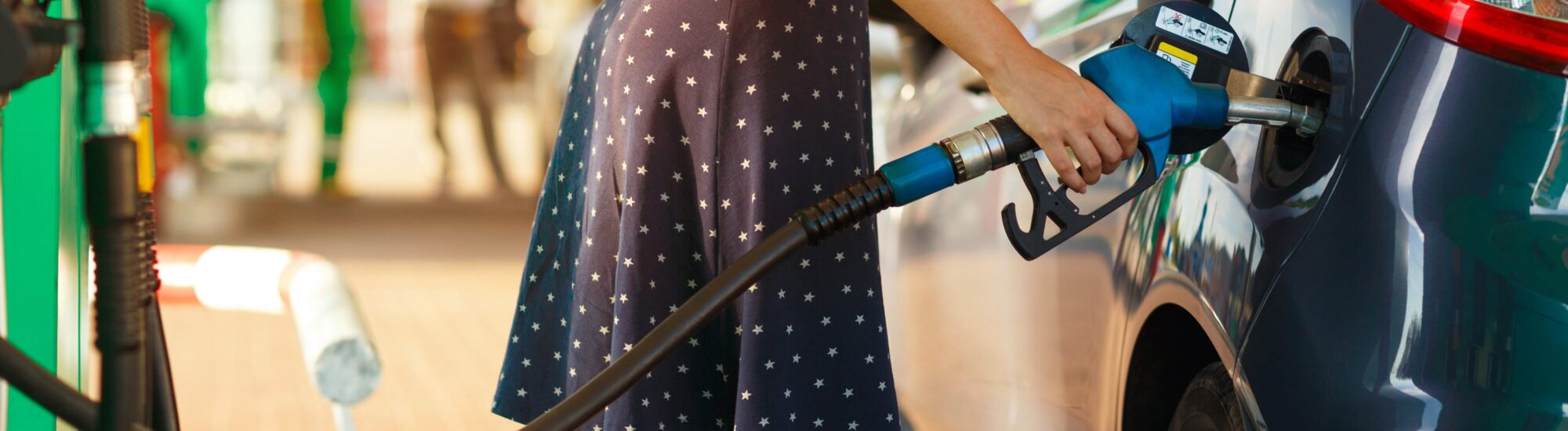
In Ireland’s major cities, finding a filling station is no difficulty. However, the situation changes once the road takes you into Connemara, across the Kerry peninsulas or along Donegal’s wild coast. Pumps become fewer and farther between, opening hours are shorter, and the fuel warning light can suddenly become far less trivial.
If you plan to hire a car in Ireland, or bring your own vehicle by ferry, a few key points will help you avoid mistakes: know which fuel your vehicle uses, understand how the pumps work and plan your fill-ups in rural areas. Here is everything you need to know about filling up and managing petrol in Ireland.
At Irish filling stations, unleaded petrol is labelled petrol or unleaded. The standard fuel is generally E10 unleaded 95, containing up to 10% ethanol. It became the standard grade in the Republic of Ireland in 2023.
Diesel is simply labelled diesel and generally meets the B7 standard. Some stations also offer ‘premium’ petrol or diesel, which is more expensive and contains added additives. Unless otherwise specified by the manufacturer or hire company, there is no need to choose this more expensive option.
Unleaded 98 is less widely available than in France. Depending on the brand, it may be sold under different names, including premium unleaded or super unleaded.
Before your first fill-up, always check the label inside the fuel flap or on the key provided by the hire company. If in doubt, consult the rental agreement or contact the hire company. Using the wrong fuel can immobilise the vehicle and result in particularly high costs.
It is not possible to say definitively that Irish petrol is cheaper than in France or that diesel costs more. Prices vary according to oil prices, taxation, exchange rates and the location of the filling station.
According to AA Ireland, the average price in the Republic of Ireland in July 2026 was €1.753 per litre for petrol and €1.728 per litre for diesel. These are national averages: there can be a difference of several cents between two nearby stations.
Stations on major routes, near airports or in particularly remote areas can sometimes be more expensive. Prices are generally displayed on large signs visible from the road, in euro cents per litre. A price of ‘175.3’ therefore corresponds to €1.753 per litre.
Do not choose your hire car solely on the price displayed at the pump. A diesel vehicle may use less fuel on a long itinerary, while a small petrol or hybrid car will often be better suited to a city break or limited mileage. The hire price and the model’s actual fuel consumption generally have more influence on the budget than a few cents’ difference between fuels.
Fuel is most often self-service. At many stations, you fill up at the pump first, then give the pump number at the counter to pay. Some automated pumps, however, require payment by card before dispensing fuel.
The main brands in the Republic of Ireland are Circle K, Applegreen, Maxol, Texaco and Inver. Several supermarkets and convenience stores also have pumps, contrary to the idea that stations linked to large retailers are unusual.
Visa and Mastercard are widely accepted. Nevertheless, it is sensible to keep another means of payment, particularly at small rural stations. Automated pumps may place a bank pre-authorisation for an amount higher than the fuel actually dispensed. This sum is not normally charged permanently, but it may be temporarily held on the account.
Opening hours vary. Large urban stations or those on major routes may be open 24 hours a day, while small rural establishments sometimes close early in the evening or on Sundays. An outdoor automated pump may remain accessible when the shop is closed, although this is not always the case.
When crossing the border into Northern Ireland, the currency changes, but not the unit of measurement: fuel is still sold by the litre. Prices are displayed in British pence. A sign showing ‘151.9’ therefore means 151.9 pence, or £1.519 per litre.
In August 2026, Consumer Council figures showed significant differences between towns. Petrol was around 149 to 155 pence per litre in several locations, while diesel often exceeded 160 pence. Conversion into euros is essential before comparing these prices with those in the Republic of Ireland.
It is therefore not always cheaper to fill up before or after the border. The exchange rate between the euro and pound sterling can alter the comparison, as can differences between stations. For a few litres, making a detour solely to save money is rarely worthwhile.
If you pay with a French bank card, always choose payment in pounds sterling when the terminal offers a conversion into euros. The conversion carried out by your bank is generally more favourable than the one offered directly by the terminal.
Filling stations are plentiful around Dublin, Cork, Galway, Limerick and Belfast, as well as along major routes. They become more spread out in certain rural areas, on the islands and at the ends of peninsulas.
This precaution is particularly useful in Connemara, Donegal, Mayo, the Beara Peninsula, the Ring of Kerry, the Dingle Peninsula and parts of the Wild Atlantic Way. Distances remain reasonable, but winding roads considerably slow down journeys and can sometimes increase fuel consumption.
In these areas, do not wait for the fuel warning light to come on. A half-full tank provides a comfortable margin when leaving a major town for a sparsely populated area. Also remember to fill up the day before if you need to catch an early-morning ferry or travel a long distance on a Sunday.
Google Maps, Apple Maps and Waze can help you locate nearby stations, but their opening hours are not always up to date. A station shown on the map may have closed or offer only limited services. In a small village, do not hesitate to ask your accommodation provider or a local business for advice.
Most hire companies apply a full to full policy: the car is supplied with a full tank and must be returned in the same condition. If the fuel level is insufficient, the hire company may charge for fuel at a higher rate than filling stations, sometimes with an additional service charge.
Locate a station near the airport or hire office before the day you return the car. Keep the receipt from your last fill-up and check that the gauge shows full. Some hire companies may ask for this proof when the vehicle was filled up several dozen kilometres from the return location.
At Dublin Airport, as around Ireland’s major airports, the nearest stations can be very busy in the morning. Allow an extra 20 minutes so that your final fill-up does not become a race against the clock.
If you have accidentally put in the wrong fuel, do not start the engine under any circumstances. Move the vehicle away from the pump only if this can be done without starting it, notify station staff and contact the hire company’s assistance service immediately.
Comparing prices can save a few euros, but driving style also plays an important role. Repeated acceleration, harsh braking and uneven speeds noticeably increase fuel consumption, particularly on smaller roads.
A compact vehicle is often the most sensible choice in Ireland. It uses less fuel, generally costs less to hire and is easier to manoeuvre on the narrow roads of Connemara or Kerry. There is no need to choose a large SUV if the number of passengers and amount of luggage do not justify it.
Also check the tyre pressure when hiring the vehicle for an extended period. Underinflated tyres can increase fuel consumption and reduce road holding.
Average prices in the Republic of Ireland in July 2026: around €1.753 per litre of petrol and €1.728 per litre of diesel, according to AA Ireland. These prices can change quickly.
Fuels: look for petrol, unleaded 95 or E10 for petrol, and diesel or B7 for diesel fuel.
Currency: payment is in euros in the Republic of Ireland and pounds sterling in Northern Ireland. Prices are always displayed per litre.
Payment: bank cards are generally accepted, but an automated pump may temporarily hold a pre-authorisation. Keep a second card and some cash if possible.
Opening hours: some large stations operate 24 hours a day. In villages, shops may close in the evening and on Sundays.
Hire car: check the fuel indicated on the fuel flap and return the vehicle with the level specified in the agreement. Keep the receipt from your final fill-up.
Remote areas: fill up before travelling through Connemara, Donegal, the Ring of Kerry or the long peninsulas of the west coast. Do not rely solely on the next station shown on your GPS.
Please note: diesel is often much more expensive than petrol.