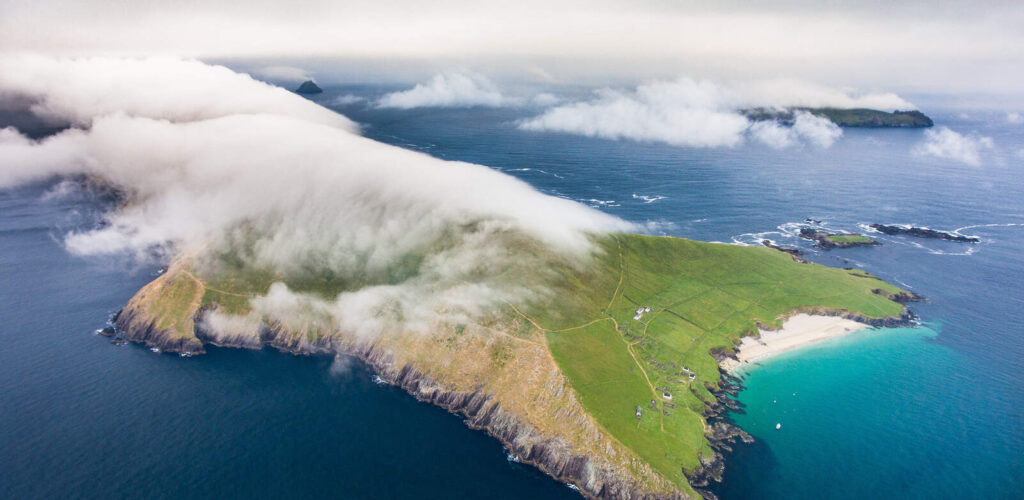
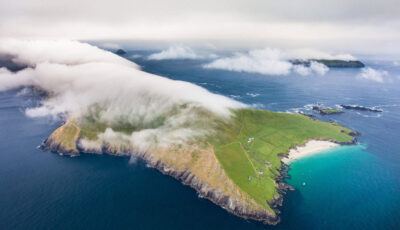
Off the Dingle Peninsula, the Blasket Islands form a windswept archipelago separated from the County Kerry coast by the shifting waters of Blasket Sound. Known in Irish as Na Blascaodaí, they rank among the wildest and most historic places on the Atlantic coast.
The largest of them, Great Blasket Island, was home to a small, almost entirely Irish-speaking community until 1953. Its inhabitants lived from fishing, modest livestock farming and the resources of the ocean. Their daily lives were difficult, but they gave rise to a remarkable literary tradition in the Irish language.
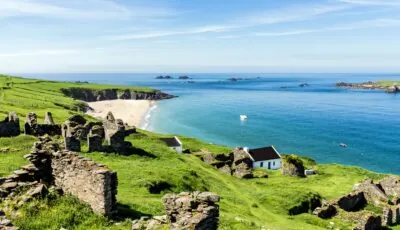
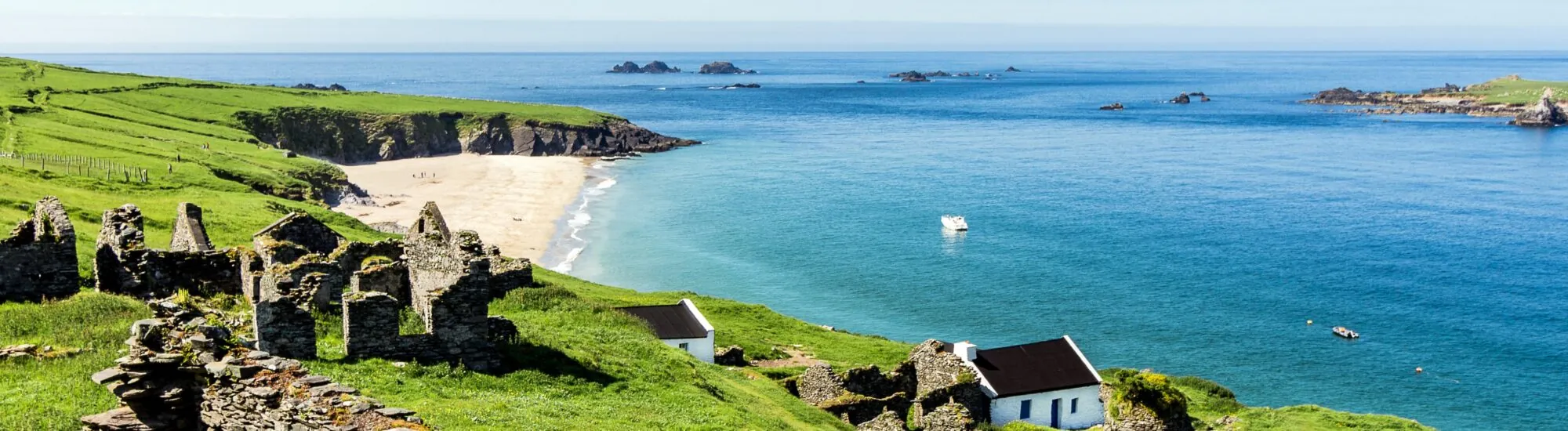
Now uninhabited year-round, the Blasket Islands attract hikers, history enthusiasts and wildlife watchers. The ruins of the former village, beaches frequented by grey seals and cliffs opening out onto the Atlantic create a landscape of striking beauty.
Discovering the Blasket Islands
A wild archipelago off the Dingle Peninsula
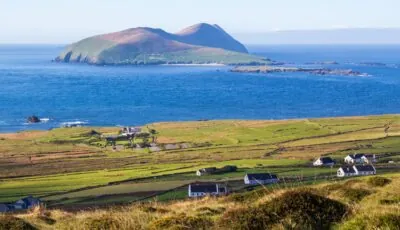
The archipelago lies at the western tip of the Dingle Peninsula, opposite the village of Dún Chaoin, or Dunquin. From the mainland cliffs, its rocky silhouettes seem to follow one another across the ocean like the links of a chain.
The Blaskets comprise six main islands:
- Great Blasket Island, or An Blascaod Mór, the largest and the only one to have supported a substantial permanent community;
- Beginish, or Beiginis, a small island near Great Blasket;
- Inishnabro, or Inis na Bró, recognisable by its high cliffs;
- Inishvickillane, or Inis Mhic Uibhleáin, long used for grazing and occupied periodically;
- Inishtooskert, or Inis Tuaisceart, whose shape has earned it the nicknames “Sleeping Giant” and “Dead Man”;
- Tearaght Island, or An Tiaracht, the westernmost island, dominated by a lighthouse built in the nineteenth century.
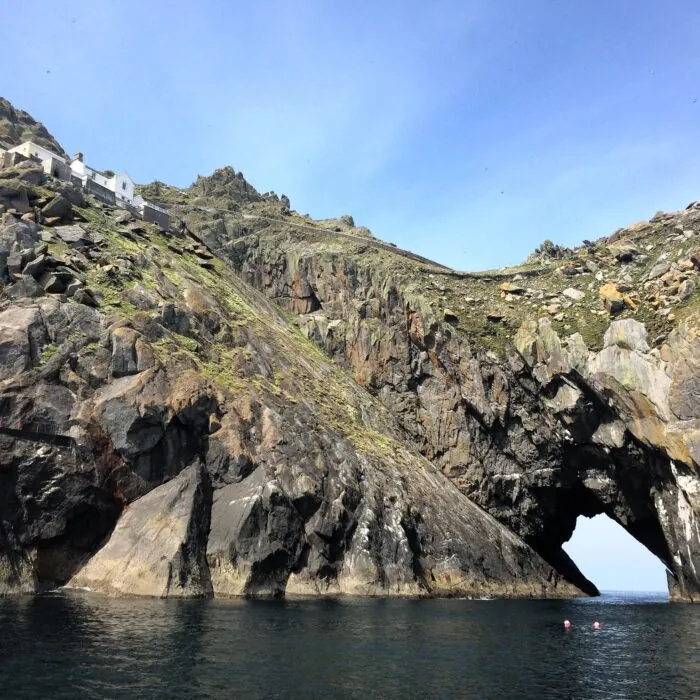
Small islets and exposed rocks complete the group. Most are difficult to access and are not open to visitors. Tourist excursions focus mainly on Great Blasket, while some boat trips sail around the other islands without landing on them.
The Great Blasket Island community
A life organised around the rhythm of the ocean
The archipelago’s permanent population lived mainly on Great Blasket Island. Set on the north-eastern slope, the village benefited from relative protection from the prevailing winds and faced the Dingle Peninsula.
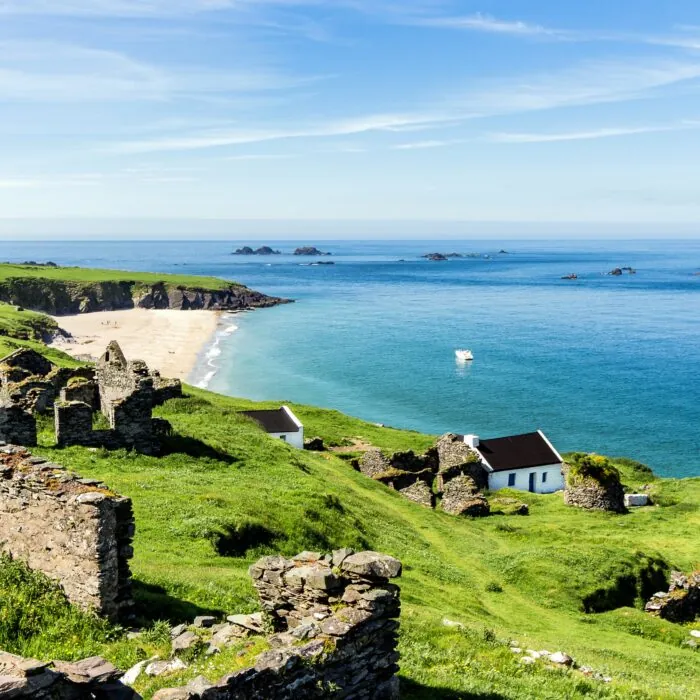
The stone houses were grouped above An Trá Bhán, the “white beach”. The island had no proper harbour, permanent doctor or electricity network. People travelled on foot, and communication with the mainland depended entirely on sea conditions.
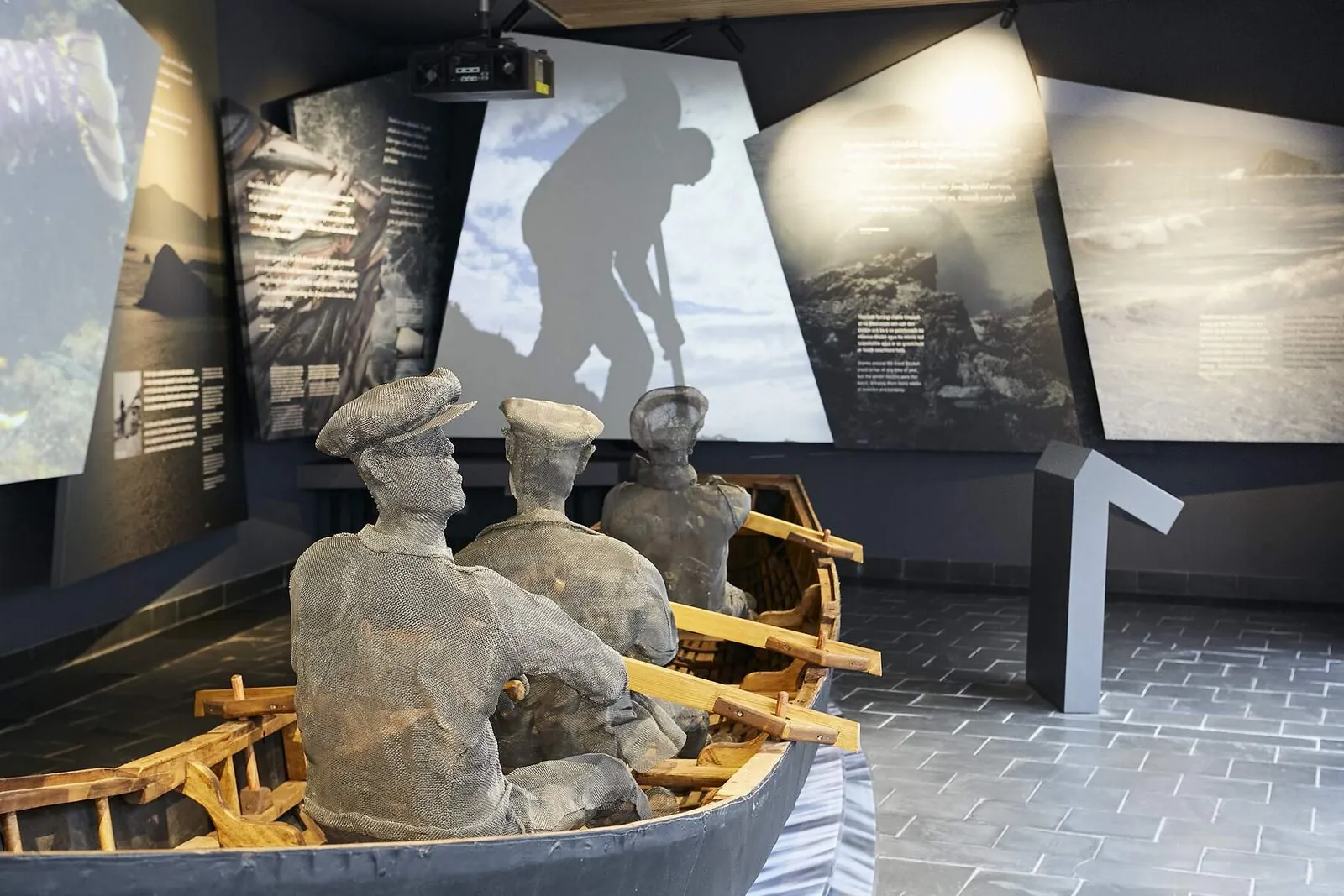
The inhabitants traditionally used naomhóga, light boats similar to currachs, made with a wooden frame that was once covered with hides and later with tarred canvas. They were used for fishing, transporting people and trading with Dún Chaoin.
The diet was based on potatoes, milk, meat, seabird eggs and fish. Families kept sheep and a few cattle on poor, treeless land constantly exposed to salt.
Life was not, however, completely cut off from the outside world. The islanders traded with communities on the peninsula, travelled to the mainland and occasionally welcomed visitors. Their isolation became particularly dangerous when storms prevented boats from crossing the strait for several days.
An entirely Irish-speaking community
The Gaelic language at the heart of daily life
Irish was the main language of the inhabitants of Great Blasket. It was not an artificially preserved tradition, but the language used at home, at work, in storytelling and in social relationships.
In the late nineteenth and early twentieth centuries, this distinctive feature attracted linguists, writers and researchers who came to study the local dialect and collect orally transmitted stories.
Among them were the Norwegian linguist Carl Marstrander, the British specialist in the Irish language Robin Flower and the researcher George Thomson. Their exchanges with the inhabitants encouraged several islanders to put their lives into writing.
This meeting between a living oral tradition and the publishing world gave rise to a body of work now regarded as one of the great treasures of Irish literature.
The writers of the Blasket Islands
A tiny community with an immense literary heritage
Tomás Ó Criomhthain, sometimes anglicised as Tomás O’Crohan, is one of Great Blasket’s most famous authors. A fisherman and farmer, he recounts his life in An tOileánach, published in Irish in 1929 and translated into French under various titles, including L’Homme des îles.
His account describes a society facing poverty, shipwrecks, storms and emigration, but also rich in mutual aid, humour and a deep knowledge of the ocean.
Muiris Ó Súilleabháin recounts his childhood in Fiche Bliain ag Fás, translated into English under the title Twenty Years A-Growing. His testimony offers a younger perspective on the community and on the islanders’ gradual departure for the mainland or America.
Peig Sayers holds an equally important place. Born on the Dingle Peninsula, she settled on Great Blasket after her marriage. Her autobiography, Peig, became one of the best-known works of twentieth-century Irish literature.
These books go far beyond simple folkloric description. They are irreplaceable social records of a vanished rural and maritime community, told by those who truly knew it.
The evacuation of Great Blasket in 1953
The departure of the last 22 inhabitants
The population of Great Blasket reached its peak at the beginning of the twentieth century, with around 170 to 180 inhabitants depending on the period. It then declined rapidly as a result of emigration, an ageing population and economic hardship.
Many young people left the island for the mainland or settled in the United States. A large community with Blasket roots formed in Springfield, Massachusetts, in particular.
As the number of inhabitants fell, life on the island became more fragile. It grew increasingly difficult to maintain a school, obtain medical care or rescue people in distress when the sea made any crossing impossible.
The death of a sick young man who could not receive medical assistance in time in 1947 tragically illustrates this isolation. The inhabitants then sought greater help from the authorities.
On 17 November 1953, the last 22 permanent residents were transferred to the mainland. The evacuation was organised by the state, but it came after several years of decline and requests from the islanders. It should therefore not be summarised as a sudden, arbitrarily ordered expulsion.
The families were mainly rehoused on the Dingle Peninsula. The village was abandoned, leaving its stone houses to slowly deteriorate under the Atlantic wind and rain.
Visiting Great Blasket Island
Walking among the ruins of an abandoned village
Great Blasket Island is the only island in the archipelago regularly accessible to visitors. Crossings are operated by several private companies from Dún Chaoin, Ventry or Dingle.
The shortest journey leaves from Cé Dhún Chaoin, the small landing place at the foot of a winding road that has become famous on social media. The crossing takes about 20 minutes when conditions are favourable.
The island still has no proper pier. Depending on the boat used, the final part of the arrival may require a transfer into a small inflatable boat. This operation requires sufficient mobility and can be difficult when the sea is rough.
From the landing point, a path climbs towards the former village. Visitors can see the ruins of the houses, the school, the paths once used by the inhabitants and the restored home of Tomás Ó Criomhthain.
Free guided tours of the village are occasionally offered by the Office of Public Works during the season. They help place the buildings in context and prevent the ruins from being viewed as merely an abandoned backdrop.
The island has several trails, but the terrain remains uneven and sometimes muddy. The cliffs are not always protected by barriers. Good footwear, waterproof clothing, water and a meal are essential.
An island subject to Atlantic conditions
Crossings entirely dependent on the weather
Ferries operate only during the warmer season and when sea conditions allow a safe crossing. A trip may be cancelled on the morning itself, even if the sky appears clear over the peninsula.
For the 2026 season, one of the main companies operates crossings from Dún Chaoin from 7 May to 9 September. Other operators offer a slightly longer season, generally from spring until the end of September or the beginning of autumn.
It is essential to book directly with the chosen company and to plan a backup activity. No operator can guarantee a departure several days in advance.
From Dún Chaoin, a return ticket generally costs €50 per adult and €30 per child in 2026. Some crossings are reserved for children aged at least 7. Longer excursions from Dingle or Ventry, sometimes including a wildlife-watching trip, cost more.
Return times are set when booking. It is essential to return to the boarding point at the scheduled time: places are limited and the company must adhere to its timetable.
The wildlife of the Blasket Islands
Grey seals, seabirds and cetaceans
The Blaskets are a major refuge for Atlantic wildlife. Great Blasket is home to a large colony of grey seals, often visible on An Trá Bhán beach.
Visitors must remain at a minimum distance of around 50 metres. Getting too close may cause the animals to rush back into the water, separate a mother from her pup or disturb their rest.
Swimming at An Trá Bhán is not recommended because of the currents and waves. The beach’s apparently peaceful beauty should not obscure its exposure to the Atlantic.
The cliffs are also home to fulmars, guillemots, petrels, shearwaters and many other seabird species. The more remote islets are particularly important nesting sites.
During the crossing, it is sometimes possible to spot dolphins, porpoises, minke whales or basking sharks. Such sightings are naturally unpredictable.
The Blasket Centre in Dún Chaoin
Understanding the islands without crossing the strait
When the sea is too rough or the ferries are not operating, the Blasket Centre, or Ionad an Bhlascaoid, is the best way to discover the history of the archipelago.
Located in Dún Chaoin on the Dingle Peninsula, this heritage centre presents the islanders’ daily lives, language, traditions and literary heritage. Completely modernised in 2022, its exhibition combines objects, archives, testimonies and interactive displays.
Its architecture was designed to direct the visitor’s gaze towards Great Blasket. A platform accessible at the top of the cliff offers a spectacular panorama of the archipelago and helps visitors understand the apparent, but deceptive, proximity between the island and the mainland.
In 2026, the centre is open every day from 6 March to 8 November, from 10 a.m. to 6 p.m., with last admission at 5:15 p.m. A ticket costs €5 per adult, €4 for seniors and groups, €3 for students and €13 for a family. Admission is free for children under 12.
Updated information is available on the official Heritage Ireland website.

 +
+
 Tourist attractions
 Irish Restaurants and Pubs
 Partner Accommodations
 Campgrounds and Lodging