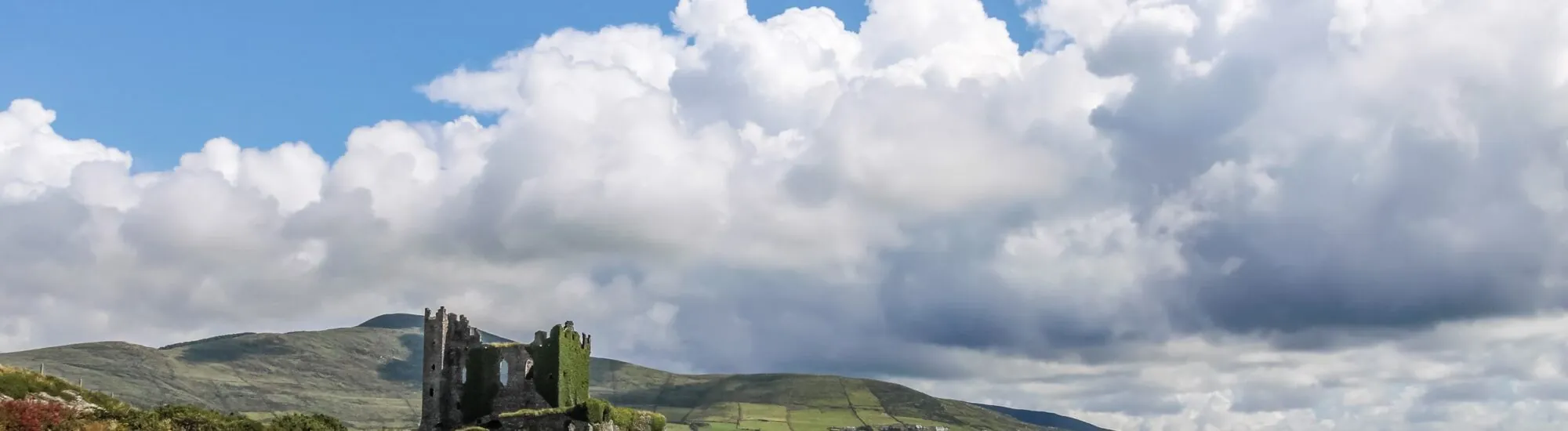
Beyond Caherciveen, the walls of Ballycarbery Castle stand out against the landscapes of the Fertha estuary. Vegetation envelops the masonry, windows open onto the sky and collapsed sections reveal the substantial thickness of this former fortified residence. Associated with the MacCarthy Mór, the castle retains a striking presence in this part of the Iveragh Peninsula. Today, it can only be seen from a distance: the ruins stand on private property and are closed to the public.
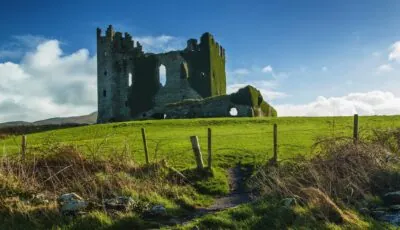
Ballycarbery Castle – © Atmosphere
Ballycarbery’s origins are medieval, but it is important to distinguish between the site’s early occupation and the construction of the walls still visible today. Generally dated to between the late 15th and the 16th centuries, the fortress belongs to the history of the MacCarthy Mór, a Gaelic dynasty of the Kingdom of Desmond, a powerful family from south-west Ireland.
The O’Connells are also associated with the castle, which they are said to have guarded for the MacCarthys. This connection links Ballycarbery to a family that would later occupy a major place in Irish history through Daniel O’Connell, champion of Catholic emancipation in the 19th century. It does not, however, mean that the celebrated “Liberator” himself lived in the fortress.
Its location near the Fertha estuary, in the Valentia Harbour area, made it possible to watch over the surrounding countryside and approaches by water. From this slight rise, the residence also asserted the presence of its occupants in the landscape.
Ballycarbery combined defensive functions with those of a prestigious residence. The main rectangular building included vaulted spaces on its lower levels and rooms arranged on the upper floors. The large openings still visible today suggest that the castle was intended as much for domestic life as for protecting its inhabitants.
An enclosing wall, known as a bawn, completed the complex. Its remains bear witness to a fortified estate extending beyond the sole silhouette that now rises above the meadows.
In the late 1590s, Ballycarbery appears among the possessions of Sir Valentine Browne. This transition formed part of the upheavals following the death of Donal MacCarthy Mór, Earl of Clancare, in 1596, and the transformation of the former Gaelic lordships.
The castle’s fate then became bound up with that of the Brownes, a family destined to become highly influential in Kerry. Behind these changes of ownership lies a broader history: that of succession disputes, intervention by the English Crown and the gradual decline of Gaelic power structures.
In 1652, during the Cromwellian conquest of Ireland, Ballycarbery was captured by Parliamentary forces. Accounts of the castle report artillery fire that is said to have severely damaged its defences.
Its present condition cannot, however, be attributed to a single event. Over the centuries, abandonment, weathering and the removal of building materials also contributed to the loss of part of the structure. The remaining walls therefore reveal traces of a residence whose volumes were once far more complete.
Today, vegetation emphasises the fractures and openings. It gives the ruins their romantic appearance, while also serving as a reminder that this is a fragile building, with no provision for exploring its interior.
Ballycarbery Castle is not open to the public. The castle and surrounding land are privately owned; access to the ruins is prohibited. Older accounts advising visitors to cross the field, use the stairs or reach the upper floors should therefore not be used as a guide to visiting.
The site should be viewed from authorised roadside vantage points, with respect for signs and property boundaries. Do not cross fences or gates to get closer to the walls, even if older photographs show visitors standing at their foot.
Even from a distance, it is possible to appreciate the castle’s silhouette, its gaping windows and the contrast between dark stone and vegetation. The appeal of stopping here lies as much in its presence within the landscape as in its architectural details.
Ballycarbery is particularly well suited to photography when the light sets the masonry against the sky. Depending on the cloud cover, the castle can appear massive and austere, or almost absorbed into the greens of the surrounding countryside.
From authorised areas, look for a composition that places the ruins within their surroundings rather than trying at all costs to photograph them up close. A lens that allows for a tighter frame can be useful, but the scene also retains its appeal in a wider composition.
Parking opportunities are limited. Stop only in an authorised place, without obstructing traffic or farm access. The small roads in the area are used daily by local residents.
The immediate area is home to two other remarkable monuments: Cahergall Stone Fort and Leacanabuaile Stone Fort. These circular stone enclosures offer the chance to explore another period of local history, predating that of the castle visible today.
Cahergall impresses with the thickness of its walls and its restored internal features. Leacanabuaile offers a complementary visit, set in a landscape open to the hills and countryside of this part of Iveragh. Their proximity makes combining all three sites particularly worthwhile.
These stops should nevertheless be treated separately: access to the forts does not grant any right of way across Ballycarbery property. Follow the paths and directions specific to each monument.
A few kilometres from Caherciveen, Ballycarbery is reached via the small roads in the area on the other side of the river, often referred to locally as “over the water”. This detour fits easily into an exploration of the Ring of Kerry, especially if you wish to leave the main route for a while.
Allow a short stop to view the castle, then more time if you continue on to the two forts. The time needed for the whole visit depends mainly on your pace, the weather and your interest in the monuments: it is better to leave some flexibility than to treat these three places as a succession of photographs to take quickly.
Before setting out, check local information and give priority to on-site signage. Some older tourist information still describes free exploration of the ruins, whereas a visit to Ballycarbery must now remain external.
Essential information to help you plan your visit, including key landmarks, access information, and booking options.
Ballycarbery East, Ballycarbery, County Kerry, Republic of Ireland, Tourist sites in Ireland
51.948887, -10.258593
Ballycarbery Castle has no public opening hours.
As the castle is on private property and closed to visitors, it can only be viewed from accessible areas nearby.
It is advisable to visit during daylight hours to enjoy the landscape and photograph the ruins in good conditions.
Please respect the fences, prohibition signs and private property around the monument.
Check the opening hours and admission requirements before you leave, especially during peak season or on Irish public holidays.
Viewing Ballycarbery Castle is free of charge. No admission ticket is required.
Please note, however: the castle stands on private property and has not been accessible to the public since 2017. It is therefore not possible to pay to enter the ruins or visit the interior.
The castle can be admired free of charge from a distance, particularly from accessible areas near the road.