
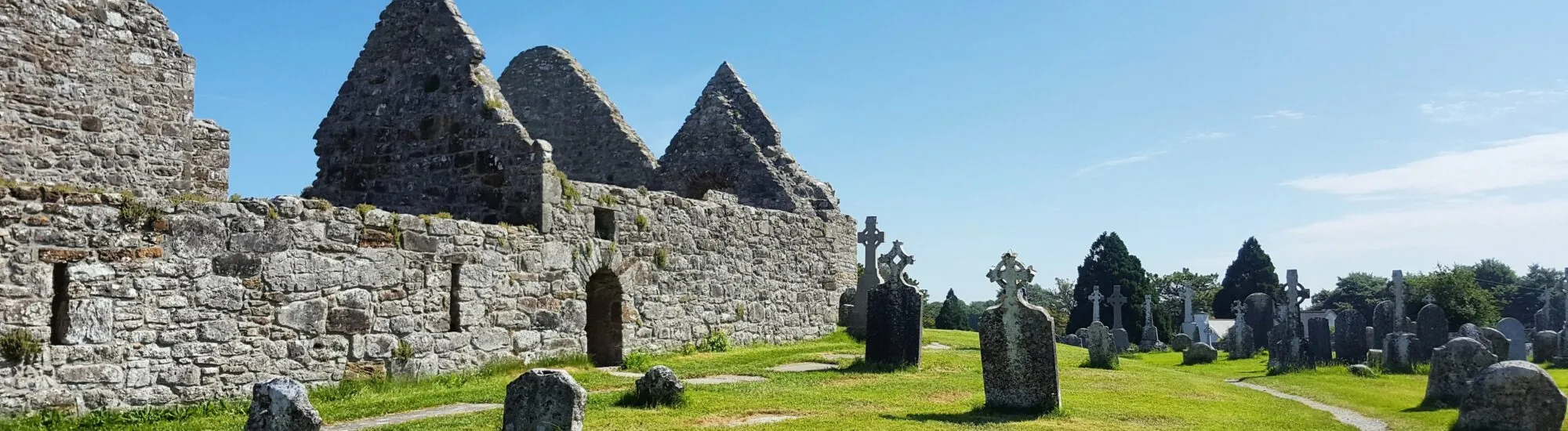
On a peaceful bank of the Shannon, round towers, ruined churches and towering carved crosses form one of Ireland’s most powerful historic landscapes. Clonmacnoise is more than an ancient monastery: for centuries, this spiritual, intellectual and political crossroads linked the island’s principal land and river routes.
Clonmacnoise, known in Irish as Cluain Mhic Nóis, lies in County Offaly, south of Athlone. The site occupies a remarkable position between the River Shannon and the Esker Riada, a long ridge of sand and gravel laid down by glaciers. In ancient Ireland, this natural ridge formed a major east–west land route. Its meeting with the Shannon, an important north–south navigation route, partly explains the monastery’s exceptional prosperity.
The landscape is an essential part of the visit. The ruins stand out against the water, meadows and ever-changing Midlands sky. The place may seem isolated today, but it once stood at the heart of a busy network of travellers, pilgrims, craftspeople, scholars and rulers.
Tradition attributes the foundation of Clonmacnoise to Saint Ciarán, who settled here around 544 or 545. Originally from Connacht, the young cleric had studied, among other places, under Saint Finian at Clonard. He is said to have chosen this bank of the Shannon with the support of Diarmait mac Cerbaill, the future High King of Ireland.
Ciarán died only a few months after establishing the community, probably while still very young. Yet his settlement survived in spectacular fashion. What began as a modest religious foundation gradually became one of the island’s most influential monastic centres.
Between the 7th and 12th centuries, Clonmacnoise developed far beyond a simple place of prayer. Its religious community studied the Scriptures, copied manuscripts and trained new generations of clergy. Craftspeople worked in metal, wood and stone, while the surrounding lands provided for the community’s needs.
The monastery maintained close ties with the royal dynasties of the Midlands and Connacht. Several rulers and dignitaries chose to be buried here, adding to its prestige. This proximity to power brought protection and donations, but also exposed it to political rivalries.
Clonmacnoise suffered numerous raids, fires and plunderings over the course of its history. Vikings attacked it repeatedly from the 9th century onwards, before Irish and Anglo-Norman armies in turn coveted its riches. On each occasion, the site was repaired, enlarged or rebuilt. Its decline was gradual after the 12th century, when the reorganisation of the Irish Church changed the role of the great ancient monasteries. The destruction of the English garrison at Athlone in 1552 dealt the settlement a decisive blow.
The cathedral is the largest religious building on the site. Its first stone construction is traditionally associated with the year 909 and the patronage of King Flann Sinna and Abbot Colmán. It was subsequently extensively altered, notably in the 11th and 15th centuries.
Its west doorway, often known as the Whispering Arch, dates from late medieval alterations. A popular tradition holds that confessions could once be heard at a distance, with someone whispering from one side of the arch while the priest listened from the other. It is a charming story, though it belongs more to folklore than to any proven liturgical function.
The round towers are among Clonmacnoise’s defining silhouettes. The taller of the two is generally known as O’Rourke’s Tower. It is thought to have been begun in the early 12th century under the patronage of King Turlough O’Connor and Abbot Gilla Christ Ua Maoileoin. Struck by lightning in 1135, it was later restored and altered.
The second, McCarthy’s Tower, is incorporated into Temple Finghín. Smaller in scale, it forms a particularly elegant architectural ensemble with the adjoining Romanesque church. The precise functions of Ireland’s round towers were varied: they served as bell towers and monumental landmarks, while also being capable of temporarily sheltering people or valuable objects.
Temple Ciarán is one of the smallest structures in the complex. Tradition places Saint Ciarán’s grave beneath this little church. Its walls have a distinctive lean, long attributed to ground movement and the weight of the masonry.
The building is modest, and almost easy to miss beside the larger neighbouring ruins. Yet it is one of Clonmacnoise’s most symbolic spaces, preserving the memory of its founder at the very heart of the monastery.
Temple Connor was built around the 11th century, then altered at various times. Unlike the other ruins, this small church still has a roof and is occasionally still used by the local Church of Ireland community. It should therefore not be described as a former prison or as a building ‘requisitioned’ in the Middle Ages by an institution that did not yet exist in that form.
The site also includes Temple Melaghlin, Temple Dowling, Temple Hurpan and several other sanctuaries. Each bears witness to a different phase in the history of the complex. Around 300 metres from the main enclosure, Nun’s Church also deserves attention. Consecrated in 1167, it features remarkable Hiberno-Romanesque decoration, particularly around its doorway and chancel arch.
The Cross of the Scriptures is the best-known of Clonmacnoise’s high crosses. Standing around four metres tall, it was carved in the early 10th century. Its reliefs depict biblical scenes, including the Crucifixion and the Last Judgement, alongside figures that may evoke royal and ecclesiastical power.
A heavily worn inscription asks for prayers for King Flann and Abbot Colmán, the two figures also associated with the cathedral. The cross therefore illustrates the alliance between religious authority and political power in medieval Ireland.
The three great historic crosses – the Cross of the Scriptures, the North Cross and the South Cross – have been moved indoors to protect them from erosion. The monuments visible in the open air are replicas. This does nothing to diminish the beauty of the landscape, but it helps explain why the sculptures displayed indoors appear sharper than those standing beside the ruins.
Clonmacnoise also preserves more than 700 early Christian grave slabs. Their inscriptions, crosses and geometric motifs form an exceptional record of the people connected with the monastery and of the evolution of Irish funerary art.
Clonmacnoise’s scholarly reputation rests partly on the production and preservation of manuscripts. The Chronicum Scotorum, sometimes mistakenly confused with the name of a tower, is in fact a medieval chronicle recounting events in Irish history. The surviving manuscript was copied in the 17th century from an earlier source connected with Clonmacnoise.
The Book of the Dun Cow, or Lebor na hUidre, is another major text associated with the monastery. Compiled in the 11th and 12th centuries, it is the oldest surviving manuscript containing an important collection of narratives in the Irish language. Among them is an early version of the Táin Bó Cúailnge, the great epic of the Ulster Cycle.
Clonmacnoise is best explored without rushing. Start by taking in the whole site from around the cathedral, then gradually make your way towards the towers, small churches and inscribed slabs. The complex’s relatively compact dimensions can be deceptive: each building relates to a different period, dynasty or function.
The ground can be uneven and damp, so suitable footwear is recommended, even though the visit is not a hike. In changeable weather, the light over the Shannon can transform the scene quickly: for photographers, a brooding sky is not necessarily bad news – quite the opposite.
Clonmacnoise makes a natural stop between Athlone, Shannonbridge and the tranquil landscapes of central Ireland. Its location makes it easy to include in an itinerary focused on Ireland’s Hidden Heartlands, away from the busiest coastal routes.
The site owes its power as much to its setting as to its monuments. Standing before the stone crosses and round towers, with the Shannon as a backdrop, it becomes much easier to imagine why religious communities, kings and travellers attached such importance to this place for almost a millennium.
Want to extend your visit without having to rush around? Here are a few well-located places to stay near the must-see attractions.
Essential information to help you plan your visit, including key landmarks, access information, and booking options.
Clonmacnoise, Shannonbridge, Athlone, comté d’Offaly, N37 V292, Clonmacnoise, Clonmacnoise
53.326307, -7.986296
The visitor centre is currently closed for works, but the monastic site remains accessible. Opening times may change during the works, so check the day’s arrangements on the official website.
Check the opening hours and admission requirements before you leave, especially during peak season or on Irish public holidays.
Official prices checked in September 2026. The Heritage Card is accepted.