

Rising above Clew Bay in County Mayo, Croagh Patrick is at once a mountain, a pilgrimage site and one of Ireland’s great spiritual symbols. Its conical summit reaches 764 metres and overlooks a spectacular landscape of islands, bays and Atlantic uplands.
Known as Cruach Phádraig in Irish and nicknamed the Reek by local people, Croagh Patrick now draws pilgrims, hikers and travellers who come to admire one of the finest views in the west of Ireland.
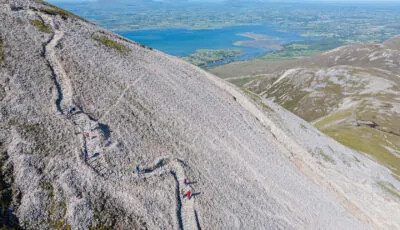
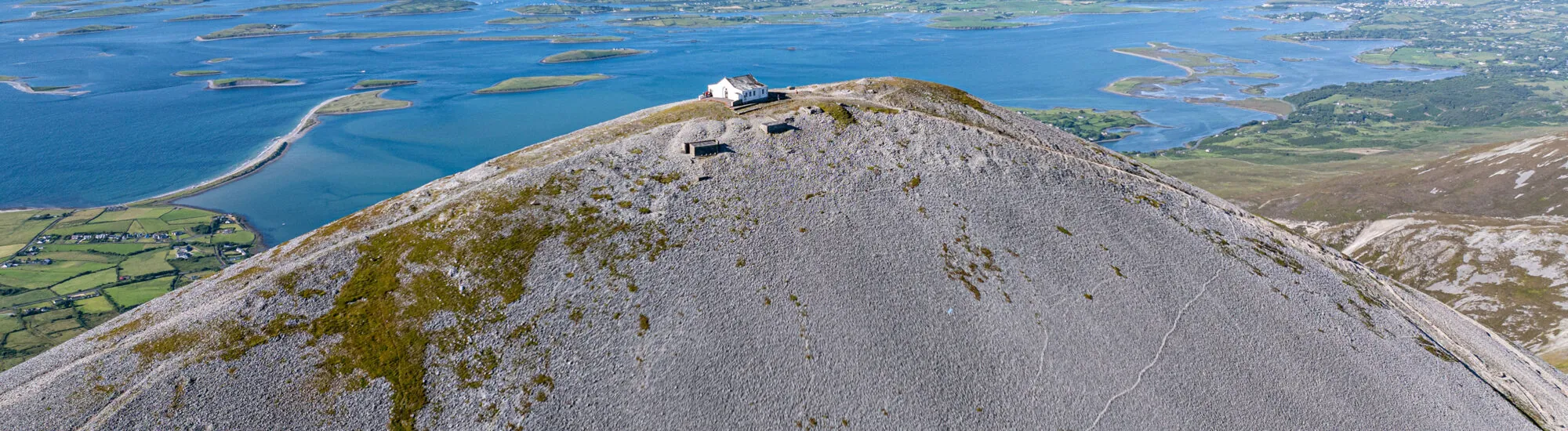
Croagh Patrick overlooking Clew Bay – © Fáilte Ireland / Big Style Media
Croagh Patrick’s almost perfectly shaped silhouette may bring a volcano to mind. Yet the mountain is not of volcanic origin: it is made chiefly of metamorphic rocks, including quartzite.
Before the arrival of Christianity, it was known as Cruachán Aigle. Its location, isolated profile and commanding position above Clew Bay appear to have given it a sacred significance from prehistoric times.
The mountain is thought to have been associated with Lughnasa celebrations, a festival marking the beginning of the harvest in the Gaelic calendar. This ancient tradition may explain why the major Christian pilgrimage still takes place at the end of July.
According to Irish Christian tradition, Saint Patrick climbed the mountain in 441. He is then said to have spent forty days and forty nights fasting and praying on the summit, in the image of Moses on Mount Sinai and Christ in the desert.
No contemporary document can confirm this episode. It belongs to a body of hagiographic accounts written after the saint’s death. Nevertheless, the tradition has left a deep mark on Irish culture and made Croagh Patrick the country’s principal mountain pilgrimage site.
A chapel known as Teampall Phádraig is thought to have stood on the summit from the earliest days of Irish Christianity. Archaeological excavations carried out in 1994 revealed the foundations of an earlier building.
The small white chapel visible today was built in the early 20th century and consecrated on 20 July 1905. It remains the spiritual destination of the climb.
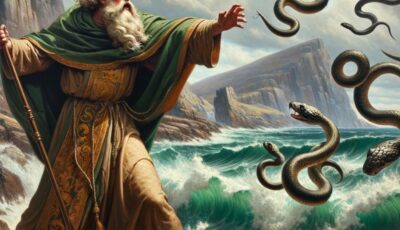
Legendary depiction of Saint Patrick driving the snakes from Ireland
Legend has it that Saint Patrick drove all the snakes from Ireland from Croagh Patrick. In some versions, he cast the reptiles into the sea after ringing his bell.
This story should not be interpreted literally. Scientific research indicates that no wild snake population lived in Ireland after the last Ice Age. The island was already separated from Great Britain and continental Europe when these reptiles might have recolonised the land.
The snakes are instead thought to represent the pagan beliefs that Christian accounts say Saint Patrick was charged with eradicating. The legend thus illustrates Ireland’s gradual conversion to Christianity.
Each year, on the last Sunday in July, several thousand pilgrims climb Croagh Patrick for Reek Sunday, or Domhnach na Cruaiche in Irish.
Masses are celebrated in the summit chapel when conditions allow. Some participants also perform prayers and rituals at the old stations spread across the mountain.
Some pilgrims still make the climb barefoot as a sign of penitence. This traditional practice is particularly risky on the sharp, unstable stones of the upper section, however. Good walking boots are still strongly recommended.
Reek Sunday is the busiest day of the year. The crowds greatly slow progress and make parking difficult in Murrisk. Travellers interested only in hiking will have a quieter experience by choosing another date.
The Tóchar Phádraig is not the standard ascent of Croagh Patrick. It is an ancient pilgrimage route linking Ballintubber Abbey with the village of Murrisk, at the foot of the mountain.
This 35-kilometre route partly follows the course of an old royal road thought to have linked Cruachan, the seat of the rulers of Connacht, with the sacred mountain. It passes along country lanes, through bogland and by several religious sites, including the village of Aghagower.
The route takes at least ten hours of walking and can be spread over two days. Participants must register with Ballintubber Abbey and, for safety reasons, there must be at least two people. Dogs are not permitted on the route.
Guided walks are organised on various dates. Rules, prices and schedules are published on the Pilgrim Paths of Ireland website.
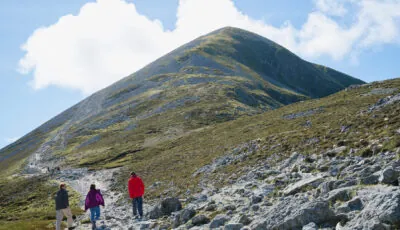
The Croagh Patrick ascent trail – © Fáilte Ireland / Big Style Media
The standard route begins in Murrisk, around 8 kilometres west of Westport. The starting point is near the main car park, visitor centre and statue of Saint Patrick.
The round trip is about 7 kilometres. Its relatively modest length can be misleading: the trail gains nearly 700 metres in elevation and climbs almost continuously.
The first section follows a steady incline to the mountain’s shoulder. The terrain then becomes temporarily less steep before the final ascent to the summit. This final stretch is the most difficult, with a sharp gradient and stony ground.
The descent often requires more care than the ascent. Stones can shift underfoot, especially after rain. Path improvement works have reduced erosion on certain sections, but Croagh Patrick remains a true mountain hike.
Most walkers complete the round trip in three to four hours. It is best to allow up to five hours to walk at a leisurely pace, take breaks and enjoy the summit.
Croagh Patrick is generally considered a difficult hike. It is not a technical climb requiring mountaineering equipment, but the gradient, elevation gain, unstable stones and weather conditions can challenge walkers.
Children accustomed to hiking can complete the route under adult supervision. The climb is less suitable, however, for young children, pushchairs and people with mobility difficulties.
It is perfectly reasonable to turn back at the mountain’s shoulder. This intermediate point already offers fine views over Clew Bay and avoids the much more demanding final ascent.
In clear weather, the summit reveals a vast panorama over Clew Bay and its multitude of small islands. The view extends across the Mayo uplands, the Nephin Beg Mountains, Clare Island and the Atlantic Ocean.
The white chapel stands at the highest point. Its very simple architecture contrasts with the scale of the surrounding landscape. It is not continuously open, but Masses are celebrated there, notably during Reek Sunday and on 15 August.
The summit is often shrouded in cloud, even when visibility appears good at the start. The panorama is therefore never guaranteed. Yet Croagh Patrick retains a distinctive atmosphere in the mist, as the chapel and the silhouettes of walkers gradually emerge between the clouds.
Walking boots with grippy soles are essential. Everyday trainers provide too little support and grip for the stony descent.
You should also bring warm clothing, a waterproof jacket, water and some energy-rich food. Even in summer, the wind can cause the perceived temperature near the summit to drop quickly.
Walking poles can make the descent safer. Check the weather before setting off and abandon the climb in the event of strong winds, thunderstorms or very poor visibility.
The return should be made via the traditional Murrisk path. Mountaineering Ireland currently asks walkers not to use the descent via Ben Goram and Kilsallagh because of access and parking issues on farmland.
Croagh Patrick remains a living religious site, as well as a fragile mountain environment. It is essential to stay on the path to limit erosion and avoid damaging vegetation.
All rubbish must be carried back down to Murrisk. Walkers should also respect ceremonies, the chapel and pilgrims who have come to undertake a spiritual journey.
Dogs are discouraged because of the presence of sheep and farmland. Where they are allowed on an accessible section, they must be kept under control at all times.
Religious information and celebration dates can be checked with the Archdiocese of Tuam.
Want to extend your visit without having to rush around? Here are a few well-located places to stay near the must-see attractions.
Essential information to help you plan your visit, including key landmarks, access information, and booking options.
Teevenacroaghy, Murrisk, Murrisk (Mayo County) - Republic of Ireland
53.760063, -9.660006
1/2 journée