

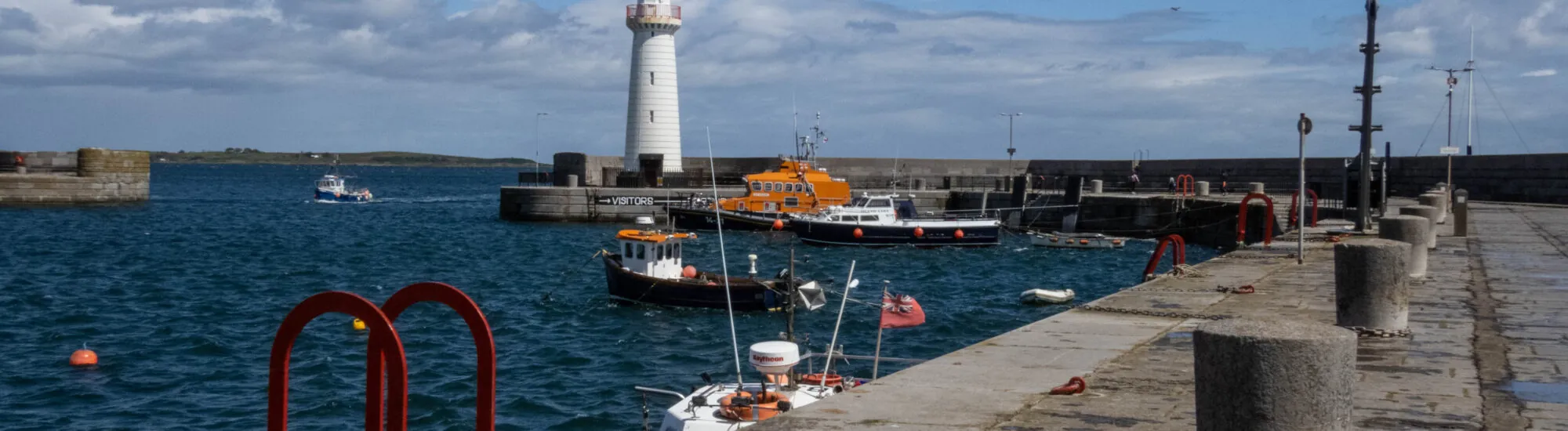
At the end of the south pier, a white tower stands above the boats in the harbour. Donaghadee Lighthouse, in County Down, is one of those landmarks best discovered on foot: a few steps along the water, a glance out over the Irish Sea, then the urge to linger a little longer. Its silhouette defines a town long associated with crossings to Scotland, before becoming a popular stop on the Northern Irish coast.
It is an easy outing to plan: come and see the lighthouse from the outside, stroll along the seafront and enjoy the cafés in the town centre. The interior is not regularly open to the public. The appeal lies as much in the harbour around it as in the tower itself, which is still used for navigation.
To understand Donaghadee Lighthouse, look beyond its lantern. A sea link with Portpatrick, on the Scottish coast, developed from 1662. Trade and the carriage of mail gave the harbour an importance that explains the works undertaken in the 19th century.
The arrival of steamships went hand in hand with improvements to the facilities. John Rennie, followed by his son, contributed to the design and completion of the new harbour. The piers are therefore more than simply a setting for a stroll: they form part of a complex designed to meet the needs of the maritime traffic of the time.
The route to Portpatrick later declined in importance, particularly as ships and rail connections evolved. The development of the crossing between Larne and Stranraer shifted traffic elsewhere. The lighthouse, meanwhile, remained closely associated with the harbour and its approach.
The Donaghadee light was established in 1836 on the south pier. The tower, which stands sixteen metres high according to Irish Lights, is built of dressed limestone. Its shaft is fluted, adding texture to an apparently very simple silhouette.
Its present whiteness is not original: the stone was once left in its natural colour. The white paint and black base were adopted in the 19th century. Today, this contrast makes the monument easy to recognise, both from the quayside and from the harbour waters.
On 2 October 1934, Donaghadee became the first lighthouse in Ireland to be electrified, according to Irish Lights archives. It is a good example of the technical interest that can lie behind small harbour towers, less spectacular than the great offshore lighthouses.
The light remains operational. For visitors, this means that the building retains a maritime purpose and its equipment is not accessible as it would be in a museum. Think of it as a working structure, woven into the harbour’s day-to-day operation, rather than a tower whose steps must be climbed to appreciate the visit.
Head for The Parade, then make your way towards the harbour. The lighthouse’s position at the end of the pier allows it to be seen from several angles. Begin with a wider view, taking in the boats and harbour walls, before walking along the accessible sections of the pier if conditions and signage allow.
This first view already tells much of the story: the lighthouse marks the entrance, the structures protect the harbour basin, and the town remains directly connected to its quays. There is no need to plan a long hike. Thirty minutes to an hour is enough for a relaxed outdoor visit with photo stops; allow half a day if you are adding a meal and other visits in Donaghadee.
The tourist office states that Donaghadee Lighthouse is not open to the public. A walk around the harbour therefore does not provide access to the tower, its staircase or its gallery. Do not include an interior visit ticket in your usual itinerary.
Occasional openings may be announced from time to time. These should be checked with the organiser, along with the specific date and conditions. A guided historical tour of the town does not automatically include entry to the lighthouse: ask exactly what the tour covers before booking.
In fine weather, the white tower stands out against the sea and sky, while boats add colour to the foreground. A wide composition from the harbour captures its setting well. By moving into authorised areas, you can also take in the proportions of the shaft and its lantern.
On very windy days, the outing takes on an entirely different character. The pier becomes exposed, even if the town centre seems sheltered. If waves are breaking over the structures or access is closed, stay back on the seafront. A fine photograph can be taken from a distance; it is not worth going around a barrier or approaching a slippery edge.
Donaghadee lies on the eastern coast of County Down, in the northern part of the Ards Peninsula. From Belfast, choose your route according to the other stops planned for the day: travelling via Bangor allows you to explore the coast, while Newtownards provides another approach to the area.
For GPS, search for Donaghadee Harbour, The Parade, BT21 0HF. Once in the town centre, use authorised parking and continue on foot. Spaces near the water can be in demand on sunny days or during events; allow a little extra time rather than arriving just before a booked activity.
Without a car, check journey options and the last return service using the Translink journey planner for your chosen date. Do not assume a fixed timetable simply because Belfast or Bangor is nearby. You can then explore the harbour independently of your chosen transport.
Viewing the lighthouse from the harbour’s authorised public areas does not require a ticket for the monument. Any parking charges, guided town tours and nearby activities are separate. There are no regular interior visiting hours to list.
Choose daytime and weather that allows you to enjoy the coast. Bring a windproof jacket and wear shoes with a good grip on wet ground. If visiting with children, keep an eye on quay edges, mooring lines and activity around the harbour.
For a pushchair or wheelchair, check surfaces, changes in level and access conditions on site. The harbour surroundings and the end of a pier may not present the same constraints. You can enjoy the view from the seafront without trying to reach every point along the route.
The lighthouse takes on an added dimension when you learn about Donaghadee’s lifeboat crews. The Sir Samuel Kelly lifeboat took part in rescuing survivors of the Princess Victoria, which sank on 31 January 1953. The RNLI documents the crew’s role in this maritime disaster.
The heritage project devoted to the lifeboat offers a way to continue this story when visits are available. Check its own opening times: it is a separate site from the lighthouse. This stop is a reminder that safety at sea also relies on crews and communities based ashore.
After your walk, the cafés, restaurants and shops in the town centre offer a chance to extend your stop. The Moat area provides another perspective on Donaghadee; its camera obscura has seasonal opening arrangements that should be checked separately.
Those interested in maritime signalling can also discover The Great Light in Belfast, a former lighthouse optic displayed in the Titanic Quarter. The experience is different: in Donaghadee, you see a working tower in its harbour; in Belfast, you get close to a historic element of the lighting apparatus.
Want to extend your visit without having to rush around? Here are a few well-located places to stay near the must-see attractions.
Essential information to help you plan your visit, including key landmarks, access information, and booking options.
South Pier, Donaghadee Harbour, The Parade, Donaghadee, County Down, Northern Ireland, Tourist sites in Ireland
54.6451167, -5.531
There are no regular interior visiting hours: the tourist office states that the lighthouse is not open to the public. For an outdoor visit, choose daytime and favourable weather, subject to signage and local restrictions. Any exceptional openings require an announcement and arrangements confirmed by their organiser.
Check the opening hours and admission requirements before you leave, especially during peak season or on Irish public holidays.
No ticket is required to view the lighthouse from the harbour’s authorised public areas. The interior is not regularly open to visitors. Parking, guided town tours and other activities are separate; any exceptional opening of the tower should be checked separately.