Dowth is a Neolithic cairn (covered corridor tomb) in the Boyne Valley, County Meath… Dowth is in fact a tomb belonging to a larger archaeological complex known as Brú na Bóinne, which comprises 3 large tombs: Dowth, Newgrange and Knowth.
Dowth – yakshini – cc
Dowth would have been the first tomb to be built on the site, and thus the oldest of the 3. Built in the Neolithic period, the Dowth tomb is smaller, narrower and has fewer engravings than its neighbors.
The tomb was plundered by Vikings as early as the 8th century. However, it wasn’t really discovered and excavated until 1847… By then, the tomb was unrecognizable, looking more like a grassy hill than a prehistoric site…
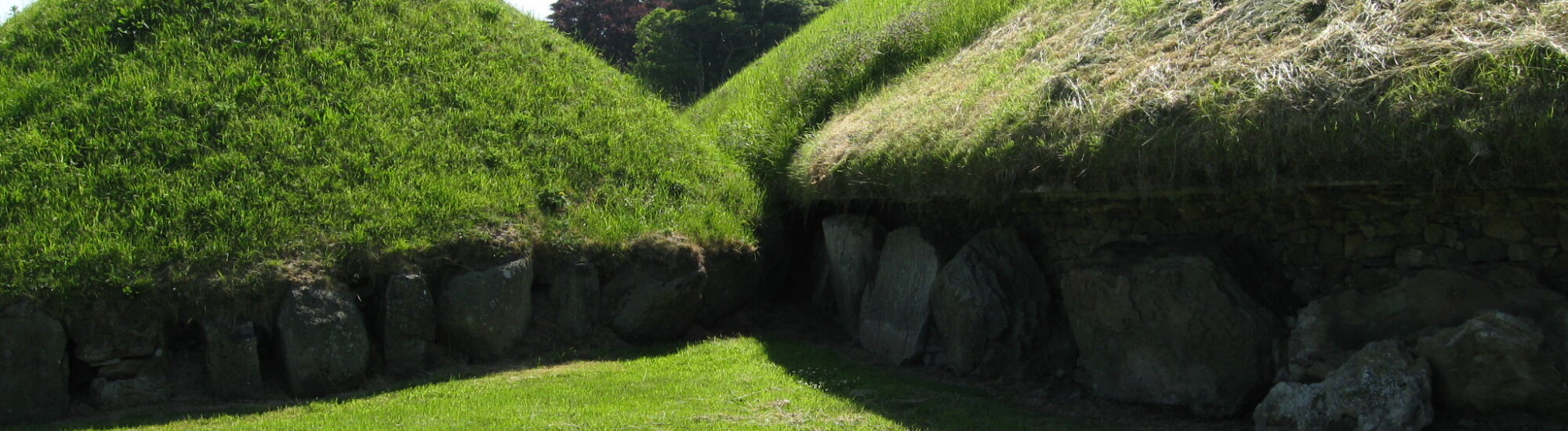
The Dowth tumulus is 90 metres in diameter and 15 metres high. Its structure is essentially made up of carved stone blocks, laid one against the other to form a circular enclosure. The rest of the tomb is topped by a kind of dome made of small stones, sand, gravel, quartz and earth, which was eventually covered with wild grass. (This is why these mounds have not been clearly identified in the past).
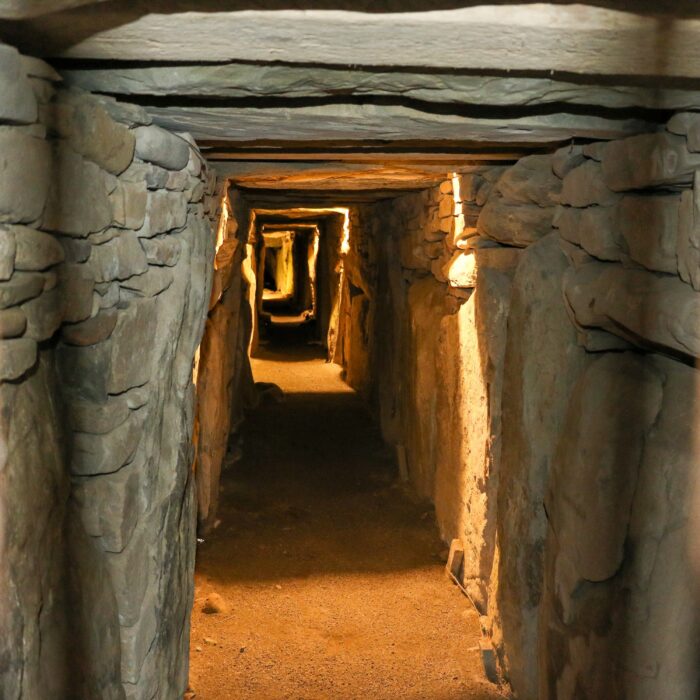
The result is a mound (also known as a tumulus or cairn), with a covered corridor and a western entrance. This corridor, also lined with ashlar, leads to a cruciform chamber.
Unlike Newgrange and Knowth, this room has a roof supported by lintels (not corbels). The walls of this room feature a number of engravings, such as spirals and radial shapes of all kinds… On the right-hand side of the chamber is access to a second chamber, this time L-shaped.
According to archaeological findings, this is the oldest room at Dowth, the first having been added much later. This room is far more devoid of engravings than the first. It does, however, have a huge slab on the floor, which has been dug out and slightly ovalized in depth…
According to some theories, this hollowed-out slab may have served as a receptacle for the bones of the deceased, or some other ritual offering. During the first excavations, remains of bones were found…
Don’t be surprised if, when looking for Dowth, you come face to face with a hill surrounded by stones, with a large oak tree on one of its sides. No, it’s not just a hill, but the archaeological site of Dowth, which has been overgrown over the centuries!
Dowth is a tomb that can be visited in part. You can follow the Visitor Centre’s guide, who will take you on a tour of the tumulus, introduce you to its history, and show you the inside of the tomb corridor.
However, you won’t be able to access the cruciform room, or the second bedroom: their lack of accessibility would require you to use a ladder, and then crawl a few meters to reach the rooms… Faced with this difficulty, access to the rooms is forbidden, and they are protected by impenetrable metal grilles.
But it’s a magical place for lovers of prehistory and megalithic sites. Don’t miss a visit to the site on the winter solstice: sunlight hits the entrance to the tumulus, lighting up the corridor and illuminating 3 stones in the tumulus.
Essential information to help you plan your visit, including key landmarks, access information, and booking options.
Dowth Dubhadh Glebe, Brú na Bóinne, Donore, The Boyne Valley (Brú na Bóinne) National Park, County Meath, Republic of Ireland, Tourist sites in Ireland
53.703875, -6.450358
45 minutes