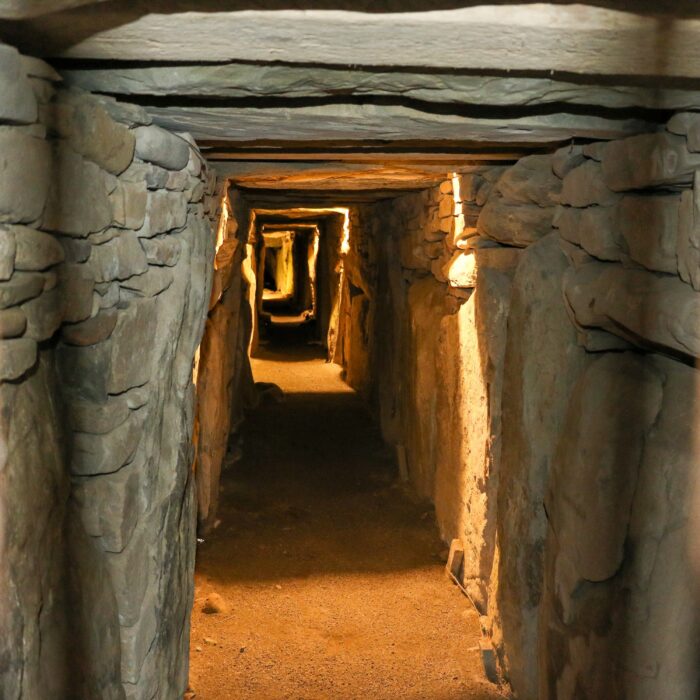
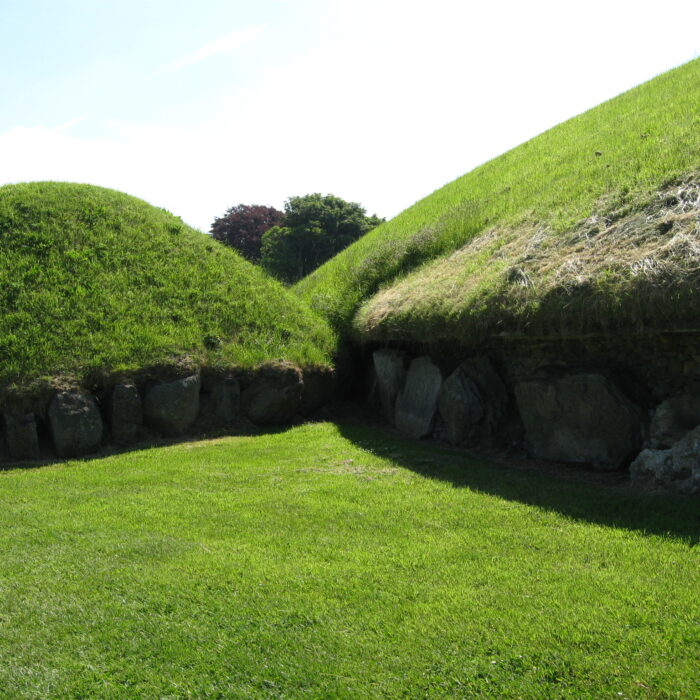
In a bend of the Boyne, immense stone tombs rise from a landscape of meadows and hills. Welcome to Brú na Bóinne, one of Europe’s most spectacular prehistoric complexes. A UNESCO World Heritage Site since 1993, this archaeological site in County Meath includes Newgrange, Knowth and Dowth, three monuments built more than 5,000 years ago.
Older than Stonehenge and the great pyramids of Egypt, Brú na Bóinne is a major site for understanding Neolithic Ireland. Here is what you need to know before visiting this outstanding archaeological landscape.
Brú na Bóinne, a treasure of prehistoric Ireland
A sacred landscape shaped more than 5,000 years ago
Brú na Bóinne lies in the Boyne Valley, near Drogheda and around 45 kilometres north of Dublin. Its Irish name can be translated as “palace of the Boyne” or “dwelling of the Boyne”.
The UNESCO-listed property covers around 780 hectares. Archaeologists have recorded nearly 90 monuments here, including passage tombs, burial mounds, enclosures and numerous carved stones. The three great tombs of Newgrange, Knowth and Dowth are surrounded by around forty smaller funerary monuments.
These structures date mainly from the Neolithic period, when the first farming communities settled permanently in Ireland. Their exact purpose remains debated. They were used to hold funerary deposits, but were probably also places for gathering, ceremony and collective memory.
Why is Brú na Bóinne UNESCO-listed?
An exceptional concentration of megalithic art
Brú na Bóinne contains one of the largest concentrations of megalithic art in Western Europe. Spirals, circles, lozenges, chevrons and wavy lines were carved into many stone blocks. Some patterns are clearly visible, while others are hidden in passages or on stones that are now difficult to access.
These carvings attest to the remarkable skill of Neolithic peoples. The construction of the great tombs also required considerable collective organisation: blocks sometimes brought from several dozen kilometres away had to be transported, assembled and incorporated into structures designed to endure for millennia.
Newgrange, the emblematic monument of Brú na Bóinne
A Neolithic tomb aligned with the winter solstice
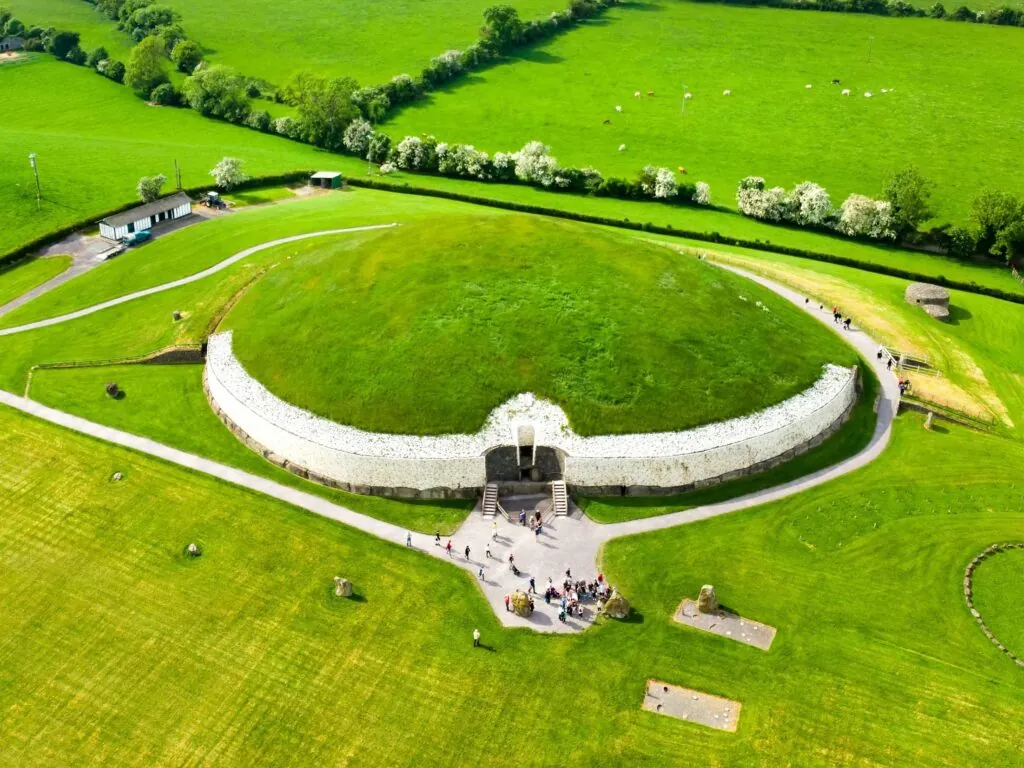
Built around 3200 BCE, Newgrange is the best-known monument at Brú na Bóinne. It predates the Great Pyramid of Giza by around six centuries. Its immense grass-covered mound conceals a narrow passage leading to a cross-shaped central chamber.
Outside, the monument stands out for its reconstructed white quartz façade and its large entrance stone decorated with spirals. But its most fascinating feature is revealed at the winter solstice.
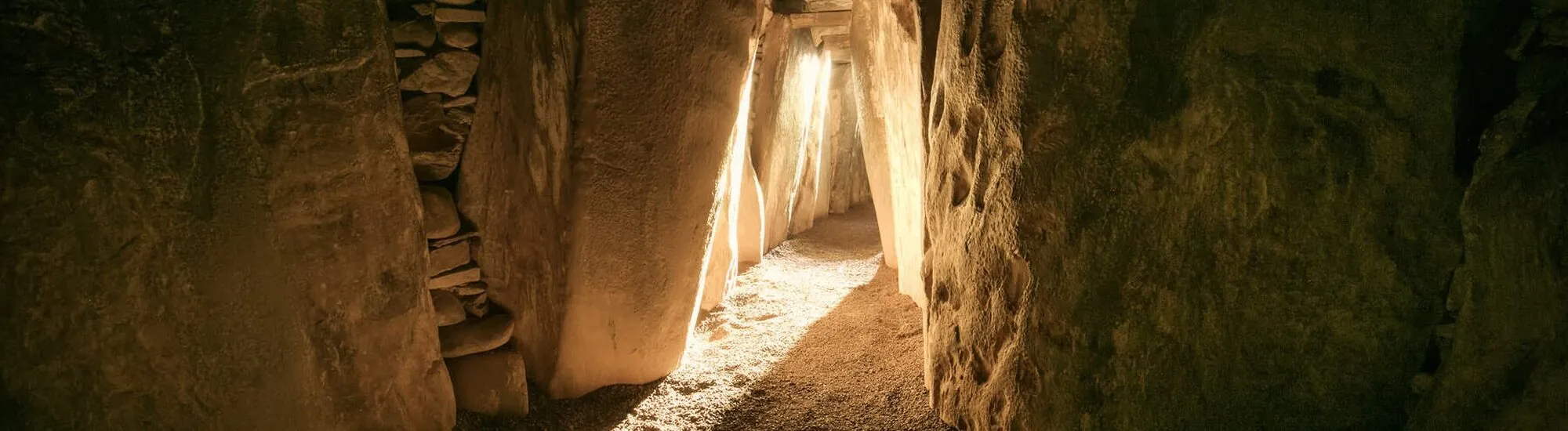
Around 21 December, when weather conditions allow, the first rays of the sun enter through an opening above the entrance. The light travels along the passage before reaching the inner chamber for a few minutes. This alignment shows that its builders had a precise understanding of the sun’s seasonal movement.
Access to the chamber during the solstice is allocated by lottery. During regular visits, however, a light simulation makes it possible to understand the phenomenon.
Knowth, the realm of carved stones
The largest burial mound in the archaeological complex
Knowth is the largest of the great tombs at Brú na Bóinne. Its main mound is surrounded by several satellite monuments and contains two independent passages, oriented approximately east and west.
The site is particularly renowned for its decorated stones. It alone contains a major share of the megalithic art known in Western Europe. The geometric patterns visible around the mound offer a striking glimpse into the symbolic world of Neolithic communities.
Knowth also experienced a long period of occupation after prehistory. The site was reused at different times, notably during the Bronze Age, the early Christian period and the Middle Ages. The inner chambers are not currently open to visitors, but exploring the exterior of the site remains especially rewarding.
Dowth, the third great tomb of the Boyne
A more discreet and still mysterious monument
Dowth completes the trio of great burial mounds at Brú na Bóinne. Less well known than Newgrange and Knowth, it has two funerary passages and several decorated stones. The monument is also associated with the movements of the sun in winter, although its architecture and alignments differ from those of Newgrange.
Dowth is not part of the usual guided tour departing from the visitor centre. Access is more limited and may change. It is therefore recommended that you check official information before going there.
A valley occupied long after the Neolithic period
From prehistoric tombs to the historic sites of the Boyne
Contrary to a widespread belief, Brú na Bóinne did not simply disappear beneath vegetation after prehistory. The landscape continued to be used and transformed for millennia. Archaeologists have found evidence of successive occupations dating back to the Bronze Age, Iron Age and Middle Ages.
The area is also associated with the Battle of the Boyne of 1690. However, the Oldbridge battlefield is not located within the prehistoric complex of Brú na Bóinne. It is a separate historic site a few kilometres away.
Likewise, the Hill of Tara, Ireland’s former royal and ceremonial centre, is not part of Brú na Bóinne. It can nevertheless complement an itinerary devoted to the major historic sites of County Meath.
How do you visit Brú na Bóinne?
The visitor centre, the compulsory starting point
All visits to Newgrange and Knowth begin at the Brú na Bóinne Visitor Centre in Donore. Do not go directly to the monuments: access is organised by shuttle bus and guided tours departing from the centre.
The building offers an exhibition devoted to Neolithic societies, the construction of the tombs, megalithic art and archaeoastronomy. A footbridge then crosses the Boyne before reaching the shuttles.
As tickets are limited, online booking is strongly recommended, particularly at weekends, during school holidays and in the high season. Every participant, including young children, must have a ticket.
Ideally, allow half a day to explore the exhibition and monuments without rushing. Available tours and access may vary depending on the season.
Practical tips for planning your visit
Booking, accessibility and on-site conditions
Address: Brú na Bóinne Visitor Centre, Donore, Drogheda, County Meath, A92 EH5C.
The archaeological site is largely outdoors and offers little shelter. Waterproof clothing and suitable footwear are therefore essential when the weather is uncertain.
The Newgrange passage is low, narrow and relatively dark. This part of the visit may be difficult for people with claustrophobia or mobility issues. Photography is not permitted in the passage or inner chamber.
The visitor centre has parking, toilets, a café, a bookshop and picnic areas. As opening hours and prices vary throughout the year, always check the official website before you leave.
What can you see around Brú na Bóinne?
Extending your exploration in the Boyne Valley
The Boyne Valley is home to several major historic sites. The Battle of the Boyne battlefield at Oldbridge is close by. A little further away, Mellifont Abbey offers the opportunity to discover the remains of the first great Cistercian monastery founded in Ireland.
The Hill of Tara is another unmissable excursion. The former symbolic seat of Ireland’s High Kings, it offers a remarkable panorama over the landscapes of County Meath. These sites are separate from Brú na Bóinne, but together they make it possible to travel through several millennia of Irish history in a single region.
Frequently asked questions about Brú na Bóinne
Useful answers before you go
Is Newgrange older than the pyramids of Egypt?
Yes. Newgrange was built around 3200 BCE, approximately six centuries before the Great Pyramid of Giza.
Can you visit Newgrange without booking?
Places are limited and advance booking is strongly advised. Access to Newgrange and Knowth is only available as part of organised tours from the visitor centre.
Is the Hill of Tara part of Brú na Bóinne?
No. Tara is a separate archaeological site located elsewhere in County Meath. The principal monuments of Brú na Bóinne are Newgrange, Knowth and Dowth.

 +
+
 Tourist attractions
 Irish Restaurants and Pubs
 Partner Accommodations
 Campgrounds and Lodging