Reservations are recommended

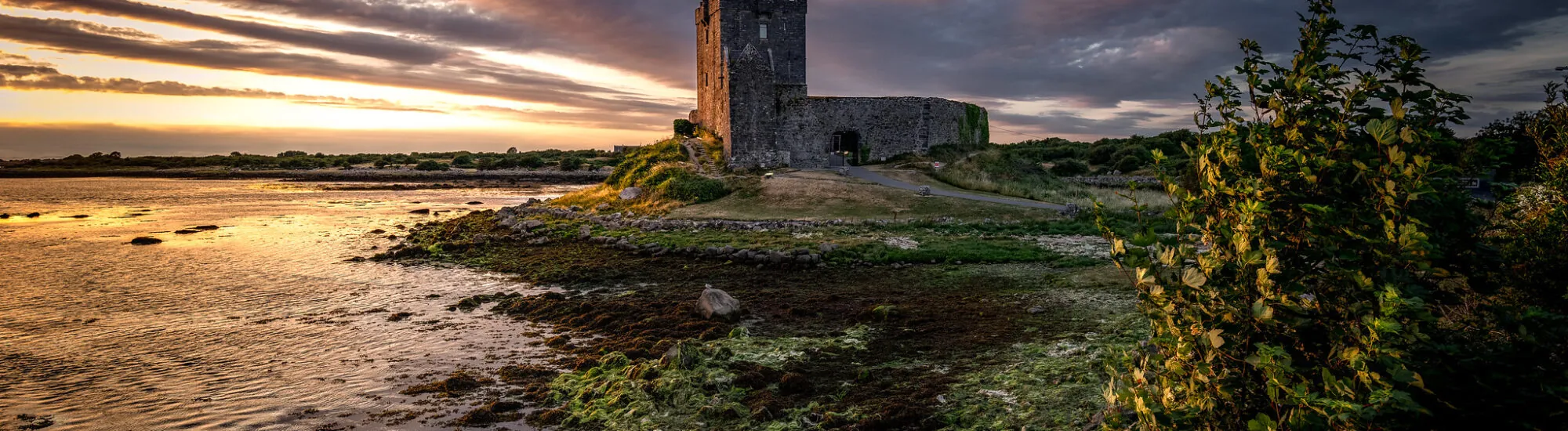
Standing on a rocky promontory on the shores of Galway Bay, Dunguaire Castle is one of Ireland’s most photographed castles. Its tall stone tower, fortified enclosure and the waters that surround it at high tide create an iconic west coast scene, just a short walk from the village of Kinvara.
Built in the 16th century, this tower house is also associated with the Irish literary revival of the early 20th century. Its owner at the time, Oliver St John Gogarty, welcomed several leading figures from Irish cultural life here. The castle later hosted visits and banquets inspired by the country’s history and traditions.
In 2026, Dunguaire Castle remains temporarily closed to the public. The interior of the tower and the banquets are therefore not accessible, but the monument can still be admired from the surrounding areas open to the public.
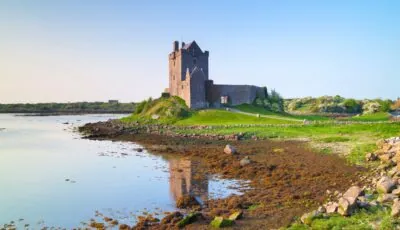
Dunguaire Castle – © kwiatek7
Dunguaire Castle stands on the south-eastern shore of Galway Bay, around one kilometre from the centre of Kinvara. It marks the transition between the green landscapes of County Galway and the limestone plateaux of the Burren, which begin further south.
The building belongs to the family of tower houses, fortified residences built in Ireland between the 15th and 17th centuries. They served as homes, symbols of power and defensive structures for influential families of the period.
Dunguaire Castle consists of a rectangular tower around 23 metres high, surrounded by an enclosing wall known as a bawn. Despite its modest size, the castle cuts a striking silhouette against the broad expanse of the bay.
The character of the site changes with the tides. As the water rises, the promontory appears almost isolated in Galway Bay. At low tide, the foreshore is exposed, revealing a more mineral landscape. This constant transformation partly explains the castle’s appeal to photographers.
Dunguaire Castle was built around 1520 for the O’Hynes, or Ó hEidhin, clan, once powerful in this part of southern County Galway. However, the available documents do not make it possible to trace every stage of its construction and early occupation with certainty.
The castle takes its name from the Irish Dún Guaire, generally translated as “Guaire’s fort”. It refers to Guaire Aidne mac Colmáin, King of Connacht in the 7th century and an important figure in medieval Irish tales.
According to tradition, the castle was built close to an earlier fortified site associated with this ruler. Nothing, however, establishes that a royal palace stood exactly beneath the present tower house. The connection between the monument and King Guaire therefore rests more on local memory and literary tradition than on formal archaeological evidence.
Guaire Aidne mac Colmáin has remained in Irish tradition as a ruler of exceptional generosity. Several accounts describe him offering food and hospitality to the poor, travellers, artists and passing poets.
This reputation has profoundly shaped the identity of Dunguaire Castle. It notably inspired the banquets held at the castle several centuries later, although these were more a cultural evocation than a faithful historical reconstruction.
A local legend also holds that anyone who came to ask a question at the castle gate would receive an answer before the end of the day. This belief belongs to the folklore surrounding Dunguaire, but it still contributes to the site’s mysterious atmosphere.
In the 17th century, Dunguaire Castle passed into the hands of the Martyn family, one of the fourteen merchant families traditionally known as the “Tribes of Galway”.
Richard Martyn, who served among other roles as Mayor of Galway, lived in the tower until 1642. The family retained the estate for several generations before moving into a more comfortable house built nearby.
Like many Irish tower houses that had become unsuited to changing ways of life, Dunguaire gradually lost its residential role. Neglected, the building fell into disrepair until restoration work began in the 20th century.
In 1924, the castle was bought by Oliver St John Gogarty, an Irish surgeon, poet, writer and politician. A friend of James Joyce in his youth, Gogarty partly inspired the character of Buck Mulligan in the novel Ulysses.
He set about restoring Dunguaire Castle and turned the residence into a popular meeting place for writers and artists. William Butler Yeats, George Bernard Shaw, Lady Gregory and George William Russell, known as AE, were among the figures associated with this cultural circle.
The castle was then part of an area deeply connected to the Irish literary revival. Not far from Kinvara, Lady Gregory welcomed numerous authors to Coole Park, while Dublin’s Abbey Theatre contributed to the emergence of a national theatrical and literary identity.
In 1954, Dunguaire Castle was acquired by Christobel, Lady Ampthill, who continued the restoration begun by Gogarty. The monument later became the property of Shannon Development, before being run as a heritage attraction by Shannon Heritage.
In 2026, the interior of Dunguaire Castle remains closed. Tours of the tower and banquets are not being offered during this transition period in the management of the monument.
The castle nevertheless remains genuinely worthwhile from the outside. Its silhouette can be seen from accessible surrounding areas and from various viewpoints around the bay. Visitors must observe barriers, signage and any restrictions in place around the property.
Even without entering the tower, Dunguaire makes an interesting stop on the route between Galway and the Burren. Its proximity to Kinvara makes it easy to include in an exploration of the village and the Galway Bay coastline.
As the situation may change, it is advisable to check the monument’s status before making a journey specifically to visit it.
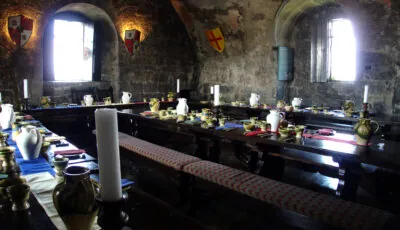
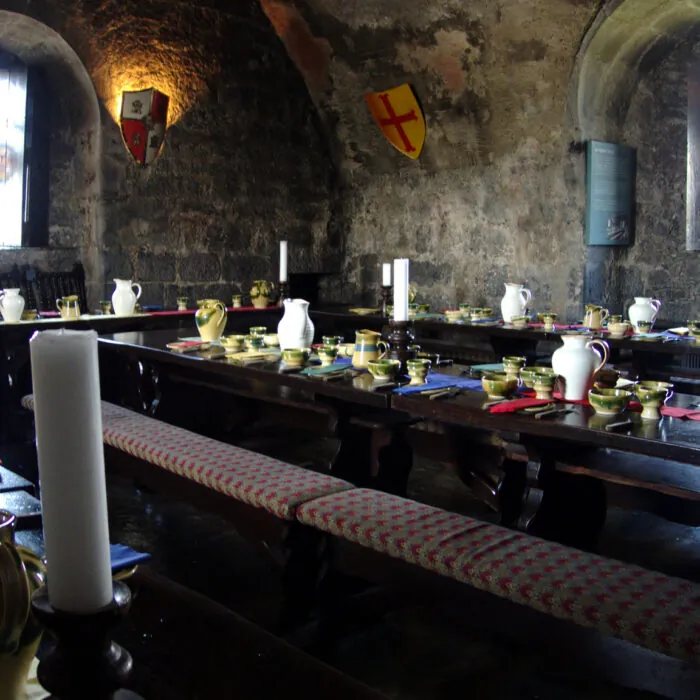
Former Dunguaire Castle banquet – dmerino13 – CC BY-ND 2.0
Before its temporary closure, Dunguaire Castle was known for the banquets held during the tourist season. Participants shared a dinner accompanied by music, storytelling, poetry and extracts from Irish literary works.
These evenings did not seek to reproduce a 16th-century meal exactly. Instead, they offered a theatrical evocation of the hospitality attributed to King Guaire, while celebrating oral traditions and great Irish authors.
The banquets are currently suspended. Any possible return will depend on the reopening of the monument and decisions made by its future management team.
Dunguaire Castle can be photographed from several viewpoints around the bay and along authorised access routes. Morning light brings out the grey tones of the stone, while the end of the day often gives the landscape warmer hues.
The tide plays an essential role in composing photographs. At high tide, the water heightens the impression of the castle’s isolation. At low tide, the exposed foreshore creates a rawer atmosphere and brings out the rocky base of the promontory. In calm weather, the tower may also be reflected in the waters of Galway Bay.
The rapid weather changes typical of western Ireland can produce very different atmospheres within minutes. A bright spell after a shower can cast particularly dramatic light over the bay.
Care remains essential around the site. Use only authorised locations, do not park on the road and never block an entrance to take a photograph.
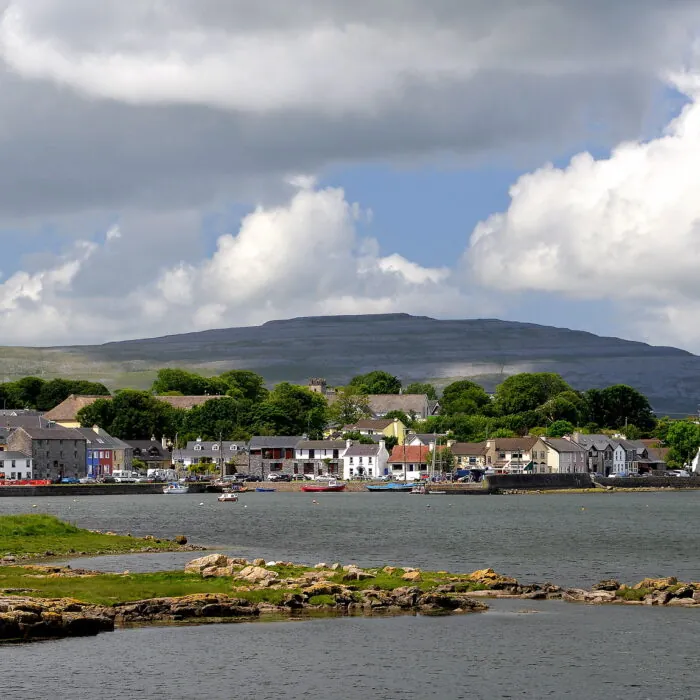
A visit to Dunguaire Castle can be followed by a stroll through Kinvara. This small harbour village is appreciated for its colourful houses, pubs, restaurants and traditional harbour. Galway Hookers, old working sailing boats characteristic of the region, can sometimes be seen there.
The castle also stands at the gateway to the Burren, a vast area known for its limestone plateaux, archaeological remains and remarkable flora. Continuing south, the road leads in particular to Ballyvaughan, Aillwee Burren Experience and Poulnabrone Dolmen.
The coastal road along Galway Bay offers numerous views across the shoreline. It provides a beautiful link between Kinvara, the Burren’s uplands and the wild landscapes of northern County Clare.
Essential information to help you plan your visit, including key landmarks, access information, and booking options.
53.142249, -8.926104
1 heure
No reopening date has yet been officially announced. It is recommended that you check the situation before travelling.
Check the opening hours and admission requirements before you leave, especially during peak season or on Irish public holidays.
Compare tickets, guided tours, and excursions available through our partner platforms.