

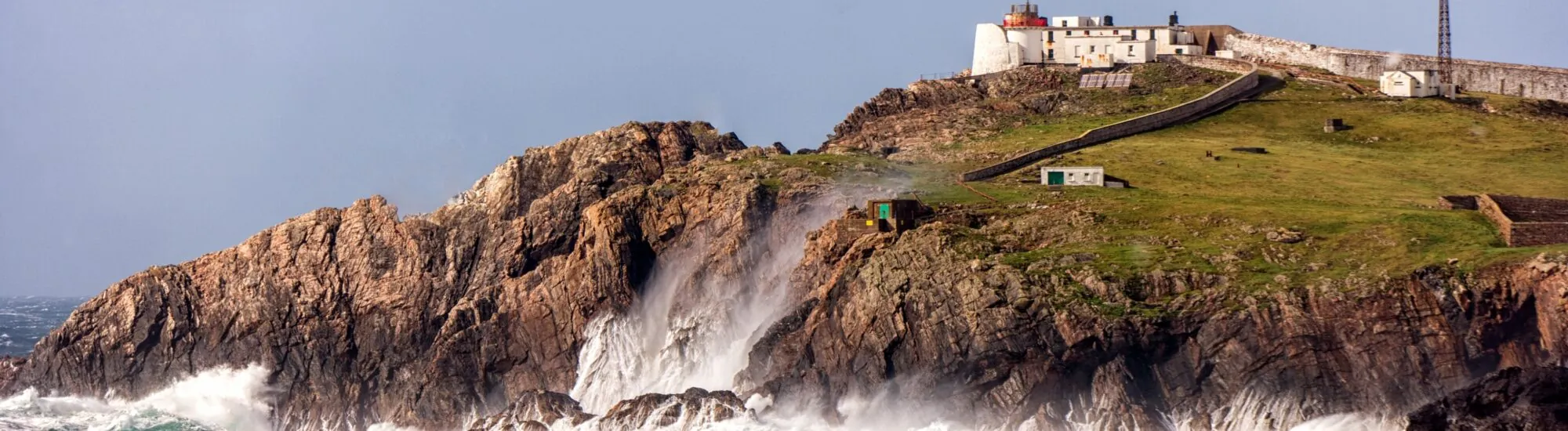
Off the northern tip of the Mullet Peninsula in County Mayo, Eagle Island Lighthouse stands on a rocky islet exposed to the Atlantic. From afar, a white tower can be seen alongside the truncated outline of a second lighthouse. Together, they tell an unusual story: that of a maritime station where storms repeatedly forced rebuilding, reinforcement and, ultimately, a rethink of how the coast was lit.
The site is as compelling for its isolation as for the stories of its keepers. For travellers, however, one detail changes how a visit must be planned: Eagle Island is not a lighthouse with regular public visits. It is best seen from the peninsula, with binoculars and good visibility. The landscape alone is more than rewarding.
In 1830, requests from the coastguard led to a study into installing a new light in this area. The engineer George Halpin selected Eagle Island. Two towers were built around 120 metres apart, their lanterns set at the same level despite the differing heights of the buildings. Both lights were first lit on 29 September 1835.
Their alignment provided a bearing for vessels navigating between Blacksod Bay and Broadhaven. Even during construction, the sea demonstrated the difficulty of the undertaking, carrying away part of the works and materials. A substantial protective wall was built to defend the installations.
On 29 December 1894, a storm severely damaged the eastern station’s accommodation and shattered the windows of its lantern. The families took refuge in the tower before the women and children were evacuated. The eastern light was permanently discontinued in 1895, in favour of the western lighthouse. Its tower was lowered so that it would not obscure the light of its neighbour.
This remnant remains essential to understanding today’s landscape. The National Inventory of Architectural Heritage lists the former eastern tower, now reduced to a masonry shell, separately from the western tower, which remains in use. What you see, then, is not simply a lighthouse beside an arbitrary ruin, but the two components of a maritime system once designed to work together.
The western tower retains the characteristics of a 19th-century structure: a circular plan, a gently tapering profile and masonry intended to withstand a particularly harsh environment. Heritage surveys also document its internal granite staircase. These details are not accessible on an ordinary sightseeing trip, but they offer an idea of the quality of work carried out on such an isolated rock.
The keepers continued to operate the station for much of the 20th century. Then came automation, on 31 March 1988. An RTÉ report broadcast the following day shows Billy Heneghan, Dillon McCarthy and Mick Barry leaving their workplace. Behind the technical change lay the end of a daily routine of shift changes, maintenance and watching the sea.
The lighthouse did not go dark, however. It remains an aid to navigation. Its significance therefore extends beyond heritage: Eagle Island continues to fulfil the role for which the first buildings were erected on the islet.
In 2013, Irish Lights undertook a particularly delicate operation: replacing the entire upper section of the lighthouse. The old lantern, its dome and the optical apparatus were removed. A stainless-steel structure, designed for this marine environment, took their place with the help of a helicopter.
The new system combines LED lights with solar power and batteries. This is why some older photographs show a different silhouette from that of the lighthouse today. The account of the works published by Irish Lights conveys the challenge of maintaining such an installation, far from conventional road access and scaffolding.
To catch sight of Eagle Island without arranging a trip out to sea, head for Annagh Head, or Ceann an Eanaigh, on the Mullet Peninsula. This headland looks north towards Eagle Island and south towards Inishglora. Free parking is indicated here by the national tourism office; then follow the designated paths on site.
You will be looking at an offshore islet, not a tower a few steps from the car park. Binoculars make a real difference when it comes to picking out the buildings. Without them, the stop is chiefly about the coastal panorama, the expanse of ocean and the changing light on the rocks. Sea mist can conceal the lighthouse even when the sky appears fairly bright.
Allow around 30 to 45 minutes for an observation stop at Annagh Head, longer if you wish to photograph the landscape. This is a planning suggestion for viewing from the coast; it is not the duration of a visit to the island.
Do not plan on a tourist landing or entry to the lighthouse. There are no advertised regular public visits allowing you to book a climb up the tower. The station’s GPS coordinates identify maritime equipment on an island; they do not provide an access route for visitors.
If you are considering a boat trip in the area, ask the operator specifically whether its route goes near Eagle Island, how close it comes and under what weather conditions. A trip to other Erris islands does not necessarily include this lighthouse. Nor should you confuse passing offshore with permission to land. The decision to sail and the route remain the responsibility of the professional.
Visibility matters more than the season. Look for a clear day with little wind rather than dramatic weather. Accounts of waves reaching the installations are not an invitation to watch a storm from the cliff edge.
To photograph the lighthouse from land, bring a telephoto lens if you have one. A wider view can also work very well, retaining the rocks and ocean that give the station its sense of scale. Clean your camera lens regularly, as sea spray can leave a fine film on the glass.
Wear a windproof jacket and footwear suited to the terrain. Stay on designated paths, well back from the edges, and keep children close to you. In strong gusts, postpone your stop. If you have reduced mobility, check local conditions at the viewpoint: the presence of a car park does not guarantee a fully accessible route.
Belmullet is a practical base for exploring the peninsula, taking a break and organising the day’s travel. Keep your plans flexible: a change in the light can make the view worthwhile, while persistent fog may lead you to favour another stop.
To go inside a lighthouse and hear stories of the region sheltered from the elements, Blacksod Lighthouse, south of the peninsula, offers a complementary experience, with guided visits according to its schedule. Eagle Island is discovered differently: at a distance, with the Atlantic between you and the buildings that withstand it.
Want to extend your visit without having to rush around? Here are a few well-located places to stay near the must-see attractions.
Essential information to help you plan your visit, including key landmarks, access information, and booking options.
Eagle Island, au large du nord de la péninsule de Mullet, Erris, Co. Mayo, Irlande. Observation depuis Annagh Head ; coordonnées du phare, pas du parking., County Mayo, Republic of Ireland, Tourist sites in Ireland
54.2837, -10.0927333
Lighthouse and island: no regular public visits are advertised. For viewing from Annagh Head, choose daylight hours, good visibility and calm weather, while following local signage. This outdoor stop does not mean the lighthouse is open 24 hours a day. Do not visit in strong gusts or during a weather warning.
Check the opening hours and admission requirements before you leave, especially during peak season or on Irish public holidays.
Free viewing from Annagh Head, where free parking is indicated by the national tourism office. This does not include entry to Eagle Island. No regular public lighthouse ticketing is advertised. Any boat excursion must be booked separately with an operator, with route and prices to be confirmed.