

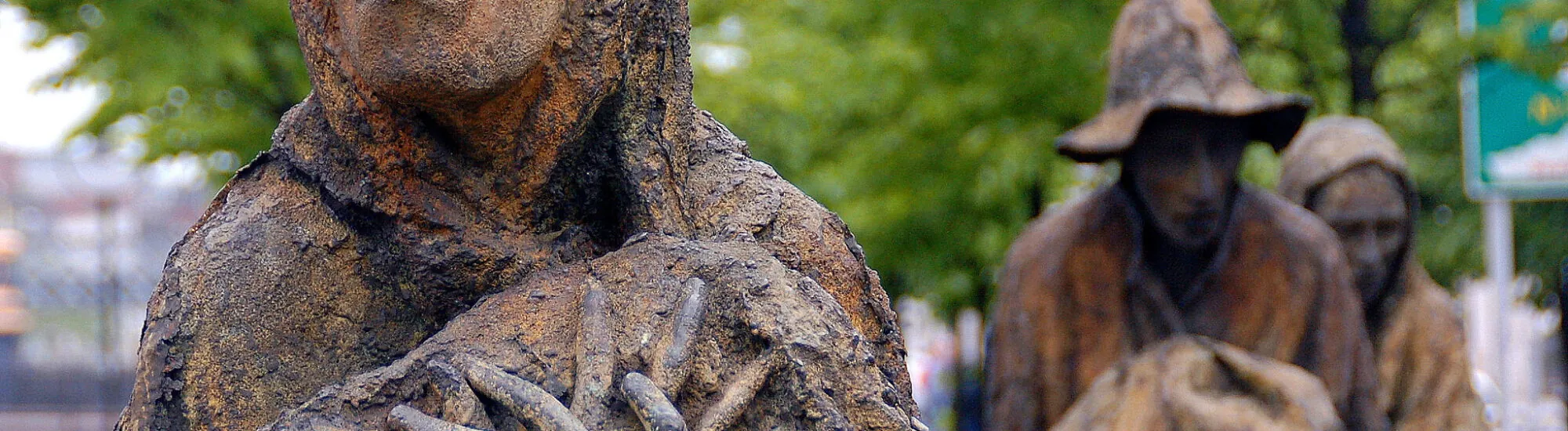
On the banks of the Liffey, seven emaciated figures walk silently towards Dublin Port. Clutching their luggage to their bodies, with hollow faces and tattered clothes, they seem still to be waiting for the ship that will take them away from an Ireland ravaged by hunger.
Officially entitled Famine, but better known as the Famine Memorial or Famine Sculptures, this work by Rowan Gillespie is among Dublin’s most moving monuments. It commemorates not only those who died during the Irish Great Famine, but also the hundreds of thousands of women, men and children forced to leave their country in an attempt to survive.
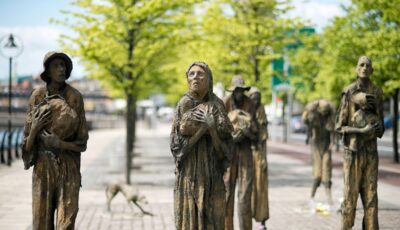
Great Famine Memorial, Dublin – PROSPER MBEMBA KOUTIHOU – Pexels
The Famine Memorial stands on Custom House Quay, in the Docklands, on the north bank of the Liffey. The sculptures are a few minutes from the Custom House, between Dublin’s historic centre and its former port districts.
The memorial can be accessed directly from the public promenade. There is no visitor centre, entrance or prescribed route. Visitors can walk among the figures and view them from several angles.
This arrangement almost creates the feeling of joining the procession. The statues do not stand on a monumental plinth or behind a barrier: they occupy the same space as passers-by, on the quay’s paving stones. This closeness greatly enhances their evocative power.
The group comprises seven figures, each slightly larger than life. Men, women and children are depicted in a state of extreme exhaustion. Some carry bags or meagre belongings, while one man bears a child on his shoulders.
They are not portraits of identifiable individuals. Each figure more broadly embodies the victims of hunger, disease, poverty and forced displacement. Their walk towards the port recalls departures for Great Britain, North America and other places across the Irish diaspora.
The bronze surface is deliberately rough and uneven. The bodies are elongated, the limbs appear fragile, and the clothes seem to merge into the flesh. Rowan Gillespie uses this troubled material to convey a sense of cold, fatigue and vulnerability.
The memorial does not seek to recount a specific scene or explain every cause of the famine. Instead, it focuses on the human experience: hunger, loss, exile and the uncertainty of the journey ahead.
The Great Famine, known in Irish as An Gorta Mór, began in 1845 when a disease destroyed much of the potato crop. A significant part of the rural population depended on this crop for their daily food.
Potato disease triggered the crisis, but its consequences were worsened by poverty, land ownership arrangements, evictions and inadequate relief policies. Hunger was quickly accompanied by epidemics, notably fever and dysentery.
Between 1845 and 1852, more than one million people died and more than one million others left Ireland. This demographic rupture permanently transformed the country, its society and its relationship with the rest of the world.
The choice of Custom House Quay was not merely aesthetic. During the famine, this stretch of the quays was one of the departure points for people leaving Dublin by ship.
On 17 March 1846, St Patrick’s Day, the Perseverance sailed from Custom House Quay with 210 passengers. The ship was commanded by William Scott, an experienced captain then aged 74. The travellers reached New York on 18 May 1846 and, remarkably for a crossing of that period, every passenger and crew member survived the voyage.
The memorial’s figures do not specifically represent the passengers of the Perseverance. Their progress towards the port nevertheless evokes those departures, along with the countless journeys undertaken in the years that followed.
The memorial was created by Rowan Gillespie, a Dublin sculptor known for his elongated, expressive human figures. The work was commissioned by Norma Smurfit and then presented to the Irish people to mark the 150th anniversary of the famine.
The Famine Memorial was unveiled on 29 May 1997 by Mary Robinson, then President of Ireland. A plaque near the statues records the date of the unveiling and reproduces an account published in 1854, describing a procession struggling along the river towards the Custom House.
The work was originally conceived without a specific location. Its installation on the quays nevertheless gave it particular power: the figures appear to move through a landscape that truly was one of waiting and departure.
In 2007, Rowan Gillespie created a complementary group for Ireland Park on Toronto’s waterfront. While Dublin’s seven figures represent departure, the five figures installed in Canada evoke the arrival of Irish migrants.
The difference between the two groups symbolises those who died during the Atlantic crossing, in quarantine stations or soon after arriving. The works thus create an artistic link between Dublin’s quays and those of Toronto.
This extension gives the Famine Memorial an international dimension. The Dublin sculpture no longer tells only of the loss of part of the population: it also evokes the birth of a diaspora now present in many countries.
Fifteen minutes is enough to observe the sculptures and read the plaques, but it is worth allowing more time if you wish to continue your walk along the quays.
The memorial stands in a paved, largely level area. It can normally be approached by wheelchair or with a pushchair, although pedestrian traffic, cycle lanes and any urban works may occasionally obstruct passage.
Photography is permitted. The commemorative nature of the site nevertheless calls for a degree of restraint: avoid climbing on the sculptures, using them as props or disturbing those who come to pay their respects.
The site is easily reached on foot from central Dublin. The Luas stops at George’s Dock and Busáras, as well as Connolly Station, are also nearby.
A few steps from the memorial, the Jeanie Johnston Tall Ship & Famine Museum explores the conditions in which emigrants crossed the Atlantic in the 19th century. A visit makes a particularly relevant complement to the memorial.
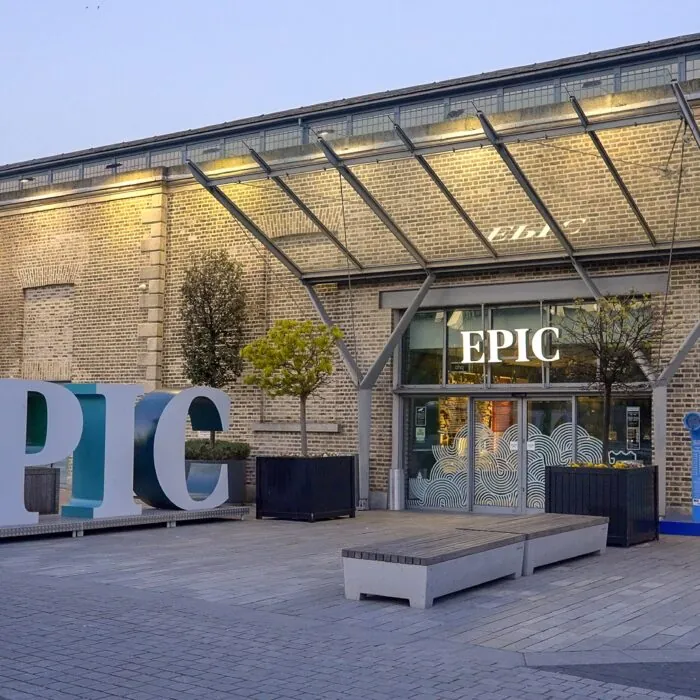
Housed in the vaults of CHQ, the EPIC The Irish Emigration Museum takes a broader look at the history of emigration and the influence of the Irish diaspora around the world.
To the east of the sculptures stands the World Poverty Stone, a work by Stuart McGrath installed in 1987. This commemorative stone is associated with the International Day for the Eradication of Poverty, held each year on 17 October.
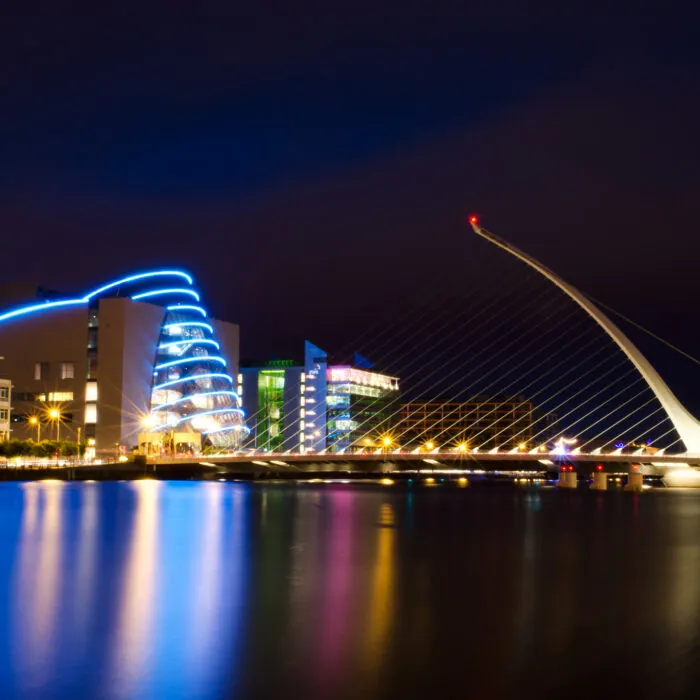
The walk can then continue towards the Samuel Beckett Bridge and the contemporary buildings of the Dublin Docklands.
Information on the commission, location and voyage of the Perseverance comes from Dublin City Council and the official Rowan Gillespie website. The number and characteristics of the figures are documented by Sculpture Dublin. Historical figures are drawn from data published by the Irish Government.
Essential information to help you plan your visit, including key landmarks, access information, and booking options.
1 Custom House Quay, North Dock, Docklands District, Dublin, County Dublin, Republic of Ireland, Tourist sites in Ireland
53.348061, -6.250068
15 minutes