Reservations are recommended

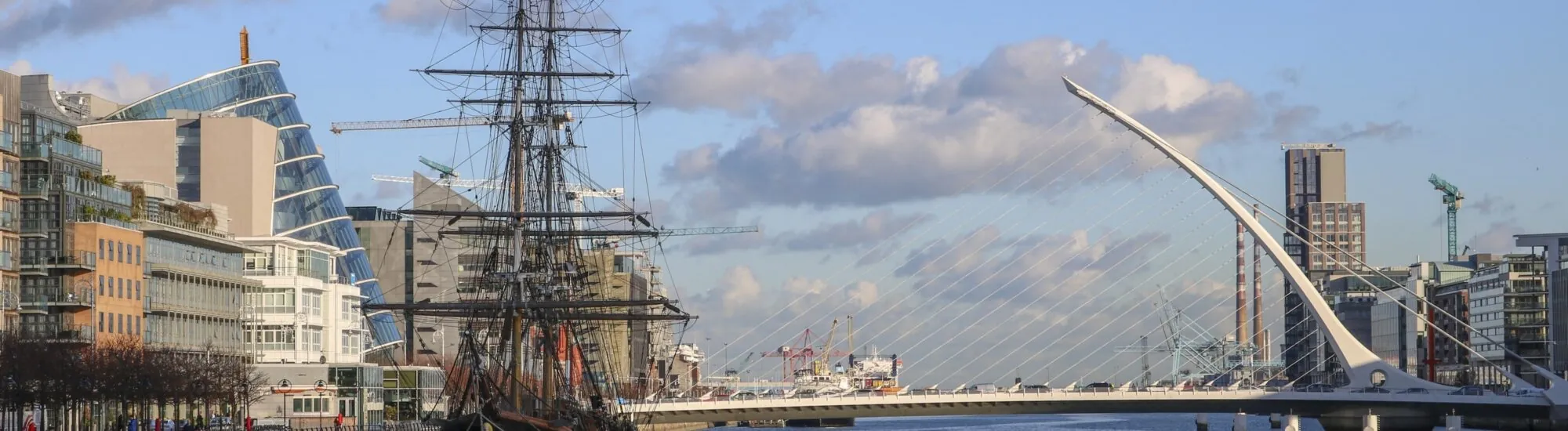
Moored along the Liffey quays, in the heart of Dublin’s Docklands, the Jeanie Johnston looks ready to set sail again. Yet its three masts, wooden deck and dark hull evoke a voyage far removed from a leisurely cruise: that of the thousands of Irish people who crossed the Atlantic in the 19th century to escape the Great Famine.
The ship seen today is a replica of the original Jeanie Johnston, a three-masted vessel built in Quebec in 1847. Between 1848 and 1855, it carried around 2,500 Irish emigrants to North America. Despite gruelling crossings, no passenger died on board: an exceptional record at a time when some emigrant ships tragically earned the nickname ‘coffin ships’.
Now a museum ship, the Jeanie Johnston offers a guided tour of its deck and reconstructed steerage area. Through the lives of real passengers, it tells the story of famine, exile and the hope of a new life across the Atlantic.
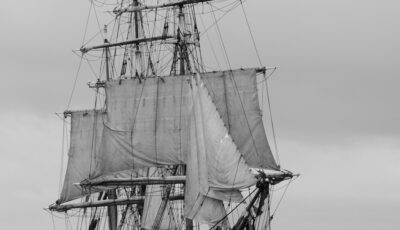
The Jeanie Johnston – wrobell – cc
The tour begins on the upper deck, facing the contemporary buildings of the Docklands. The contrast is striking: modern Dublin surrounds the sailing ship, while the guide takes visitors back to the mid-19th century, when famine drove entire families to leave their homeland.
The route continues below deck. This low, dark and confined space has been reconstructed to show the conditions in which emigrants travelled. Narrow bunks line the walls, while life-size figures represent several of the ship’s passengers.
The visit is guided only and lasts around 50 minutes. Rather than relying on a collection of objects, the tour is built around human stories. It gives names, ages and faces to those who made the crossing.
The original Jeanie Johnston was built in 1847 in Quebec, Canada. It was a 408-tonne three-masted merchant vessel, originally designed to carry goods rather than passengers.
The ship was purchased by the Donovan family, merchants based in Tralee, County Kerry. Their business relied on trade between Ireland and North America: emigrants travelled west, while the vessel carried timber and other goods on its return journey.
Its first passenger voyage left Tralee in spring 1848. Ireland was then experiencing one of the worst disasters in its history. For shipowners, emigration became a profitable business; for passengers, it was often their only chance of survival.
The Great Famine struck Ireland from 1845 onwards. Potato blight destroyed several successive potato crops, a staple food for much of the rural population.
Crop disease alone, however, does not explain the scale of the catastrophe. Poverty, the dependence of small farmers, evictions and the policy decisions of the British government all worsened the crisis. Even as the population starved, foodstuffs continued to be exported from Ireland.
More than one million people died as a result of famine, disease and economic collapse. More than one million others left the country during the worst years, mainly for Great Britain and North America. Emigration then continued for several decades, permanently transforming the island’s demographics.
Many of the ships used to carry emigrants had originally been simple merchant vessels. Their holds were rudimentarily fitted out to accommodate as many passengers as possible, often without sufficient space, ventilation or sanitation.
Travellers spent several weeks in a damp, poorly lit steerage area filled with odours. Families had to bring some of their own food, prepare meals in difficult conditions and share an extremely limited space.
Typhus, dysentery, cholera and malnutrition could spread very quickly. The bodies of passengers who died during the crossing were generally wrapped in cloth or canvas before being committed to the sea.
These ships became known as coffin ships. Not all had the same mortality rate, and estimates varied considerably from one voyage to another. It is therefore inaccurate to claim that every crossing systematically resulted in the deaths of 25 to 50% of passengers. Some were relatively safe; others became genuine public health disasters.
Between 1848 and 1855, the Jeanie Johnston made 16 transatlantic crossings and carried around 2,500 emigrants. No passenger died during these voyages, an exceptional outcome given the health conditions of the time.
This success is attributed in particular to Captain James Attridge. An experienced seaman, he ensured that his ship was not excessively overcrowded and imposed stricter hygiene rules than those observed on many contemporary vessels.
The presence of Dr Richard Blennerhassett was also decisive. This qualified doctor monitored passengers’ health, isolated the sick when necessary and sought to limit the spread of infections.
The ship also benefited from better ventilation and relatively strict health discipline. This did not mean the journey was comfortable: cold, overcrowding, seasickness and uncertainty remained ever-present. But these precautions considerably increased the chances of survival.
During the inaugural crossing of 1848, Margaret Ryal boarded in Tralee with her husband Daniel while pregnant. She gave birth to a boy in the middle of the Atlantic, assisted by Dr Blennerhassett.
The child was named Nicholas Johnston after the ship’s owner. His birth became one of the most famous stories associated with the vessel and further reinforced its singular record: not only did no passenger die during the emigrant crossings, but a new life began on board.
The reconstruction below deck allows visitors to discover Margaret’s journey and those of several other travellers. This narrative approach gives the museum a particularly powerful human dimension.
The Jeanie Johnston does not portray emigrants as an anonymous crowd. The tour follows several people identified through passenger lists and historical research.
They include Patrick Kearney, a 23-year-old farm labourer who left to seek a better life in Baltimore, and Ellen Mahony, who travelled with her children in an attempt to find her husband, who had emigrated three years earlier.
The tour also tells the story of Margaret and John, two orphans aged 15 and 12 who made the crossing alone in 1851. Their presence is a reminder that some children travelled without their parents, entrusted to relatives or forced to fend for themselves once they arrived in America.
These lives highlight the different faces of emigration. Some left alone before sending money home to their families. Others travelled on tickets prepaid by relatives already settled across the Atlantic. The poorest could benefit from a departure funded by a landlord, a local institution or a workhouse.
On board a sailing ship, the length of the journey depended entirely on the winds and sea conditions. A crossing to Canada or the United States could take six to eight weeks, sometimes longer when conditions were unfavourable.
Passengers on the Jeanie Johnston travelled mainly to Quebec, but the ship also sailed to Baltimore and New York. Once in Canada, some continued onwards to Montreal, Ontario or the United States.
Arrival did not always mark the end of their ordeal. Sick travellers could be placed in quarantine, notably at Grosse-Île, in the St Lawrence River. Those admitted to the country then had to find accommodation and work in an unfamiliar land, sometimes unable to read or speak English fluently.
After its emigrant voyages, the Jeanie Johnston was sold in 1858 and returned to carrying goods. That same year, while sailing between Hull and Quebec with a cargo of timber, the ship began taking on water.
The timber stored on deck gradually became waterlogged, dangerously weighing down the vessel. The Jeanie Johnston slowly sank, forcing crew members to take refuge in the rigging and tie themselves to the ropes.
They survived there for nine days before being rescued by the Dutch ship Sophie Elizabeth. The Jeanie Johnston sank in the Atlantic, but its remarkable record remained intact: no lives were lost on its final voyage.
The vessel moored in Dublin is not the original ship, which was lost in 1858. It is a replica built in Tralee to commemorate the Great Famine and the history of Irish emigration.
Its construction used traditional techniques and involved shipwrights from several countries. The new Jeanie Johnston was launched in May 2000.
Far from being simply a hull intended to remain at the quayside, it did indeed sail. Between 2002 and 2008, the vessel travelled to Great Britain, France, Spain, Canada and the United States, among other destinations. These voyages strengthened its maritime credibility and its role as an ambassador for Irish memory.
The ship is now berthed at Custom House Quay in Dublin’s Docklands, where it welcomes visitors throughout the year.
On deck, the guide introduces the structure of the three-masted vessel, sailing conditions and the context of the Great Famine. This first part also offers a fine view of the Liffey, the Custom House and the contemporary Docklands buildings.
The descent below deck is the most evocative part of the visit. The bunks, meagre luggage and passenger figures give a tangible sense of the cramped conditions. The present-day space remains a museum reconstruction, however: actual conditions on board the original ship were darker, noisier and far less comfortable.
The guide then tells the passengers’ stories, explains the crew’s role and outlines the measures that helped prevent deaths. Spoken interpretation is central to the experience, so this is not an exhibition to explore freely at your own pace.
Regular tours are conducted in English. The vocabulary used is generally accessible, but a basic understanding of the language is recommended to make the most of the stories and historical explanations.
The settings and reconstructions nevertheless make it possible to grasp the main points of the tour. French-speaking visitors can also read about the Great Famine before visiting to better place the individual stories in context.
Online booking is recommended, particularly at weekends, during school holidays and in peak season. The number of participants is limited by the layout of the ship.
The tour may suit families and children old enough to follow a guided story. The ship, masts, bunks and reconstructed figures make the history more tangible than a traditional exhibition.
The subject remains serious, however. Famine, disease, poverty and family separation are discussed openly. The guide generally adapts the narrative to the audience, but parents may need to answer younger children’s questions.
At around 50 minutes, the tour is short enough to avoid becoming too long. The stairs and narrow passages nevertheless require a degree of care with young children.
Access to the ship is via a gangway whose incline may vary according to the level of the Liffey. The visit also includes a descent below deck.
Because of the ship’s structure, certain areas may be difficult to access for people with reduced mobility. It is advisable to contact the team directly before booking to check the access arrangements available for each situation.
Visitors should wear sturdy shoes and follow the crew’s instructions. The deck can become slippery in wet weather, a fairly common occurrence in Dublin.
Located around a two-minute walk away in the CHQ Building, EPIC The Irish Emigration Museum is a natural way to extend your visit.
The Jeanie Johnston focuses on the Great Famine and the conditions of a transatlantic crossing. EPIC takes a much broader perspective, tracing more than 1,500 years of emigration and examining the influence of the Irish diaspora around the world.
A combined ticket allows visitors to see both attractions at a reduced price. Allow around 50 minutes for the Jeanie Johnston and at least 1 hour 30 minutes for EPIC. Both visits can easily be combined in one half-day.
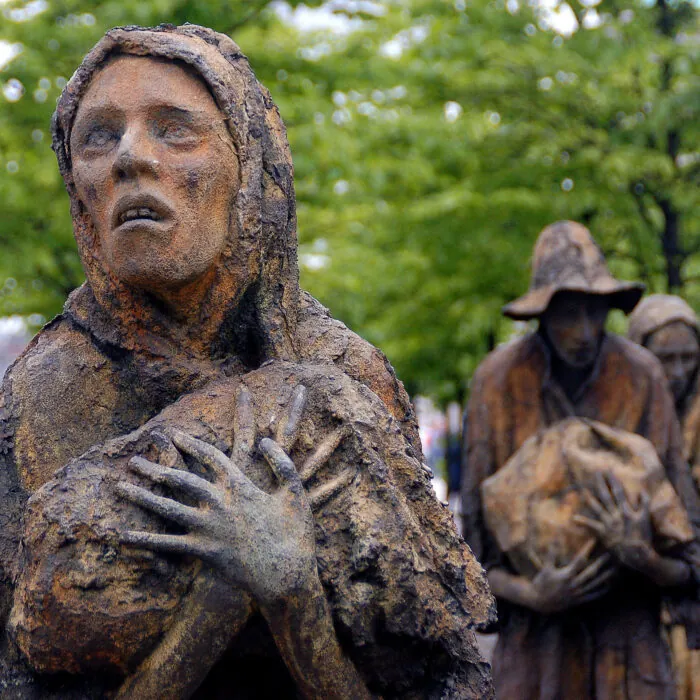
The Jeanie Johnston is moored in the immediate vicinity of the Famine Memorial. Created by sculptor Rowan Gillespie, its bronze figures depict emaciated men, women and children walking towards the port with their meagre possessions.
Installed on Custom House Quay, the statues evoke the thousands of emigrants who came to Dublin’s quays before their departure. Their proximity to the ship creates a particularly coherent memorial route.
The monument also stands at the end of the National Famine Way, a route tracing the forced march of families who left Strokestown, County Roscommon, to reach Dublin before embarking for Canada.
Essential information to help you plan your visit, including key landmarks, access information, and booking options.
Custom House Quay, North Dock, Dublin Docklands, Dublin Docklands
53.347568, -6.245474
45 minutes
The Jeanie Johnston is open every day. Guided tours depart at the following times:
Tour duration: around 50 minutes.
There is usually no departure at 1 pm. Timings may change in the event of an exceptional closure, maintenance work or adverse weather conditions.
It is recommended that you arrive at least 10 minutes before your booked time. Late arrivals may not be able to join a tour that has already started.
Check availability on the official Jeanie Johnston ticket office.
Check the opening hours and admission requirements before you leave, especially during peak season or on Irish public holidays.
Individual tickets:
Family tickets:
Combined Jeanie Johnston and EPIC ticket:
The ticket includes a guided tour of the upper deck and steerage area. The prices shown are starting prices and may vary depending on the booking method or temporary offers.
The free return offered with certain EPIC tickets within ten days of the first visit applies to the EPIC museum only. It does not allow a second visit to the Jeanie Johnston.
Check current prices on the official Jeanie Johnston website.
Compare tickets, guided tours, and excursions available through our partner platforms.