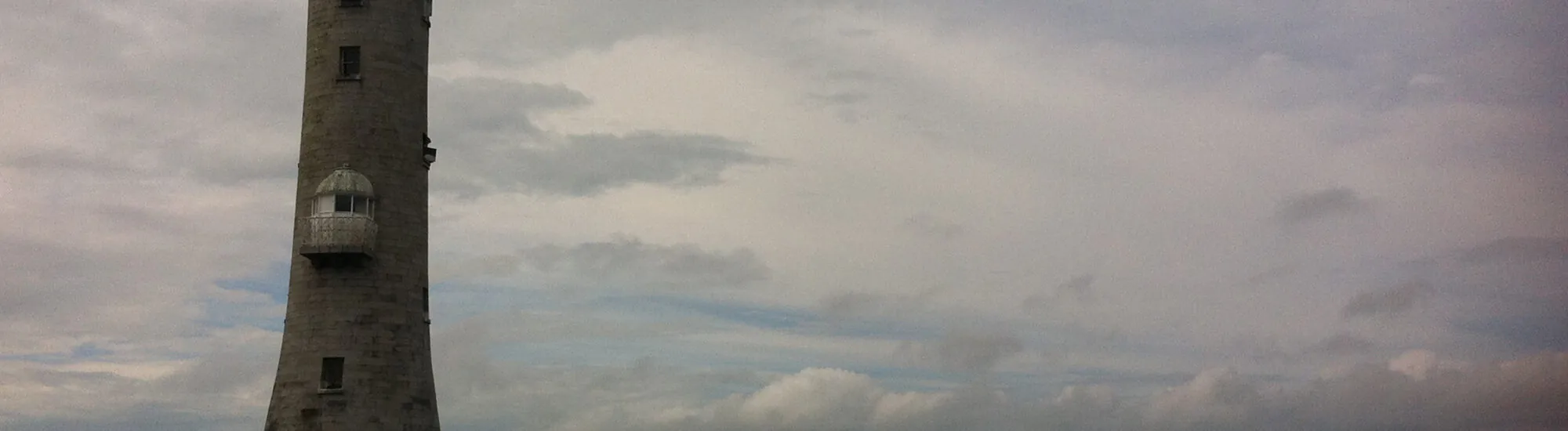
At the entrance to Carlingford Lough, a stone tower rises from the water, with only the currents and boats making their way into the estuary for company. Haulbowline Lighthouse has the visual power of an offshore lighthouse: its very presence makes clear that this passage demands precision. First lit in 1824, it watches over a maritime entrance shared between the landscapes of County Down and the Cooley Peninsula.
Visitors come here to view the lighthouse from the shore, take in its architecture and explore the shores of Carlingford Lough. The tower is not open to visitors and there is no footpath leading to it. The best plan, then, is to choose a viewpoint on land before extending your outing around Cranfield and Greencastle.
In the early 19th century, growing maritime trade called for better navigation marks in Carlingford Lough. A lighthouse had stood at Cranfield Point since 1803, but its location did not adequately address the challenges of navigation. In 1817, Newry merchants asked the Ballast Board, then responsible for lighthouses, to replace it.
A rock at the entrance to the estuary was chosen. The project was entrusted to George Halpin Senior. His ambition went beyond a simple tower on a headland: construction had to take place in an environment where currents and the rock’s submersion made it difficult to transport materials and for workers to carry out their work. The first white light was lit on 1 September 1824.
The old Cranfield Point lighthouse retained a connection with the new station, as its accommodation housed the keepers’ families. Its tower would eventually collapse as a result of coastal erosion in the 19th century. Haulbowline, meanwhile, continued its role in the entrance channel.
Irish Lights gives the tower a height of 34 metres. Its dressed granite masonry broadens at the base, following a profile designed to lessen the impact of the waves. This shape comes fully into its own when looking at the point where stone meets water: the building was designed for this environment, not simply placed in a beautiful landscape.
Another distinctive feature catches the eye: the small projecting structure halfway up the tower, on the seaward side. It housed a light associated with the state of the tide. The lighthouse therefore marked more than a position; it also helped mariners assess the conditions of the passage.
The Northern Ireland built heritage inventory describes the care taken with the balconies, lantern and metalwork details. Listed Grade B+ since 2002, the structure combines technical interest with architectural quality. A pair of binoculars makes it possible to appreciate its proportions from the shore, without approaching the installations.
The lighthouse was arranged vertically, with rooms spread over several levels. An account published by the Newry and Mourne Museum mentions the kitchen and the keepers’ bunks, among other details. Behind its solitary silhouette lay a very practical organisation: keeping the light in service, maintaining the equipment and living in a confined space.
The families remained housed at Cranfield Point until 1922, before new accommodation was built at Greencastle. This connection with land is essential to understanding offshore lighthouses. Their apparent isolation depended on relief crews, supplies and a community that made their operation possible.
On 17 March 1965, Haulbowline was converted to electricity and automatic operation, monitored from the shore. The equipment was subsequently upgraded several times. The fog signal was permanently discontinued in 2009.
The lighthouse remains operational. Its light characteristic, published by Irish Lights, is a group of three white flashes every ten seconds, shown during the hours of darkness. For visitors, this continuity matters: they are viewing a heritage structure that retains a navigational function.
On the northern shore in County Down, the Cranfield area offers views of the lighthouse from the coast. It is a good option for combining a view of the tower with time by the water. Visibility depends on the weather: a clear sky is more helpful than a long walk when fog obscures the entrance to the estuary.
Allow 30 minutes to an hour for a stop with photographs, or longer if you also make the most of the beach. This timing is for an outdoor visit. It does not include a sea crossing or a visit inside the lighthouse.
The monument is best viewed from a distance. Binoculars or a telephoto lens will help you make out its galleries and lantern; with a phone, a wider composition better conveys its place in the landscape. Keep the shore and water in the frame: they give the tower its scale.
The Greencastle area offers another perspective on the maritime landscape, with channels and facilities connected with crossings. Depending on the viewpoint, the distance and alignment of the elements change. Stay in permitted public spaces, without using private access routes to homes or entering restricted harbour areas.
Haulbowline may also appear in photographs taken from a boat. This does not mean that an excursion to the lighthouse is available on your chosen date, nor that it permits landing. If you are considering a trip at sea with an operator, check its actual programme, route and booking conditions.
The rock on which the tower stands is exposed in certain tidal conditions. It is not a causeway connecting the lighthouse to the beach. The site remains surrounded by water and subject to the currents at the entrance to the lough. Do not attempt to reach the building on foot, by swimming or in an improvised craft.
Viewing the site from land is enough to appreciate it. Along the coast, also keep your distance from exposed areas, slippery edges and waves. Pleasant conditions on one stretch of beach do not necessarily reflect those in the channel.
For a visit on land, set your navigation for Cranfield Beach or the Greencastle area, near Kilkeel. The lighthouse GPS point is in the water: it is useful for locating the monument on a map, not for identifying a destination accessible by car.
Use authorised parking areas and follow local signage. Bring sturdy footwear, a windproof jacket and extra layers if you plan to spend a long time watching. For meals and services, plan a stop into your itinerary rather than relying on visitor facilities at the lighthouse.
The crossing between Greenore in County Louth and Greencastle in County Down still appears on many itineraries. However, the operator states that no service is running in 2026. Do not therefore plan your day around this maritime shortcut.
If you are coming from the southern shore, plan your road journey around the lough. For a later trip, check for any resumption of services directly on the Carlingford Lough Ferry website before booking or finalising your plans. An old photograph taken from the ferry is not evidence that the route is currently operating.
There is no regular lighthouse admission ticket to announce. Viewing from public coastal areas does not require a ticket for the monument; any parking or activity charges are separate. The tower remains a maritime installation, with no regular visitor access inside confirmed.
Choose a daytime outing to identify permitted access points and enjoy the landscape. If you wish to watch the light after dark, select a safe location on land in advance and plan your return journey. Night-time is no reason to venture onto an unfamiliar shore.
On the northern shore, Cranfield, Greencastle and Kilkeel make it possible to plan a coastal day without multiplying journeys. The southern shore offers other views towards the Cooley Peninsula and Carlingford. The two areas complement one another during a stay, but require a realistic calculation of driving times when the ferry is not operating.
Finally, always check the location when planning your searches: Haulbowline Lighthouse at Carlingford Lough is not on Haulbowline Island in Cork Harbour. The name is the same, but these two sites are in very different parts of Ireland.
Want to extend your visit without having to rush around? Here are a few well-located places to stay near the must-see attractions.
Essential information to help you plan your visit, including key landmarks, access information, and booking options.
Cranfield, County Down, Northern Ireland, Tourist sites in Ireland
54.0199333, -6.079
No regular opening times for interior visits are confirmed. Outdoor viewing is available from authorised public areas, preferably by day, subject to weather and local restrictions. The lighthouse is operational. According to the operator, no Greenore–Greencastle ferry service is running in 2026.
Check the opening hours and admission requirements before you leave, especially during peak season or on Irish public holidays.
There is no charge to view the lighthouse from authorised public coastal areas. The tower is not open for independent visits and no regular interior ticketing is confirmed. Parking and any maritime activities are separate.