
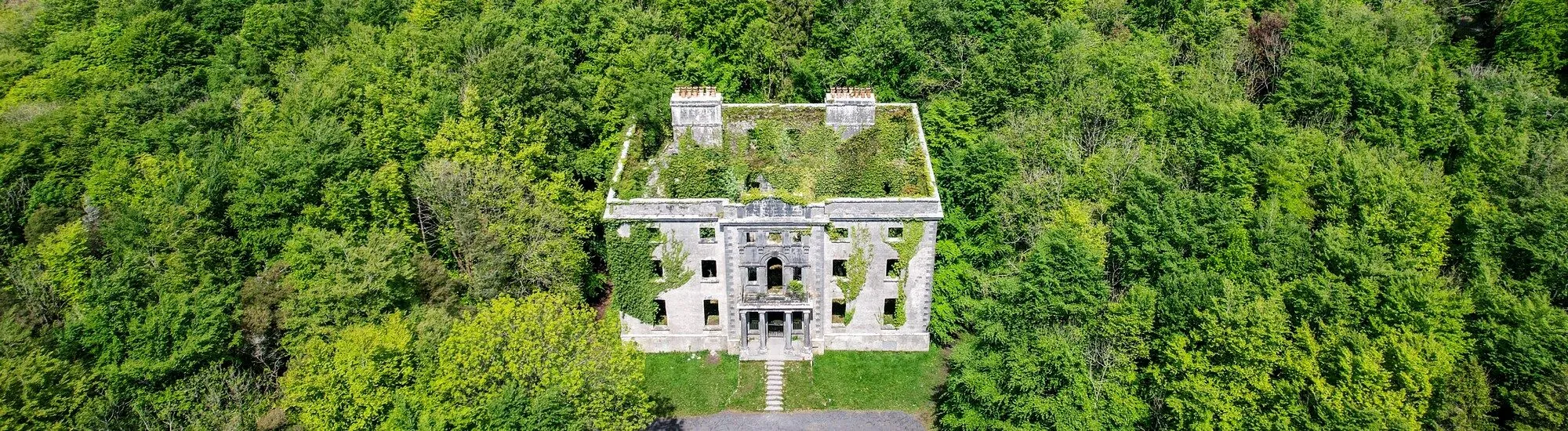
In the heart of a forest in County Mayo, the roofless walls of Moore Hall rise among the trees like the setting of a Gothic novel. This former Georgian house, built in the late 18th century on the slopes of Muckloon Hill, overlooks the clear waters of Lough Carra, near the village of Carnacon.
The vegetation, gaping windows and silent façade lend the site a compelling atmosphere. Moore Hall should not, however, be regarded as a freely accessible urbex site. The estate and its trails are open to walkers, but the interior of the house is closed for safety reasons and to protect wildlife.
A visit to Moore Hall begins at the car park beside Lough Carra. A forest path gradually leads to the manor-house ruins, its former courtyard and walled garden. The walk is easy and follows gravel tracks for the most part.
The stated distance varies slightly depending on the route chosen. Mayo Trails and Sport Ireland describe a main loop of around 2 kilometres, while Coillte presents a broader 3-kilometre route. Allow between 45 minutes and 1 hour 30 minutes, depending on detours and the time spent at the manor house.
The approach is particularly striking. After a few minutes beneath the trees, the monumental façade emerges in a clearing. Its central portico, empty openings and weathered walls still evoke the grandeur of a house once considered one of Mayo’s great houses.
Visitors can view Moore Hall from outside the protective barriers. Doors, windows, cellars and prohibited passageways must not be entered. As well as the risk of falls and collapse, the manor’s cellars are home to a colony of lesser horseshoe bats, a species protected across Europe.
The site has a large car park, picnic area and toilets. Across the road, the shores of Lough Carra make for a pleasant extension to the walk, with fine views across this limestone lake of remarkable ecological interest.
Moore Hall was commissioned by George Moore, an Irish merchant who had made a considerable fortune in Alicante, Spain, through the wine and spirits trade. On returning to County Mayo, he set about building a residence that would embody his family’s success.
Work began in 1792, and the house was completed around 1795 or 1796. Its design is traditionally attributed to John Roberts, the renowned Waterford architect, although this attribution is not documented with absolute certainty. Roberts is also associated with Tyrone House, another grand Irish residence now in ruins in County Galway.
Moore Hall was an imposing late-Georgian country house. Built of limestone, it had three storeys above a partly raised basement. Its symmetrical façade was arranged around a monumental columned entrance, still recognisable despite the fire and a century of exposure to the elements.
Its location was no accident. From Muckloon Hill, the house looked out over the family estate and the islands of Lough Carra. The woodland was then far less dense, and the residence enjoyed wide-ranging views of the lake, farmland and Mayo’s hills.
The significance of Moore Hall extends far beyond its architecture. Several members of the Moore family played a part in Ireland’s major political, social and cultural upheavals between the late 18th and early 20th centuries.
George Moore made his fortune in the wine and brandy trade in Alicante. He is also thought to have owned several merchant ships. His activities enabled him to acquire extensive landholdings in Mayo and fund the construction of Moore Hall. He died in 1799, only a few years after the house was completed.
George Moore’s son, John Moore, studied in France before becoming a lawyer. During the Irish Rebellion of 1798, the French general Jean-Joseph Amable Humbert appointed him president of the short-lived Republic of Connacht, proclaimed in Castlebar.
The experiment lasted only a few weeks. Following the defeat of the Franco-Irish forces, John Moore was arrested and sentenced. His death sentence was commuted, but he died in custody in Waterford on 6 December 1799. He remains associated with one of the first attempts at republican government in Ireland.
A landowner, horse breeder and politician, George Henry Moore became one of the family’s most respected figures. His horse Coranna won the Chester Cup in 1846, as the Great Famine ravaged western Ireland.
George Henry Moore devoted a significant part of his resources to supporting the people living on his estate. He helped import flour, reduced certain rents and organised various forms of relief. Local accounts particularly stress that his tenants were not evicted for non-payment during the most difficult years.
He also served as MP for County Mayo and championed the rights of tenant farmers. He is buried in the family vault at Kiltoom, on the former Moore Hall estate.
Born at Moore Hall, George Augustus Moore became a novelist, art critic, memoirist and a figure in the Irish literary revival. After moving in Parisian artistic circles, he became close to figures such as William Butler Yeats and Lady Gregory, and took part in Ireland’s cultural life in the early 20th century.
His best-known works include Esther Waters, Confessions of a Young Man and the autobiographical trilogy Hail and Farewell. After his death in 1933, his ashes were placed on Castle Island, a small island in Lough Carra opposite Moore Hall.
George Augustus’s brother, Maurice George Moore, first pursued a military career with the Connaught Rangers. He took part in the Second Boer War in South Africa, before denouncing the treatment of civilians and the existence of British concentration camps.
He later became involved in the Irish cultural and nationalist movement, supported the Irish language, helped organise the Irish Volunteers and became a senator of the Irish Free State in 1922. This political role played a part in the tragic fate of the family home.
Moore Hall was set on fire on the night of 31 January to 1 February 1923, during the Irish Civil War. The attack was carried out by republicans opposed to the Anglo-Irish Treaty, at a time when several properties associated with members of the Free State Senate were targeted.
The house then belonged to the writer George Augustus Moore, while his brother Maurice sat in the Senate. The fire destroyed the roof, floors, furnishings and an important library. Only the outer walls, vaulted cellars and certain stone structures survived the blaze.
Moore Hall was never rebuilt. The land was gradually divided up, while part of the estate came under public management and was planted with trees. Without a roof, the walls were gradually overtaken by ivy, mosses and young growth, creating the unusual landscape seen today.
In January 2018, Mayo County Council announced the purchase from Coillte of around 80 acres including Moore Hall, its courtyard, walled garden and part of the surrounding woodland. Coillte remains involved in managing neighbouring forest areas, alongside the National Parks and Wildlife Service.
An initial phase of works focused on the walled garden, historic walls, paths, furniture and visitor facilities. The project then took on a new dimension with the official launch of the Masterplan for Moorehall and Environs on 31 October 2025.
The plan does not necessarily provide for rebuilding Moore Hall exactly as it was before the fire. It favours the sensitive conservation of the ruins, partial restoration of the house, enhancement of the walled garden and, in time, the creation of an interpretation centre devoted to the Moore family, the history of the estate and its surroundings.
The aim is also to bring Moore Hall and Lough Carra together within a destination combining cultural heritage, sustainable tourism and nature conservation. New trails, visitor facilities and educational spaces are envisaged, while keeping bat conservation at the heart of the project.
In summer 2026, the project was still in the design and preparation phase. A tender for specialist quantity surveying services was published in May 2026, but no definitive date has yet been announced for the opening of a visitor centre or access to the interior of the manor house.
Moore Hall is near Carnacon, in a rural area between Ballinrobe, Castlebar and Claremorris. From Ballinrobe, follow the local L1607 road for around 13 kilometres, then take the road signposted for Moore Hall for the final 500 metres.
Good footwear is still recommended, especially after rain, as some sections can become wet or slippery. As the estate is wooded, it is best to finish the walk before nightfall and not to visit in strong winds or during a weather warning.
Lough Carra lies immediately beside the car park. This marl lake is part of a protected environment home to otters, waterbirds, orchids and several bat species. Its shores provide a peaceful setting to extend the walk or enjoy a picnic.
Moore Hall is also less than ten minutes from Ballintubber Abbey, an abbey founded in the 13th century and still in use today. A visit can be combined with Ballinrobe, Partry or Castlebar for a day exploring the historical and natural heritage of south Mayo.
Sources consulted: National Inventory of Architectural Heritage, Coillte, Sport Ireland, Mayo County Council and Dictionary of Irish Biography.
Essential information to help you plan your visit, including key landmarks, access information, and booking options.
53.71341029539426, -9.22631938306018
Moore Hall has no published fixed visiting hours. The forest trails are normally accessible year-round, subject to works, temporary restrictions or adverse weather conditions.
It is recommended to visit the estate only during daylight hours and to leave the forest before nightfall. Any opening times displayed at the entrance and local safety instructions take precedence.
Please note: the interior of Moore Hall, its cellars and sealed openings are permanently closed. This is not an authorised urbex site.
In the event of a red warning for strong winds, Coillte asks visitors not to enter any forest area. Toilet availability may also vary depending on the season and maintenance operations.
Check the opening hours and admission requirements before you leave, especially during peak season or on Irish public holidays.
Access to the forest trails, walled garden and secured surroundings of Moore Hall is free. No booking or ticket is required to explore the estate.
The future interpretation centre and new facilities announced in the masterplan are not yet open.