Viator


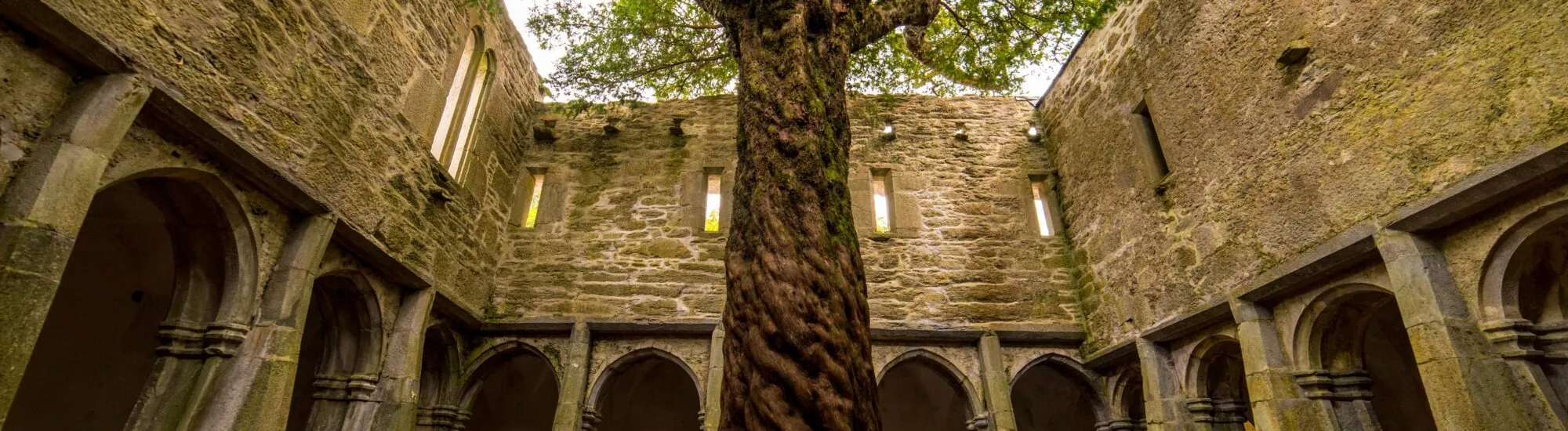
Amid the woodland of Killarney National Park, Muckross Abbey reveals its roofless walls, vaulted cloister and a striking ancient yew growing at the centre of the courtyard. Founded in the 15th century for a Franciscan community, this religious complex is among the best-preserved medieval ruins in County Kerry.
Admission is free and visitors are free to explore at their own pace. You can visit the church, cloister and former convent rooms before walking through a cemetery that remains in use. Despite its common name, Muckross Abbey was not, strictly speaking, an abbey, but a friary for Franciscan brothers.
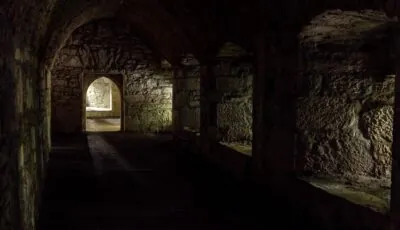
One of the rooms at Muckross Abbey – © Links Productions
Muckross Abbey, formerly known as the Friary of Irrelagh, was founded around 1448 for the Observant Franciscans. This branch of the Franciscan order upheld a strict observance of the Rule of Saint Francis, based on poverty, prayer and preaching.
The foundation was supported by Donal MacCarthy Mór, a member of one of Munster’s most powerful Gaelic families. Contrary to what some older accounts claim, Donal MacCarthy Mór was not himself a monk. He belonged to a dynasty that controlled much of southern Kerry and acted as protector of the new community.
Construction of the friary is thought to have continued for several decades. The complex included a church, cloister, prayer spaces and various rooms needed for the brothers’ daily life.
Local tradition also links the site to an earlier religious settlement, said to have been founded by Saint Fionan in the 6th century. However, this origin is less well documented than the 15th-century Franciscan presence.
The monument is now universally known as Muckross Abbey. Its most accurate historical name, however, would be Muckross Friary, meaning the Franciscan friary of Muckross.
An abbey generally housed a monastic community led by an abbot. Franciscan brothers, by contrast, belonged to a mendicant order. They did not live solely in seclusion: they travelled through towns and the countryside to preach to the local population.
Their resources came largely from donations given by local people and nearby noble families. At Muckross, the Franciscans maintained close ties with the MacCarthys and other leading Gaelic families of Kerry.
Despite the lack of a roof over much of the monument, Muckross Abbey retains a remarkable amount of its medieval layout. The church consists of a nave for worshippers and a chancel where religious services were held.
A transept on the south side probably contained secondary altars, statues and areas set aside for prayer. Several liturgical features can still be seen in the walls, including burial niches and the remains of fittings used during services.
An imposing square tower separates the nave from the chancel. Built after the earliest parts of the church, it is almost as wide as the building itself. Its massive proportions make it one of the monument’s most distinctive features.
To the north of the church, the vaulted cloister galleries surround a small square courtyard. The community’s former rooms were arranged around this space: the sacristy, kitchen, refectory, chapter house, dormitory and accommodation for the head of the friary.
Stone staircases still provide access to some upper levels. As the monument is neither furnished nor converted into a museum, you need to look closely at the fireplaces, openings, vaults and passageways to imagine the Franciscans’ daily life.
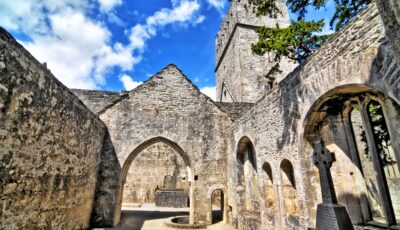
The cloister of Muckross Abbey – © robnaw
At the centre of the cloister grows a large yew tree whose dark branches spread above the arcades. Its gnarled trunk and evergreen foliage contribute greatly to Muckross Abbey’s mysterious atmosphere.
Local tradition holds that the tree is as old as the friary itself. Heritage Ireland takes a more cautious view, stating that the yew may be up to 400 years old. It would therefore be one of the oldest examples of its species in Ireland.
Its presence has been recorded for several centuries. As early as 1756, the writer Charles Smith described a yew of remarkable height, its branches stretching above the cloister courtyard.
The tree is also surrounded by legends. According to local folklore, anyone attempting to cut it down or damage it would face serious consequences. Even without invoking these beliefs, its age and fragility are reason enough not to touch its branches, climb it or walk on its roots.
At the end of the 16th century, the Muckross community suffered the consequences of the Desmond Rebellions. These conflicts pitted the English Crown against the FitzGeralds of Desmond and several Gaelic families of Munster.
The friary was legally dissolved in 1541, but the Franciscans managed to remain there for several decades. An English attack around 1589 resulted in the deaths of two brothers and forced the survivors to leave the buildings temporarily.
The Franciscans nevertheless returned on several occasions, particularly in the early 17th century. Their presence in the region continued despite bans, expulsions and periods in hiding.
In 1652, during the Cromwellian conquest of Ireland, troops under the command of Edmund Ludlow once again drove the brothers from Muckross. They probably found refuge in the surrounding mountains and valleys. Part of the Franciscan community remained in the area over the following centuries, but the great medieval friary was never truly reoccupied.
Oliver Cromwell did not personally lead the attack on Muckross. He had left Ireland in 1650, two years before Ludlow’s soldiers intervened. The buildings subsequently remained roofless and gradually became the ruins visible today.
The cemetery surrounding Muckross Abbey has been in use for several centuries. Burials still take place there, and many local families come to tend their graves. Visitors should therefore regard it as an active burial ground and behave respectfully.
Several members of leading Gaelic families from Kerry are buried here, including the MacCarthys, O’Donoghues and O’Sullivans. The site is also known for the graves of several poets who wrote in the Irish language.
Aodhagán Ó Rathaille, born around 1670 and died in 1726, is regarded as one of the last great figures of the Gaelic poetic tradition. Eoghan Rua Ó Súilleabháin, an 18th-century poet, is also buried at Muckross, along with Geoffrey O’Donoghue.
The cemetery is also associated with Piaras Feiritéar, a Gaelic chief, poet and rebel executed in Killarney in 1653. The many gravestones, some old and covered in moss, add to the site’s distinctive atmosphere.
Entry to Muckross Abbey is entirely free. No ticket, timed booking or guided tour is required. The monument is protected by the Irish State and is one of the unguided sites managed by Heritage Ireland.
You are free to follow your own route, with no set direction. Allow around 30 to 45 minutes to explore the church, cloister, former convent rooms and cemetery. An hour will give you more time to examine the architectural details and funerary inscriptions.
Killarney National Park is open to pedestrians throughout the year. However, it is best to visit the ruins during daylight hours: the interior is dark in places and has no lighting suitable for night-time exploration.
The stones can become particularly slippery after rain. Closed shoes with good grip are recommended, even if you are only planning a short visit.
The outer path leading to the monument is relatively easy, but the interior presents several challenges. Steps, uneven floors, narrow corridors and changes in level severely restrict access for wheelchair users and people with limited mobility.
Part of the ruins and cemetery can nevertheless be seen from outside. Visitors concerned should assess the conditions on site, particularly after wet weather.
Families can visit Muckross Abbey, but young children must remain under the constant supervision of an adult. Some windows are unglazed, the staircases are old, and several elevated areas do not have the safeguards found in a modern visitor attraction.
There is no ticket office, café or toilet at the monument itself. The main visitor facilities are grouped near Muckross House.
Muckross Abbey is in Killarney National Park, around 5 kilometres south of the town centre. Its GPS coordinates are approximately 52.0261, -9.4956.
By car, take the N71 towards Kenmare. Two free parking areas provide access to the site. The first is on the left-hand side of the N71, opposite the park entrance leading to the abbey. The second, smaller one is opposite the Muckross Park Hotel.
From these car parks, a path crosses the woods before reaching the ruins. Spaces are limited, so it is best to arrive early in the morning at weekends and during the peak tourist season.
Muckross Abbey can also be reached on foot from Muckross House. The route is around 1.5 kilometres long and takes in part of the estate, passing through woodland, meadows and along the shores of Lough Leane.
Cyclists can reach the area by following the park’s permitted routes. Jaunting cars, Killarney’s traditional horse-drawn carriages, also run between the estate’s main sites.
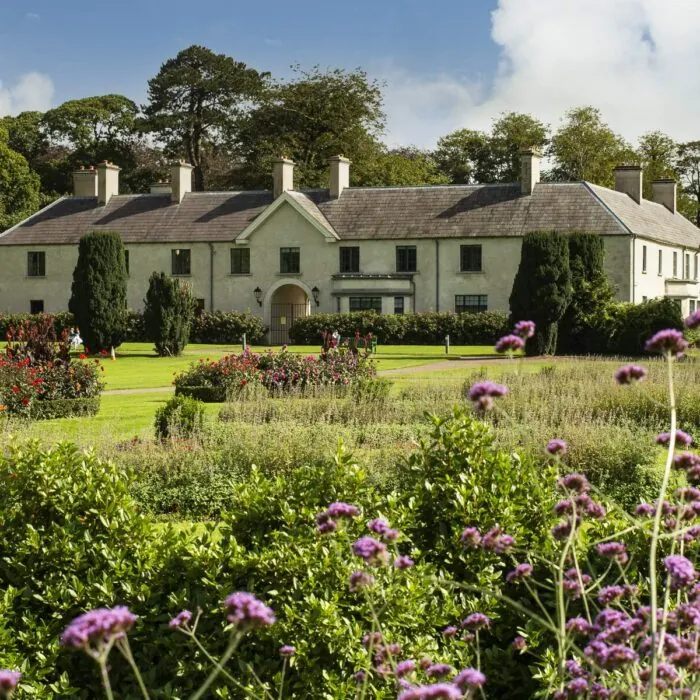
Muckross House is the natural complement to a visit. This Victorian mansion, built in the 19th century, overlooks the shores of Muckross Lake. Its interior can be visited on a guided tour, while the gardens are free to access.
Torc Waterfall is a few kilometres away. A relatively short woodland trail leads to this waterfall, which is particularly impressive after wet weather.
Walking enthusiasts can follow the Muckross Lake Loop or part of the paths along the Lakes of Killarney. These routes link several sites in the park without having to get back in the car.
In the direction of Killarney, Ross Castle offers a fine example of a 15th-century Gaelic tower house on the shores of Lough Leane. Further south, on the road to Kenmare, Ladies View reveals one of the national park’s most famous panoramas.
Address: Killarney National Park, Muckross, County Kerry, Ireland.
GPS coordinates: 52.0261, -9.4956.
Admission: free entry.
Booking: no booking required.
Opening times: the national park is open to pedestrians throughout the year. For safety reasons, it is recommended to explore the ruins only in daylight.
Recommended duration: between 30 minutes and one hour.
Parking: two small free parking areas are accessible from the N71. Overnight parking and camping are not permitted.
Facilities: no reception, café or toilets in the immediate vicinity. Toilets and food outlets are available at Muckross House.
Accessibility: relatively easy outdoor access, but moving around the ruins is difficult because of steps, narrow passageways and uneven ground.
Best time: early morning for a quieter visit or late afternoon for softer light. After rain, the stones can be slippery.
Is admission to Muckross Abbey free?
Yes. The monument and its cemetery can be visited free of charge, with no ticket or booking required.
Is Muckross Abbey really an abbey?
Not exactly. The monument was a friary for the Observant Franciscans. Its most accurate historical name is Muckross Friary.
How old is the yew in the cloister?
Tradition gives it the same age as the friary, but Heritage Ireland more cautiously estimates that it may be up to 400 years old.
Why is Muckross Abbey in ruins?
The friary suffered several attacks and expulsions between the 16th and 17th centuries. The Franciscans were permanently driven from the large medieval complex during the Cromwellian conquest.
Did Oliver Cromwell attack Muckross Abbey?
No, not personally. Cromwell had left Ireland in 1650. The 1652 expulsion was carried out by troops under the command of Edmund Ludlow.
Can you reach Muckross Abbey from Muckross House?
Yes. A walk of around 1.5 kilometres links the two sites through the Muckross estate.
Are dogs allowed?
Dogs are permitted in the national park when kept under control. They must be kept on a lead near animals, visitors and burial grounds.
Essential information to help you plan your visit, including key landmarks, access information, and booking options.
suivre la N71, Ring of Kerry, Killarney National Park, Killarney National Park, Ring of Kerry (County Kerry) - Republic of Ireland
52.026198, -9.494804
45 minutes
Compare tickets, guided tours, and excursions available through our partner platforms.