Viator

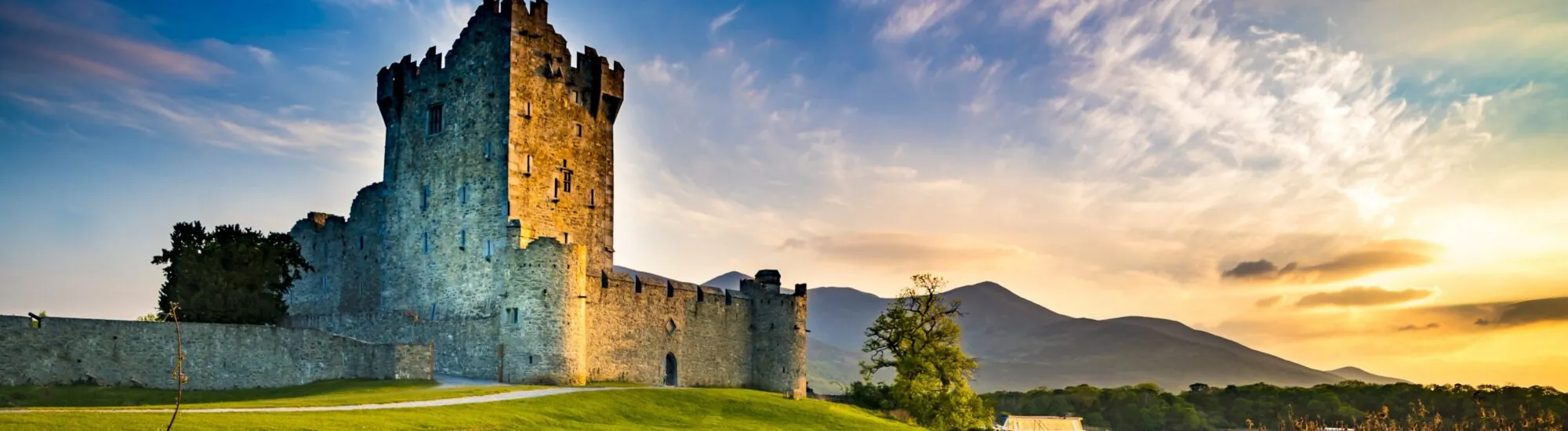
Standing on the shores of Lough Leane, Ross Castle has watched over the lakes of Killarney for more than five centuries. This imposing 15th-century tower house, surrounded by mountains and forests, is one of County Kerry’s most photogenic landmarks. Its exterior can be explored freely throughout the year, while the interior is open seasonally for guided tours.
The former seat of the O’Donoghue clan and the last major Munster stronghold to resist Cromwellian forces, Ross Castle combines military history, Gaelic architecture and Irish legend. Its location in Killarney National Park also makes it an excellent starting point for a walk, a boat trip or an exploration of Ross Island.
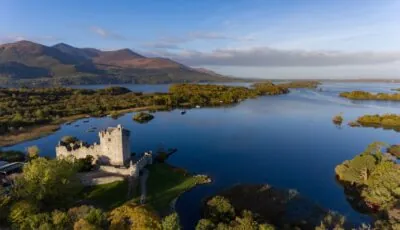
Ross Castle in Killarney – © gabriel12
Ross Castle, or Caisleán an Rois in Irish, is believed to have been built during the 15th century by O’Donoghue Mór, leader of a powerful Gaelic clan based around the lakes of Killarney. The fortress stands on Ross Island, a peninsula extending into the waters of Lough Leane, the largest of Killarney’s three lakes.
Its location served several purposes. The lake provided both a route of travel and an essential resource, while the fortress made it possible to control the surrounding area. The mountains, woods and wetlands around the estate also made it difficult for an enemy army to approach.
Ross Castle was not a castle of display in the modern sense. It served as the clan chief’s residence, a political centre and a defensive stronghold. Its presence in the landscape asserted the O’Donoghues’ authority over this part of Kerry.
Ross Castle is a fine example of a late medieval Gaelic tower house. Its main building rises over several storeys, with massive walls, narrow openings and a spiral stone staircase.
The tower was surrounded by a fortified courtyard known as a bawn. This enclosure had round towers at its corners, from which defenders could keep watch over the approaches to the castle. Several features near the entrance also helped to slow down attackers.
Each floor had a particular function. The lower levels, darker and more difficult to access, were mainly used for storage. Service areas and food-preparation spaces occupied the middle levels. The private apartments and great hall were located higher up, where larger windows provided more light.
Ross Castle therefore did not have a ‘dungeon’ intended to imprison beggars, as some older tourist accounts claim. At the heart of the building was a fortified residence designed to protect a ruling family, its relatives, servants and stores.
The O’Donoghues’ control of Ross Castle came to an end during the Desmond Rebellions, in the second half of the 16th century. The property then passed to the MacCarthy Mórs, another major Gaelic family of south-west Ireland.
From the late 16th century onwards, the castle and its lands were also associated with Sir Valentine Browne and his descendants, the future Earls of Kenmare. The site thus went through a period of profound upheaval, during which the Gaelic political order gave way to the authority of the English Crown.
Military and domestic buildings were added around the tower house at different periods. Some of the structures visible nearby date from alterations made after the medieval period, particularly when the castle was used as a barracks.
Ross Castle holds a special place in Irish military history. In 1652, during the Cromwellian conquest of Ireland, the fortress was among the last strongholds in Munster to resist Parliamentarian forces.
The castle was then defended by Lord Muskerry’s men. According to an old prophecy, Ross could only be taken when a warship appeared on Lough Leane. Such a prospect seemed unlikely to the defenders, as the castle stood far from the coast.
However, General Edmund Ludlow, commander of the Parliamentarian forces, had a large vessel launched on the lake. At the sight of the boat, the occupants realised that the prophecy was coming true, and their surrender was hastened.
Contrary to the frequently repeated account, Oliver Cromwell did not personally lead the siege of Ross Castle. He had left Ireland in 1650, two years before the capitulation. Nor is there any evidence to suggest that the castle was entirely given over to the flames at that time.
Ross Castle is inseparable from the legend of O’Donoghue Mór. According to local tradition, the clan chief did not simply vanish: he is said to rest in a palace hidden beneath the waters of Lough Leane.
Every seven years, on the morning of 1 May, he is said to emerge from the lake on a white horse and ride through his former lands. Anyone who manages to see him will enjoy good fortune for the rest of their life.
This legend has several variations. Some tell how O’Donoghue was drawn through a window with his horse, table and library. His fall should therefore not be presented as a historical event that took place during a battle, but as one of the wondrous tales associated with the castle and the lakes of Killarney.
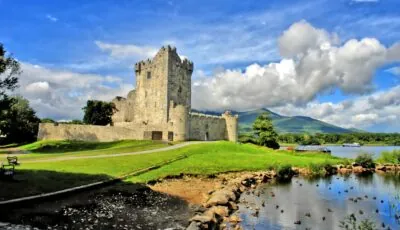
The enclosure at Ross Castle – © robnaw
The interior of Ross Castle can only be visited on a guided tour. The tour explores the tower house’s vertical layout, its defensive architecture and the daily life of a Gaelic aristocratic family in the late Middle Ages.
The rooms have been restored and furnished with period-appropriate furniture. The tour includes the storage areas, service rooms, the chief’s private apartments and the great hall in the upper part of the building.
The ascent uses narrow, particularly steep staircases. The interior is therefore difficult to access for people with reduced mobility. Groups are limited to 15 participants, and tickets are allocated on site on a first-come, first-served basis. In summer, there may be a wait for the next tour.
You can admire the exterior of Ross Castle, its enclosure and the landscapes of Lough Leane free of charge. This part of the site remains accessible even when the interior of the tower house is closed.
The guided interior tour is, however, chargeable. In 2026, the official price is €5 for an adult, €4 for a senior or group visitor, €3 for a child or student, and €13 for a family.
As prices and access arrangements may change, it is advisable to check the official Ross Castle page on Heritage Ireland before setting off.
In 2026, the interior of Ross Castle is open daily from 5 March to 3 November, from 9.30 am to 5 pm. The first guided tour begins at 10 am and the last is scheduled for 4.55 pm.
As places are limited, it is best to arrive in the morning or outside the busiest times during July and August. It is not currently possible for individual visitors to book a time slot online: admission tickets are distributed on site.
Outside the opening period, visitors can still reach the area around the castle and enjoy the national park scenery. Only access to the interior of the tower house is closed.
Ross Castle is around two kilometres from the centre of Killarney. The walk is pleasant and gradually passes through the wooded areas of the national park. The route is also very suitable for cycling.
Free parking is available near the castle. During the high season, it can fill up quickly. The famous jaunting cars, Killarney’s traditional horse-drawn carriages, also travel to the site from the town centre.
Toilets are available nearby. Dogs must be kept on a lead in the park and are not permitted inside the monument.
Allow around 45 minutes for the guided interior tour. An hour and a half is enough to explore the castle, walk beside the lake and enjoy the main viewpoints at an unhurried pace.
Half a day is worthwhile if you add a boat trip or the Ross Island trail. The castle is particularly photogenic early in the morning, when the water is calm, and at the end of the day, when the light falls across the Kerry mountains.
A jetty at the foot of the castle is the departure point for several trips on the lakes of Killarney. These tours offer the chance to sail on Lough Leane, discover landscapes dominated by the MacGillycuddy’s Reeks or reach Innisfallen Island.
The island is home to the remains of an ancient monastery founded in the 7th century. Some excursions include a landing and time to explore the island. Others cross several lakes towards the Meeting of the Waters or the Gap of Dunloe.
These trips are run by independent operators. They are not included in the Ross Castle admission ticket, and their operation depends on weather conditions.
Ross Castle is also the starting point for the Ross Island Mining Trail. This waymarked route passes through woodland and alongside several areas associated with former copper workings. The earliest documented mining activity on the island dates back to prehistory and is among the oldest known in this part of Europe.
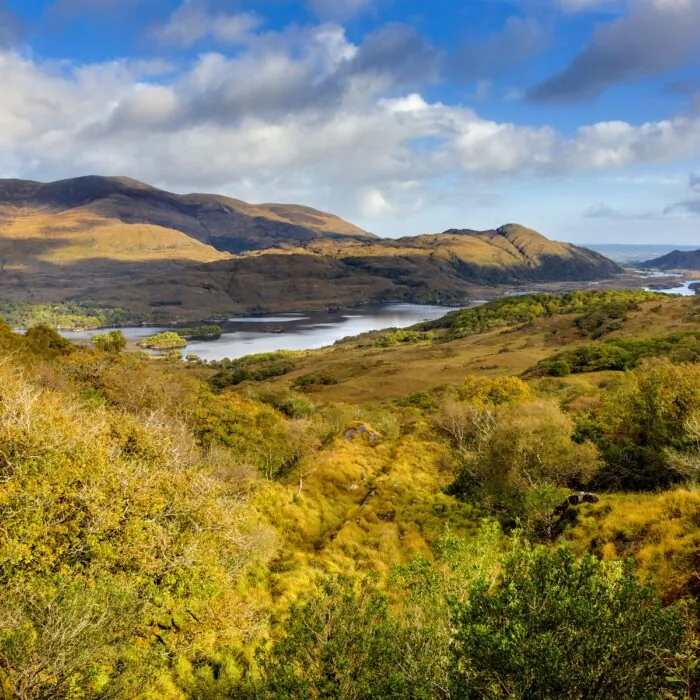
The walk offers fine views across Lough Leane, its islands and the landscapes of Killarney National Park. As elsewhere in the park, visitors should stay on the paths to protect natural habitats and avoid disturbing wildlife.
Is Ross Castle open all year round?
The exterior and the area around the castle are accessible all year round. In 2026, guided tours of the interior run from 5 March to 3 November.
Do I need to book a visit to Ross Castle?
Individual visitors cannot book a time slot online. Tickets are allocated on site in order of arrival, with a maximum of 15 people per tour.
Is Ross Castle accessible for people with reduced mobility?
The surrounding area has some accessibility features, but the interior of the tower house includes a steep slope, narrow passageways and very steep staircases. It therefore remains particularly difficult to access for people with reduced mobility.
Essential information to help you plan your visit, including key landmarks, access information, and booking options.
Ross Rd - Killarney, Ring of Kerry, Killarney National Park, Killarney National Park, Ring of Kerry
52.041278, -9.531139
Compare tickets, guided tours, and excursions available through our partner platforms.