

In Ballysteen, on the road to the Cliffs of Moher, a stone passage leads to a spring. Inside, rosaries, small statues and remembrance cards catch the eye before the water itself comes into view. St Brigid’s Well in Liscannor, known as St Brigid’s Well in English and Dabhach Bhríde in Irish, is one of County Clare’s best-known shrines. Visitors often stop here for a few minutes between the village and the cliffs. To understand what you see, look as closely at the objects left by pilgrims as at the spring itself.
The well lies in the hamlet of Ballysteen, near Liscannor. The National Inventory of Architectural Heritage dates the structure sheltering the spring to around 1830. It notes, in particular, the use of Liscannor flagstones and the arched opening leading to the well. This date applies to the building itself. An account from 1814, recorded by Clare Heritage, already refers to a tradition linking the site with Brigid and the Virgin Mary.
By way of reminder, St Brigid of Kildare is one of Ireland’s three patron saints, alongside St Patrick and St Columba. According to tradition, she founded a monastery in Kildare at the end of the 5th century, and her feast day is celebrated on 1 February.
According to an account recorded in Clare, Brigid is said to have stopped here while travelling to Connacht. Folklorist Máire Mac Neill, for her part, suggested a connection with the Lughnasa gatherings associated with the harvest season. This hypothesis helps explain the pilgrimage calendar, which also includes a summer date. It does not make it possible to date the spring’s earliest uses.
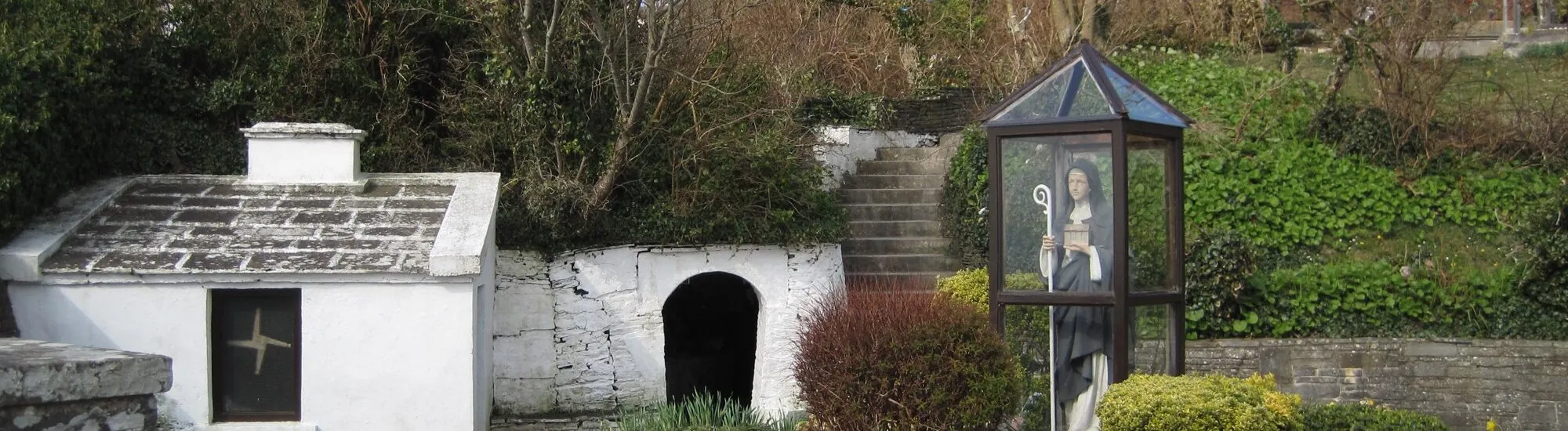
At the lower level, a statue of the saint welcomes visitors beside the shelter. The passage leads to the spring, among objects brought over the course of many visits. Some accompany a prayer or request, while others offer thanks or commemorate a loved one. Their accumulation gives an idea of the bond families retain with this place long after their first visit.
Clare Heritage also documents the custom of leaving pieces of cloth as a sign of prayer. Accounts link the water from the well with healings. They form part of the history of local devotion.
A flight of steps leads up to the cemetery and the upper part of the shrine. In the prayer route documented by researchers, pilgrims begin near the statue, climb to the upper section, then return to the spring. The two dates traditionally associated with the site are 1 February, St Brigid’s feast day, and 15 August, the Feast of the Assumption. To place the first occasion in context, discover the traditions of St Brigid’s Day.
From Liscannor, follow the R478 towards the Cliffs of Moher and look for St Brigid’s Well on your map. The stop is beside a busy road. Use an authorised parking space only and leave yourself enough room to manoeuvre. Allow around 15 minutes to see the lower shrine, or longer if you climb up to the cemetery. The passage is narrow and the steps can be slippery in wet weather. If you are visiting with a pushchair or find steps difficult, plan to limit your visit to what you can see from the lower level.
The shrine remains a place of contemplation. Allow those who come to pray to pass, and avoid close-up photographs of cards bearing names or personal messages.
The well fits easily into a half-day on the Clare coast. Start at Liscannor harbour, stop at Ballysteen, then continue by road to the viewing platforms at the Cliffs of Moher. If visibility is poor, save the cliffs for a clearer spell and take time to see the shrine and the bay. Check the status of the coastal trail before planning to connect the sites on foot.
Want to extend your visit without having to rush around? Here are a few well-located places to stay near the must-see attractions.
Essential information to help you plan your visit, including key landmarks, access information, and booking options.
R478, Liscannor, County Clare, Republic of Ireland, Tourist sites in Ireland
52.95213, -9.42236
The well is indicated as freely accessible all year round. Clare Heritage publishes no official opening hours. Visit during daylight to see the passage and steps more clearly.
Check the opening hours and admission requirements before you leave, especially during peak season or on Irish public holidays.
Free admission. No entry ticket or booking is indicated.