

In Dingle, St James’ Church brings together a still-active church, an ancient graveyard and a music venue known far beyond Kerry. Just off Main Street, its gravestones place the town in a history that stretches further back than its pubs and boats. Within the church walls, services sit alongside concerts and cultural gatherings. A visit offers a chance to explore these different lives, provided you distinguish between visiting the site, gaining access to the interior and attending an event.
The site of St James’ belongs to the history of Dingle’s medieval parish. The building seen today, however, dates from the early 19th century: it should not be described as an intact medieval church. Older masonry was reused, while successive alterations gave the whole its present appearance.
The side chapel of St Mary’s is an important landmark in this continuity. It was retained for worship while much of the old church fell into disrepair. The site includes a memorial to John Fitzgerald, Knight of Kerry, who died in 1741.
St James’ is part of the Church of Ireland, in the Anglican tradition, and remains a place of worship. Its welcome for visitors and cultural activities is additional to this religious role. During your visit, discretion is therefore called for if a service or a time of reflection is under way.
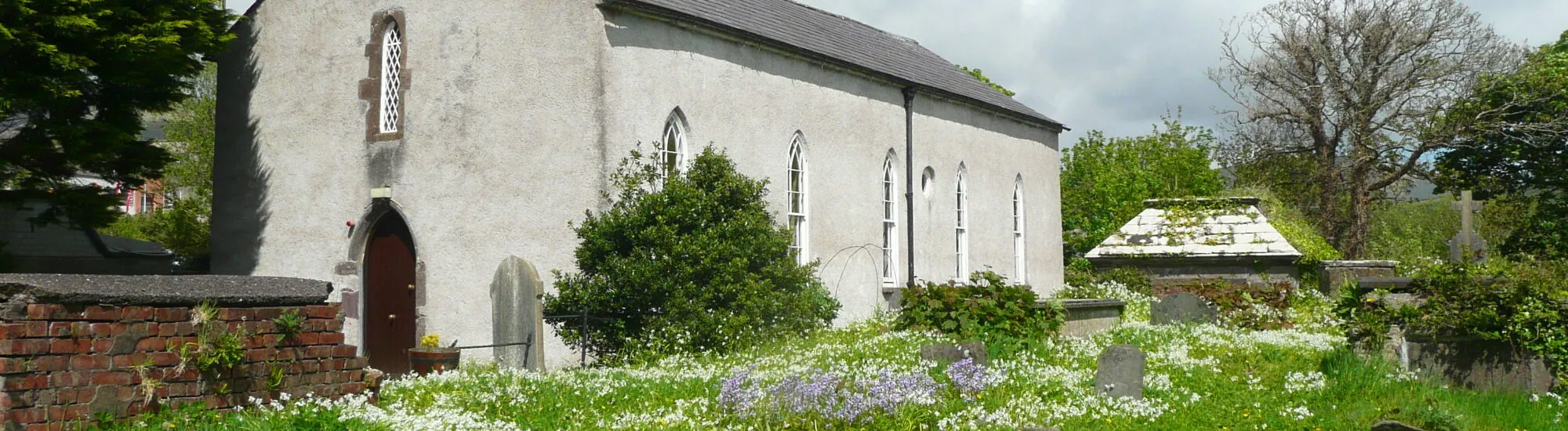
The architecture combines an early 19th-century structure with Gothic Revival features. Look at the narrow lancet windows, then the chancel window and its wooden tracery. These elements give character to a building whose interest lies as much in its proportions and details as in its exterior silhouette.
The Irish Georgian Society documents a window restoration begun in 2004. The work involved their surrounds and damaged timber sections; two replacement windows were also reworked to restore consistency with the other openings. Looking closely at these details helps explain what it means to preserve a building that is still in use: to repair, adapt and pass it on, rather than freeze a ruin in time.
Around the church, the sloping ground contains an ancient graveyard. The Heritage Council notes that it was the subject of an archaeological survey in 2014. Exploring it complements a visit to the building: the graves recall the families and generations who lived in this part of Dingle.
St James’ historical account mentions, in particular, a gravestone dated 1504 and linked to the Fitzgeralds, whose carvings and inscriptions are greatly worn. Not every mark can therefore be easily read. Take time to observe the visible shapes and dates without touching, rubbing or attempting to clean the stones.
Keep to accessible paths and avoid walking over graves. If you are visiting with children, it is best to explain the nature of the place before entering: it is a space of remembrance, even if your walk is brief.
The dedication to St James takes on particular significance in a maritime town. Dingle was one of the Irish ports from which pilgrims set sail for Galicia on their way to Santiago de Compostela. The religious site thus places Dingle Harbour within an ancient network of travel and exchange.
One tradition attributes the construction or funding of the old church to the Spanish. The detailed historical study published by St James’, however, calls for a more nuanced reading. Relations with Spain are indeed an important aspect of local history; they are not enough to prove that the building was constructed by Spanish craftsmen.
The Heritage Council also links the site to the Treaty of Dingle, concluded in 1529 between the Earl of Desmond and a representative of Charles V. For visitors, this context is a reminder of how closely this small Atlantic port was connected to European affairs.
The church hosts folk and traditional music concerts, as well as talks and other cultural events. This use helps keep the building at the heart of town life. It does not replace services: the two roles coexist.
Other Voices has played a particular part in bringing St James’ to wider attention. Recordings made in this small church are among the event’s most recognisable images. For its 2026 edition, the organiser states that places for recordings in the church are allocated by competition. A ticket or wristband for another part of the festival does not therefore automatically grant access to these sessions.
Before planning an evening out, check the programme and admission arrangements directly with the organiser. Seeing a concert in the church and visiting it for its heritage are two different experiences, with separate access arrangements.
The site is very close to Main Street and fits easily into a walk around the town centre. To visit the interior, consult the official St James’ Church visitor information or contact the Friends of St James’. The church does not advertise daily visitor opening: a closed door does not mean you will be able to visit later that same day.
Wear suitable footwear for the ground in the graveyard. If you need step-free access or particular assistance, ask about the exact arrangements before travelling: the historic nature of the site and the slope of the ground mean that full accessibility cannot be assumed.
To extend your exploration of Dingle’s artistic side, you can visit the Carol Cronin Gallery. A walk towards the waterfront then leads to the quays, connecting this religious and cultural history with the town’s harbour landscape.
Want to extend your visit without having to rush around? Here are a few well-located places to stay near the must-see attractions.
Essential information to help you plan your visit, including key landmarks, access information, and booking options.
Main Street, Dingle, Dingle Peninsula, County Kerry, Republic of Ireland, Tourist attractions in Ireland
52.141695, -10.267486