Just off Capel Street, a lane in north Dublin leads to a chamber whose floor lies below today’s street level. Descend the steps and you will find the ribs of a medieval vault that survived the disappearance of the monastery to which it belonged. This is St Mary’s Abbey Chapter House, the chapter house of the former Abbey of St Mary. Monks once gathered here to read their rule. Much later, before the Council of Ireland, a young nobleman surrendered his sword of office here and defied Henry VIII.
Heritage Ireland dates the foundation of St Mary’s Abbey to 1139. The abbey was among the most important religious houses in medieval Ireland. To picture its scale, set aside the present-day street layout for a moment. The chamber open to visitors was part of a complex that included a church, cloister and the buildings needed for community life. The street names around Capel Street still offer a few clues, while most of the buildings have disappeared from the cityscape.
Heritage Ireland identifies two surviving parts of the original buildings: the chapter house and the slype, an adjoining passage. Nothing of the church itself remains visible on the site. After the monastery was dissolved, its buildings were reused, dismantled or absorbed into later construction. According to the National Inventory of Architectural Heritage, the chamber survived in the basement of a later warehouse. This proximity between medieval masonry and commercial buildings partly explains why the site is so inconspicuous from the street.
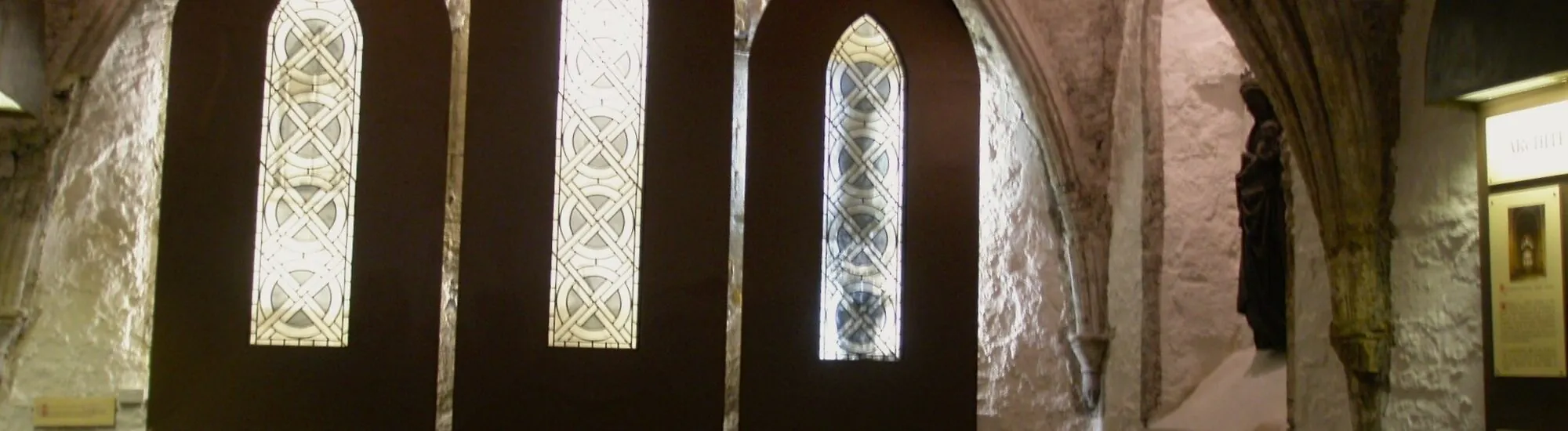
The surviving chamber dates from around 1200. Look up to follow the ribs that structure the vault and examine the carved stones on which they rest. The heritage inventory describes it as the earliest known rib vault in a Cistercian abbey in Ireland. It also notes three narrow openings to the east, now blocked up. These are useful markers for understanding the building: the openings show where the light came from, the ribs give the room its shape, and the neighbouring passage recalls its connection with the rest of the monastery.
The chapter house was used for meetings of the community. After morning Mass, the monks gathered here to hear a passage from their rule. The abbot would comment on it, followed by prayers for the dead and a time when each man could acknowledge his failings before the others. The name of the room then takes on a concrete meaning: the chapter refers both to the text being read and to the assembly gathered to hear it. This routine offers another way of looking at the walls. Beneath the vault, the affairs of a house whose communal life followed a precise rhythm were conducted.
The slype helps to picture this movement through the complex. Heritage Ireland explains that this corridor linked the cloister to the spaces on the east side, where the infirmary was generally located in this type of complex. A few metres are enough to grasp what the centuries have erased: a passage that now appears to lead nowhere once belonged to a network of rooms and walkways used every day.
The Council of Ireland also used the chamber for its meetings. In 1534, Thomas FitzGerald, son of the Earl of Kildare, arrived here while his father had been summoned to England. A rumour claimed that he had been executed. The Dictionary of Irish Biography recounts that the young man surrendered the sword symbolising his office and denounced royal policy. The episode marked the beginning of the rebellion of the man known as Silken Thomas.
The revolt failed, and FitzGerald was executed in 1537. In Dublin, the chamber places this act in context: a Council meeting held in an abbey, where the surrender of a sword publicly marked a break with the authority the young man had represented until then. The contrast with the monks’ daily assemblies gives the visit its full force. Centuries apart, the same room was used to read the rules of a community and to defy a king.
The entrance is at 4 Meetinghouse Lane, near Capel Street, on the north bank of the Liffey. Access is seasonal and by guided tour only. Check the available dates through Heritage Ireland’s booking link before travelling. The chamber floor lies below street level. If you need step-free access or assistance, contact the Office of Public Works before booking.
To continue exploring medieval Dublin, cross the Liffey to St Audoen’s Church. It offers another point of comparison with the chamber on Meetinghouse Lane: here, you will find a religious building in its historic neighbourhood, while the Abbey of St Mary can largely be glimpsed through its two surviving rooms. If you are looking for the ruins overlooking Howth Harbour, that is another site: our page on St Mary’s Abbey in Howth is dedicated to it.
Want to extend your visit without having to rush around? Here are a few well-located places to stay near the must-see attractions.
Essential information to help you plan your visit, including key landmarks, access information, and booking options.
4 Meetinghouse Lane, Smithfield, Dublin, County Dublin, Republic of Ireland, Tourist sites in Ireland
53.34750, -6.26917
Seasonal opening, by guided tour only. Check available dates on the official Heritage Ireland website.
Check the opening hours and admission requirements before you leave, especially during peak season or on Irish public holidays.
Free admission. Book online through the link provided by Heritage Ireland.