

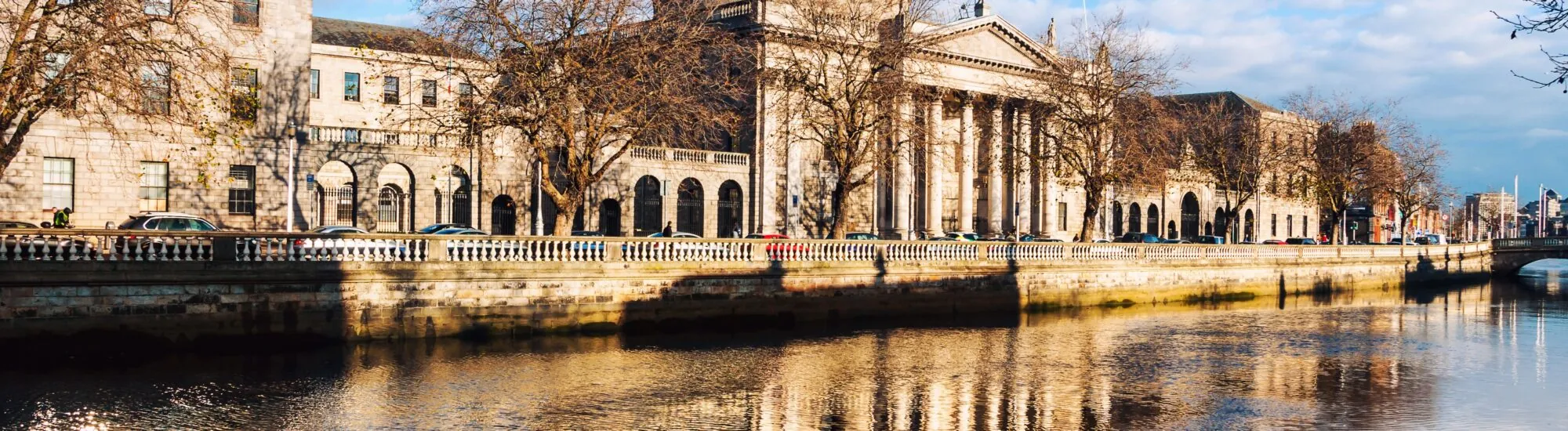
With its green dome, monumental portico and long façade facing the Liffey, Dublin’s Four Courts cut a striking figure in the heart of the Irish capital. Located on Inns Quay, the complex is home to the Supreme Court, the Court of Appeal and the High Court of Ireland, among other institutions.
Yet this neoclassical masterpiece is more than a judicial building. Occupied during the Easter Rising, shelled at the start of the Civil War and then devastated by an explosion that destroyed centuries of archives, its very stones bear witness to several pivotal chapters in Irish history.
The name Four Courts does not refer to the complex’s internal courtyards. It denotes the four main common-law courts that sat there before Irish independence:
Contrary to a claim sometimes made, the Four Courts were not built to house a future Supreme Court independent of British rule. Their creation formed part of the judicial system of Ireland, which was then administered from London.
In the 20th century, however, the building became one of the principal symbols of the new Irish state’s judicial system.
Work began in 1776 under the direction of the architect Thomas Cooley. The initial project included the construction of a repository for public records. When Cooley died in 1784, James Gandon took over the project and gave it a new scale.
Gandon was already one of the leading figures of neoclassical architecture in Dublin. He also worked on the Custom House, another landmark on the banks of the Liffey. For the Four Courts, the architect devised a monumental composition centred on a vast circular space, now known as the Round Hall.
The courts began moving into the complex from 1796. Work continued for several more years, with extensions and arcades added in the early 19th century.
The main façade is dominated by a portico of six Corinthian columns. Above it, a triangular pediment and a circular drum draw the eye towards the famous copper-clad dome, recognisable by its green patina.
The centre of the building is occupied by the Round Hall, a circular space lit by the dome. Several courtrooms and judicial offices are arranged around this impressive rotunda.
The façade is composed chiefly of granite and Portland stone. Its highly symmetrical design, columns, pavilions and allegorical sculptures express the values traditionally associated with justice. Several figures sculpted by Edward Smyth represent Justice, Wisdom, Mercy and Authority, among others.
Viewed from the south bank of the Liffey, the complex forms one of Dublin’s most recognisable architectural vistas. The best views are from the opposite quays or from O’Donovan Rossa Bridge.
In April 1916, the Four Courts district became one of the areas controlled by republican insurgents. Volunteers under the command of Edward “Ned” Daly occupied several positions around the judicial complex and in neighbouring streets.
One objective was to control the western approaches to central Dublin and slow the advance of British forces. Fighting was particularly intense in the North King Street area.
The building survived the uprising, unlike other Dublin landmarks that were severely damaged during the fighting. Six years later, however, it found itself at the centre of an even more destructive conflict.

The Four Courts shelled during the Battle of Dublin – public domain
Following the signing of the Anglo-Irish Treaty in 1921, the independence movement split. Part of the IRA accepted the compromise that led to the creation of the Irish Free State. Opponents of the treaty rejected, among other things, the oath of allegiance to the British Crown and the continued partition of the island.
In April 1922, around 200 anti-Treaty IRA fighters occupied the Four Courts. Their presence placed the new provisional government in a particularly difficult position.
On 28 June 1922, government forces opened fire on the complex with artillery pieces. Michael Collins authorised the offensive, regarded as the beginning of the Battle of Dublin and, more broadly, the Irish Civil War.
After several days of shelling and fighting, the anti-Treaty garrison surrendered. The building was left badly damaged.
On 30 June 1922, a huge explosion devastated the Public Record Office in the western wing of the complex. The resulting fire destroyed a considerable part of the administrative, judicial, parish and genealogical archives held there.
Documents dating back to the Middle Ages disappeared within hours. This disaster helps explain why research into the history of Irish families is particularly complex today.
The precise causes of the explosion have long been debated. Munitions had been stored in the occupied building, but the exact circumstances of their detonation remain disputed. It is therefore best to avoid attributing the destruction to a deliberate act without solid historical evidence.
The Beyond 2022 project, now the Virtual Record Treasury of Ireland, is working to digitally reconstruct part of these collections from copies and documents scattered across different institutions.
Following the destruction of 1922, the main courts had to leave the complex. They first sat at King’s Inns, then at Dublin Castle while reconstruction work was under way.
The reconstruction sought to restore the overall appearance envisioned by James Gandon, while adapting the interior to the needs of the new state. Some of the current rooms, including the main Supreme Court chamber, therefore do not exactly replicate the spaces that existed before the Civil War.
The courts returned to the Four Courts in 1931. Less than ten years after its near-destruction, the building resumed its place at the centre of Irish judicial life.
The Four Courts are now home to several major institutions, including the Supreme Court of Ireland, the Court of Appeal and the High Court. Various administrative departments and judicial offices are also spread across the buildings of the complex.
The Supreme Court is the country’s highest court. It primarily hears cases involving important points of law or matters of general public interest. Its hearings take place in the historic building designed by Gandon.
The Four Courts therefore remain a working centre of justice. Lawyers, judges, court clerks, litigants and members of the public pass through them every day. This official function means that access rules are very different from those of a museum.
The Four Courts are not a conventional tourist attraction. There is no permanent programme of daily guided tours at set times. The 10.30am and 12.30pm times sometimes mentioned online are no longer confirmed by the Irish Courts Service.
Members of the public can nevertheless enter the accessible parts of the complex on working days and attend certain hearings, particularly those of the Supreme Court. It is advisable to check the court calendar in advance to ensure that a case is actually being heard.
All visitors must pass through security screening at the public entrance on Inns Quay. Identification may be requested and certain items are prohibited. Allow extra time when court activity is particularly busy.
Inside a courtroom, visitors must remain silent and dress and behave respectfully. Mobile phones must be switched off. Photography, video recording and audio recording of hearings are prohibited.
It is possible to enter or leave a hearing discreetly, provided proceedings are not disrupted. However, the number of seats open to the public depends on the courtroom and the case being heard.
Even without attending a hearing, the Four Courts are worth stopping at during a walk along the Liffey. The façade, Corinthian portico and dome can easily be admired from Inns Quay, but the distance afforded by the south bank gives a better sense of the whole complex.
The monument stands close to several historic sites in Dublin, including Christ Church Cathedral, Dublinia, Smithfield, St Michan’s Church and the old Liberties districts. It can therefore be naturally included in a walking tour of the western part of the city centre.
An official virtual tour of the Four Courts also makes it possible to explore the Round Hall, the Supreme Court and several courtrooms without being subject to the hearing schedule.
Want to extend your visit without having to rush around? Here are a few well-located places to stay near the must-see attractions.
Essential information to help you plan your visit, including key landmarks, access information, and booking options.
Inns Quay, Smithfield, Smithfield
53.345899, -6.273463
45 minutes
The Four Courts are closed on Sundays and public holidays.
Check the opening hours and admission requirements before you leave, especially during peak season or on Irish public holidays.