


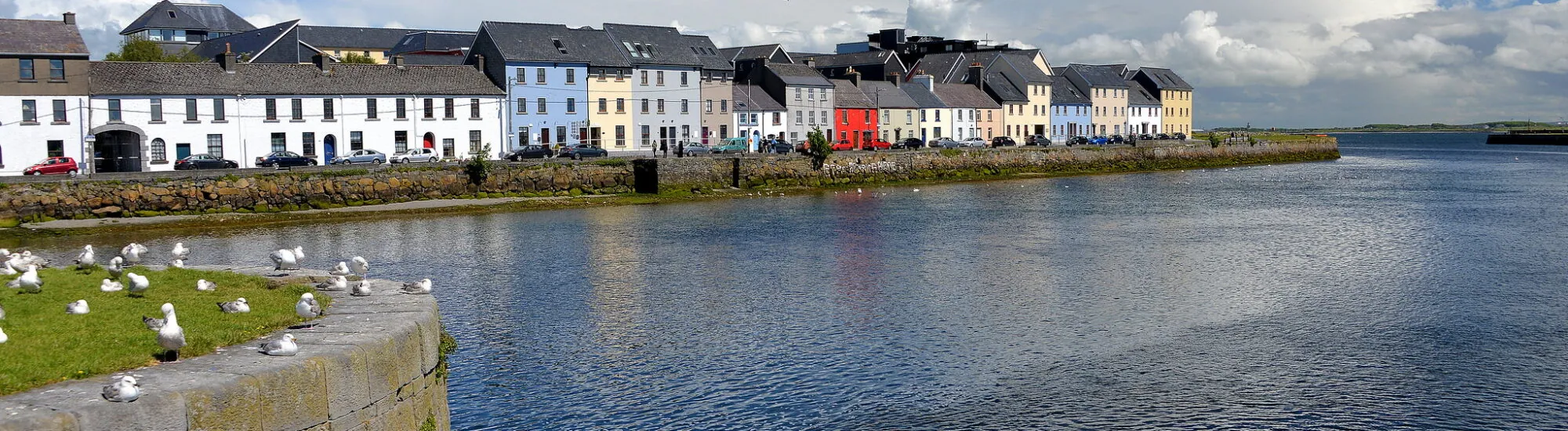
The Long Walk is one of Galway’s most recognisable sights. This short waterside walk, just beyond the Spanish Arch and the Galway City Museum, features a row of colourful façades overlooking the River Corrib, only a few metres from Galway Bay.
It has become a true postcard image of the city. From the opposite bank, especially on the Claddagh side, the houses of the Long Walk form one of Galway’s most photographed views: a pastel-coloured row of houses, a small quay, a few boats and, in the background, the city’s historic heart.
Its name is misleading, however: The Long Walk is anything but a long hike. It is instead a pleasant urban stroll, easily incorporated into a visit to central Galway, between the Spanish Arch, the Claddagh and Salthill.
The Long Walk is a natural next stop after visiting the Spanish Arch or Galway City Museum.
From Spanish Parade, simply make your way to the quay beside the water and follow the row of houses overlooking the Corrib. Within minutes, the bustle of the shopping streets gives way to a far more maritime atmosphere.
The walk itself is very short. Allow around 5 to 15 minutes to stroll along it at an easy pace, or longer if you stop to take photographs or watch the boats.
The appeal of The Long Walk lies not in its length, but in its atmosphere.
Here, Galway perfectly reveals its character: a human-scale city built on the water’s edge, where the river, harbour and bay remain ever-present in the landscape.
The Long Walk owes its reputation above all to its strikingly photogenic setting.
The houses lining the quay have façades in a range of colours, from white and yellow to red and blue, depending on the building. When the light reflects on the water, the scene can feel almost like a maritime village, despite being right in the heart of Galway.
This image contrasts with the rest of the city centre, which is more built-up and lively, especially around Quay Street and the Latin Quarter.
For the most spectacular view, however, walk a little further to the Claddagh area, on the other side of the water.
From this bank, The Long Walk can be seen in its entirety, with its colourful houses lined up along the quay, the Spanish Arch at one end and Galway Bay gradually opening out to the west.
Most of the site’s iconic photographs are taken from this angle.
The Long Walk is part of Galway’s maritime history.
Nearby stands the Spanish Arch, built in 1584 as an extension of the city’s medieval fortifications to protect the quays and the ships that came here to load and unload goods.
At the time, Galway had important trading links with Spain and other European ports. The area around the Spanish Arch was therefore a real interface between the fortified city and its maritime activity. :contentReference[oaicite:1]{index=1}
The Long Walk came later. In the 18th century, the Eyre family developed an extension of the quays along the waterfront, gradually creating the walk we know today. :contentReference[oaicite:2]{index=2}
The area therefore retains a direct link with several centuries of port history, even if the colourful houses now give it a far more peaceful appearance than the old commercial quays once had.
To truly understand The Long Walk, look across to the other side of the river.
Opposite the houses lies the Claddagh, a former fishing village that is now a district of Galway.
The Claddagh once had a very strong identity, with its own maritime traditions, fishermen and community organisation. Today, it is best known worldwide for the famous Claddagh ring, a symbol of love, friendship and loyalty. :contentReference[oaicite:3]{index=3}
The area also offers a glimpse of Galway’s maritime life: small boats, birds, walkers and sometimes seals can be found in the waters near the mouth of the Corrib. :contentReference[oaicite:4]{index=4}
From the Claddagh, the view of The Long Walk is particularly beautiful at sunrise or later in the day, when the light brings out the façades.
The Long Walk can easily serve as the starting point for a much longer walk.
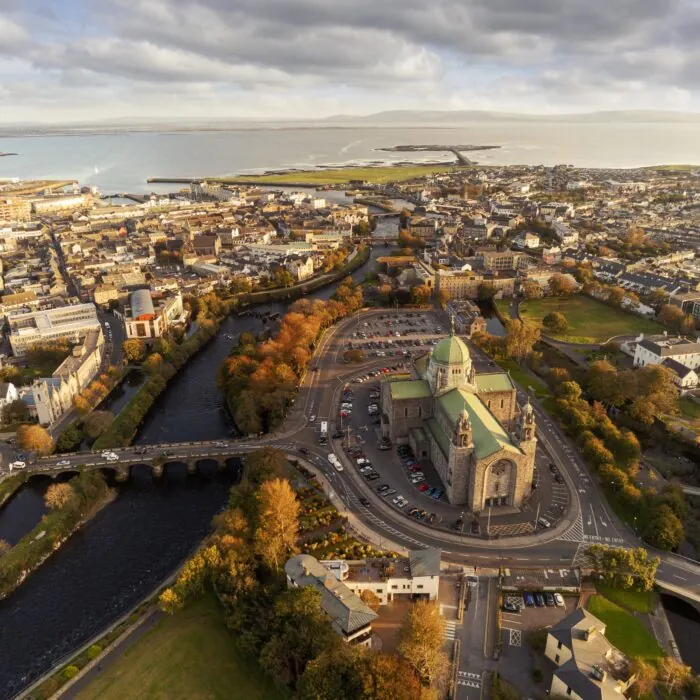
Galway City Council offers a walking route that begins at the Spanish Arch, takes in the Claddagh Basin, Nimmo’s Pier and South Park, then continues to the Salthill Promenade and Blackrock.
The route covers around 6 km, with dedicated walking and cycling paths along several sections. :contentReference[oaicite:5]{index=5}
This walk gradually takes you from Galway’s historic centre to a landscape much more open to the bay.
For a traveller visiting the city for the first time, it is one of the most pleasant routes: the Spanish Arch and The Long Walk provide the historical dimension, the Claddagh recalls the old maritime tradition, and Salthill then offers a true seafront facing the Atlantic.
The Long Walk is ideally located for exploring central Galway.
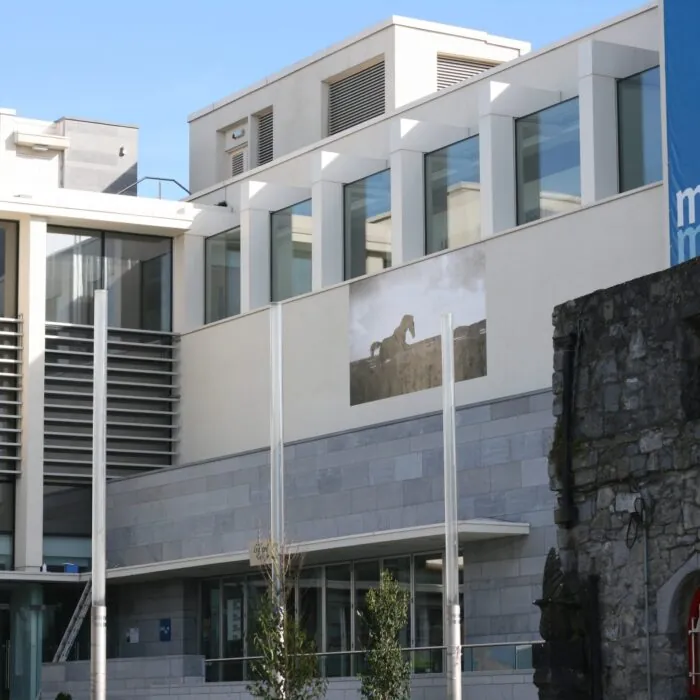
Just a few metres away is the Galway City Museum, dedicated to the city’s history, archaeology and heritage.
Right beside it, the Spanish Arch is one of the last major remnants of the city’s former fortifications.
Heading back towards the centre, Quay Street and the Latin Quarter are only a few minutes away: Galway’s lively heart, with its pubs, restaurants, shops and street musicians.
In the other direction, cross the Corrib to reach the Claddagh, then continue to Nimmo’s Pier and, if you have more time, on to Salthill.
The Long Walk can be visited at any time of day, but the light changes the scene dramatically.
In the morning, the area is generally quiet, allowing you to enjoy the quays without too many people around.
In the late afternoon and evening, the colours often become more interesting for photography. When the sky clears to the west, light travels across Galway Bay and gives the Long Walk’s façades particularly warm tones.
Overcast skies are not a problem, however. Galway is famous for its changeable weather, and the colourful façades can sometimes stand out even more against a grey sky.
At high tide, when the water is calm, reflections of the houses can also enhance the site’s photogenic character.
The walk itself takes no more than around ten minutes.
It would nevertheless be a shame to treat The Long Walk as simply a street to rush along.
Instead, allow 30 minutes to an hour to explore the Spanish Arch at a leisurely pace, walk along the quay, cross over to the Claddagh and enjoy the different viewpoints.
If you then continue to Salthill, the walk can easily take up half a day.
The Long Walk ultimately sums up Galway rather well: a city where history, colourful houses, the river and the Atlantic are always just a few steps apart.
Want to extend your visit without having to rush around? Here are a few well-located places to stay near the must-see attractions.
Essential information to help you plan your visit, including key landmarks, access information, and booking options.
The Long Walk, Galway, Galway (County Galway) - Republic of Ireland
53.269523, -9.053563
15 minutes