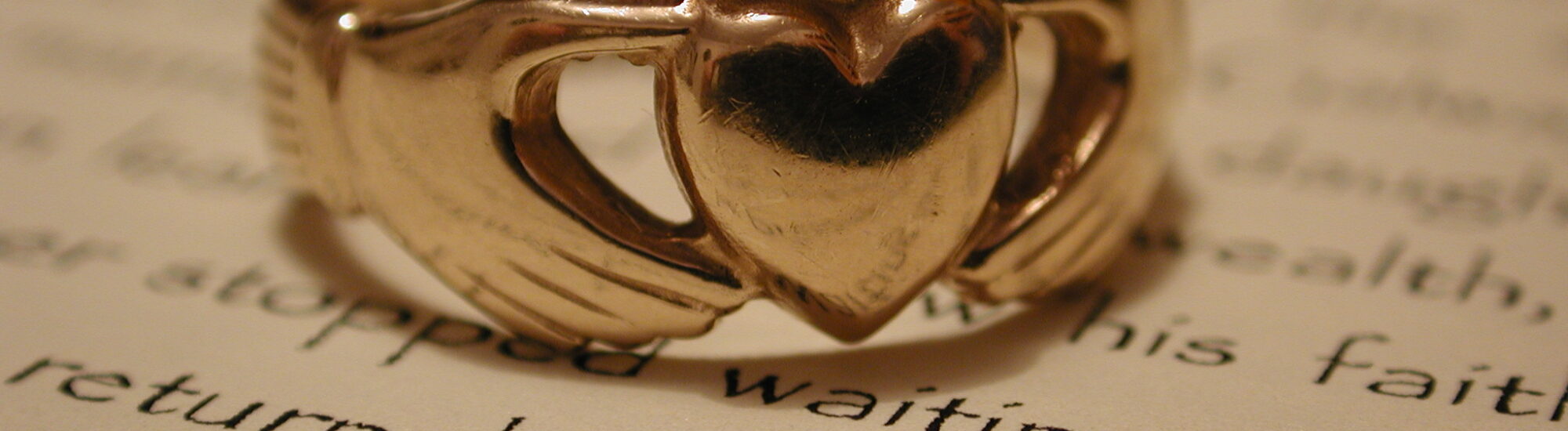
Two hands hold a crowned heart. In three symbols, the Claddagh ring tells a story of love, friendship and loyalty. Born in Galway more than three centuries ago, this Irish ring has become an engagement ring, a wedding ring, a family heirloom or simply a discreet way of expressing one’s attachment to Ireland.
Tradition also holds that the way it is worn reveals the wearer’s relationship status. But beware of a common misunderstanding: it is the direction in which the heart points, not the crown, that should be observed.
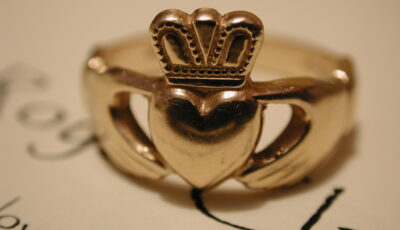
A Claddagh ring – Royal Claddagh – CC BY 2.0
Each element of the ring has a particular meaning:
This symbolism explains why the ring is not limited to romantic relationships. It may be given to a spouse, child, parent or close friend. Some Irish people also wear it as a symbol of their heritage, particularly within communities living abroad.
The Claddagh ring is also a unisex piece of jewellery. Historic designs could be wide and substantial enough to be worn by men, long before jewellers began offering separate collections.
There are now four common ways of wearing a Claddagh ring. Their interpretation depends on the hand chosen and the direction in which the heart points.
| Ring position | Direction of the heart | Common meaning |
|---|---|---|
| Right hand | Point facing the fingers | The heart is free: the wearer is single. |
| Right hand | Point facing the wrist | The heart is taken: the wearer is in a relationship. |
| Left ring finger | Point facing the fingers | The wearer is engaged. |
| Left ring finger | Point facing the wrist | The wearer is married. |
This interpretation should nevertheless be regarded as a popular tradition, rather than an unchanging rule. The National Museum of Ireland points out that the precise origins of these customs remain uncertain. The distinction between engagement and marriage, in particular, may vary between families and periods.
There is therefore nothing to stop you wearing a Claddagh ring simply for its beauty or sentimental value. Nor do you need to be Irish, in a relationship or to have received the ring as a gift.
The earliest known rings corresponding to today’s design date from around 1700. Their design, however, belongs to a much older history: that of the European rings known as fede rings.
The term comes from the Italian expression mani in fede, which may be translated as ‘hands joined in faith’ or ‘in trust’. These pieces of jewellery depict two clasped hands and were used for several centuries as promise, engagement or wedding rings. The motif itself has precedents dating back to Roman antiquity.
The Claddagh ring therefore did not emerge without an earlier model. Goldsmiths in Galway are thought to have adapted this European tradition by adding a crown to the heart and hands, creating the composition that became emblematic of western Ireland.
The ring’s creation is most often attributed to Richard Joyce, a goldsmith active in Galway from the late 17th century to the early 18th century. A gold ring bearing his maker’s mark, made around 1700, is held by the Galway City Museum. It is among the oldest known examples.
The traditional story tells that Richard Joyce was captured by privateers while travelling to the West Indies. Taken to North Africa and sold to a goldsmith, he is said to have learned the craft of working precious metals from his master. Released several years later, he is said to have returned to Galway, where he was reunited with the woman he loved before creating a ring as a token of his fidelity.
This story has all the ingredients of a great romantic legend, but it should not be confused with a fully substantiated biography. Galway City Museum presents it as a remarkable tradition, but one that is largely impossible to verify.
Richard Joyce did exist and worked as a goldsmith in Galway. He was based on Shop Street in the early 18th century and made silver objects for several decades. However, other Galway craftsmen, including Bartholomew Fallon, also made rings of this type at an early date. It is therefore more accurate to say that the design is generally attributed to Joyce than to present him with certainty as its sole inventor.
The ring takes its name from Claddagh, a former fishing village on the western bank of the Corrib, opposite the walled city of Galway. Its name derives from the Irish An Cladach, meaning a bank or shore.
Claddagh once had a very distinct identity. The largely Irish-speaking community lived mainly from fishing and maintained its own customs. Rings depicting the crowned heart and clasped hands were used there as wedding jewellery and could be passed down within families.
The design was not, however, reserved for the village’s inhabitants. The National Museum of Ireland states that it was also worn in Connemara, the Aran Islands and other areas of the west. It was only from the mid-19th century that its association with Claddagh became particularly strong and its current name came into widespread use.
The former village of thatched houses has now disappeared. Considered unsanitary, its homes were gradually demolished after 1927. The modern district nevertheless retains its name and memory, just a few minutes’ walk from Galway city centre.
A Claddagh ring can certainly be used as an engagement ring or wedding ring. Traditional designs are generally understated, while contemporary creations may incorporate a diamond, a gemstone, Connemara marble or Celtic knotwork.
In some Irish families, the ring is passed from mother to daughter. This custom is not universal, however. A ring may be given for a wedding, birthday, birth or departure abroad. It then becomes less an indicator of relationship status than an object of remembrance, linking several generations.
Galway’s jewellers are the best place to discover locally made designs. Several workshops in the city centre continue the craft of working silver and gold, notably around Shop Street, Mainguard Street and Quay Street.
Claddagh rings are also sold throughout Ireland and on Irish jewellers’ websites. Before buying, however, check the difference between jewellery simply inspired by Ireland and a ring actually made in the country.
For a precious-metal design, look for the following information:
The ‘925’ marking alone indicates the declared silver content, but does not prove that the ring was made in Ireland. If the jewellery’s origin matters to you, choose an identifiable maker and an explicit ‘Made in Ireland’ indication.
In 2026, a costume ring may cost a few dozen euros. For an Irish-made sterling silver ring, you should generally expect to pay around €50 to €150. Heavier, handmade designs, or those combining silver, gold and stones, may exceed €200.
A solid gold ring costs several hundred euros and may exceed €1,000 depending on its weight, carat value and the stones used. These figures are indicative only: precious-metal prices and the craftsperson’s work directly affect the final price.
It is best to know your ring size before buying. The crown and hands make some designs more difficult to resize than a conventional band, especially when they feature stones or a continuous pattern.
The Galway City Museum holds a gold ring made around 1700 and marked with Richard Joyce’s initials. The museum also presents the history of the former village of Claddagh and its fishing community.
Admission to the museum is free, with no booking required. In 2026, it is generally open from Tuesday to Saturday, 10 am to 5 pm, and on Sundays from 12 pm to 5 pm between Easter and mid-September. Opening hours and displayed objects may change, so check the official website before your visit.
Carried around the world by generations of emigrants, the Claddagh ring was already known far beyond Galway when it appeared on television. The series Buffy the Vampire Slayer nevertheless helped introduce it to a new audience in the late 1990s.
In the series, Angel gives Buffy a Claddagh ring. The piece of jewellery becomes a symbol of their relationship and mutual affection. This memorable appearance reinforced its international profile, without being the origin of a tradition already several centuries old.