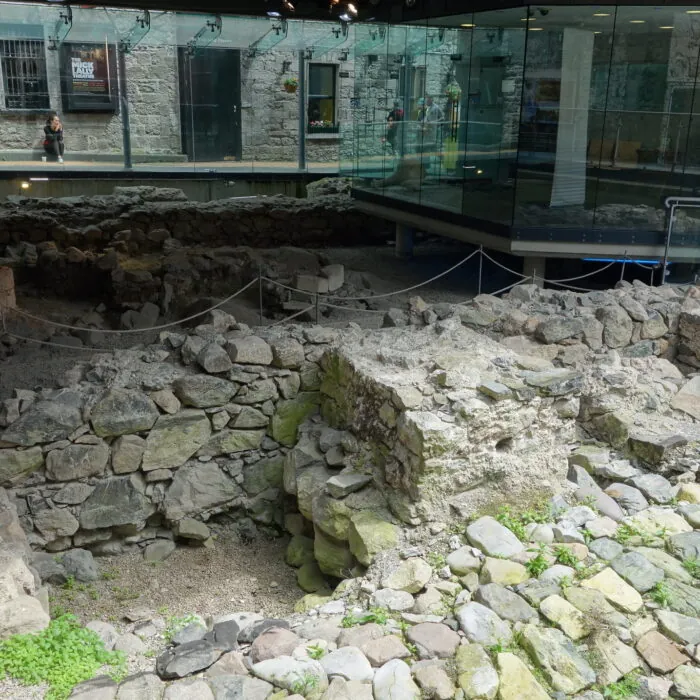

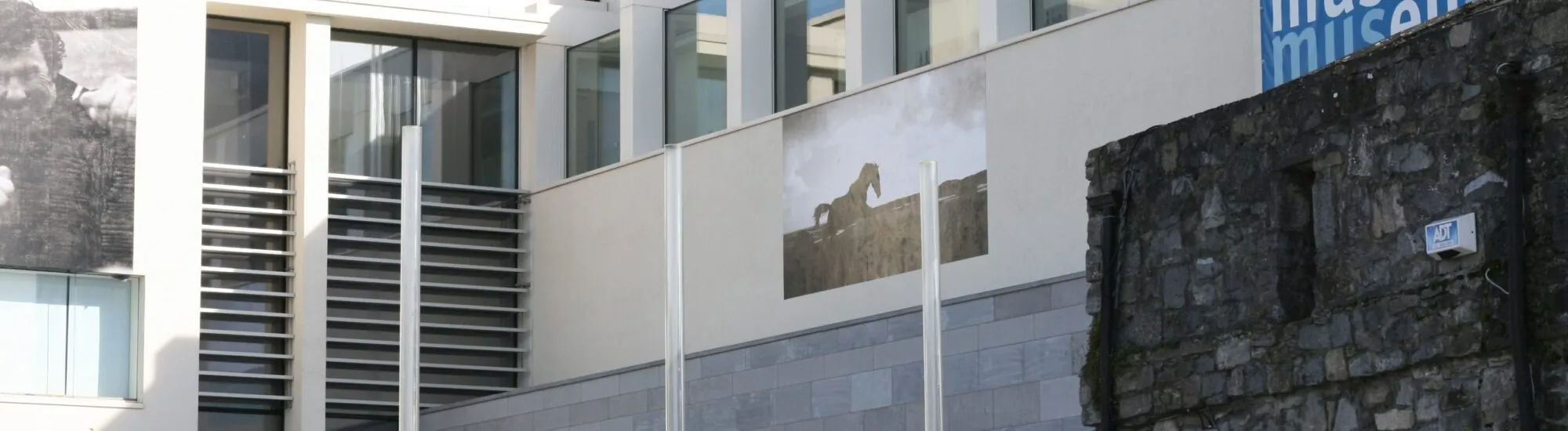
Set against the remains of the medieval city wall and overlooking the mouth of the Corrib, the Galway City Museum tells the story of a city shaped by the Atlantic. Its collections trace the county’s earliest settlements and follow Galway’s development through medieval trade, fishing, Gaelic culture and the struggle for Irish independence.
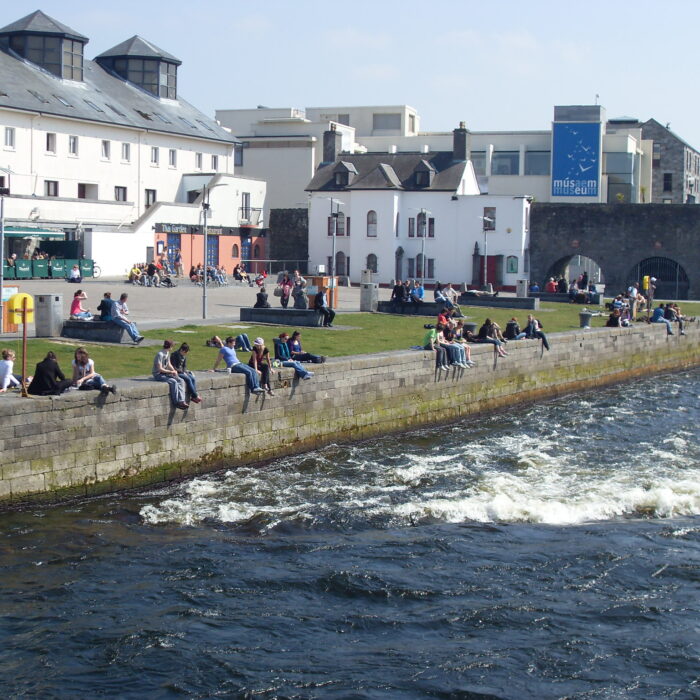
The museum is housed in a contemporary building beside the Spanish Arch, just a few steps from Claddagh and the famous Long Walk. Free admission and a wide range of exhibitions make it an excellent introduction to the city, particularly before exploring its historic centre.
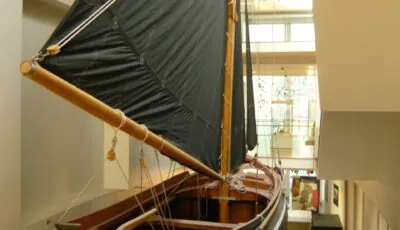
A Galway Hooker at Galway City Museum – WordRidden – CC
The various galleries explore Galway’s archaeology, social history, maritime traditions, marine science and political life. The displays combine original objects, photographs, archival documents, films, relief maps and interactive exhibits.
The museum does not follow a strictly chronological route. Each exhibition examines an aspect of the city or county: prehistoric Galway, the medieval merchant city, the fishing village of Claddagh, traditional boats and the revolutionary period of the early 20th century.
Most information is provided in English and Irish. Even without a full command of these languages, the objects, maps and reconstructions make the main themes easy to understand.
Galway’s first municipal museum was established in the mid-1970s in Comerford House, a residence near the Spanish Arch. Its initial collections included carved stones and various remains from the city’s old buildings.
As the collections expanded and visitor numbers rose, a new museum was built behind Comerford House. Designed by the Office of Public Works for Galway City Council, the present building officially opened in April 2007.
Its L-shaped architecture was designed to respect the scale of the historic district and preserve the prominence of the Spanish Arch. Large openings look out over the Corrib, Claddagh and Galway Bay, constantly recalling the city’s relationship with the water.
The prehistoric exhibition traces the earliest human communities to settle in western Ireland. Stone tools, everyday objects and archaeological information chart the transition from hunter-gatherers to the first Neolithic farmers.
The route also presents the changes brought about by metalworking during the Bronze and Iron Ages. These collections place the city within a region inhabited for millennia, long before the medieval port was founded.
This section is relatively accessible for families, thanks to its illustrations and reconstructions. Above all, it adds welcome historical depth to a visit to Galway, which is often approached solely through its medieval heritage.
Galway developed in the Middle Ages around a fortress built near the Corrib. Following the arrival of the Anglo-Normans, the town gradually became a walled trading port.
From the 13th century onwards, merchant families took on a central role in local economic and political life. They would later become known as the Tribes of Galway.
The museum displays architectural fragments, carved stones, coins, imported objects and maps that help reconstruct the fortified city. These remains testify to trade links with England, France, Spain and Portugal.
The collections also shed light on several monuments still visible in the city centre, including Lynch’s Castle, St Nicholas’ Collegiate Church and the Spanish Arch. The museum is therefore an excellent starting point before a walk through the medieval streets.
Galway City Museum stands immediately beside the Spanish Arch. Despite its name, the arch was not built by the Spanish. It formed part of an extension to the city walls built in the 16th century to protect the quays.
Its name recalls the commercial links between Galway and the Iberian Peninsula. Spanish ships called at the port to trade wine, salt and various goods for Irish produce.
The monument’s proximity naturally extends the museum’s explanations. Several stones and fragments displayed in the galleries in fact come from former buildings or defensive structures in the city.
One of the museum’s most striking exhibits is the Máirtín Oliver, a full-size Galway Hooker suspended in the atrium. This traditional vessel is recognisable by its dark hull and reddish-brown sails.
Contrary to what its English name might suggest, Galway Hooker does not refer to a single type of boat. The term covers several categories of vessels suited to fishing, transport and sailing in the bay’s sometimes challenging waters.
These sailing boats carried fish, cattle, turf, limestone and various goods between Galway, Connemara and the Aran Islands. Their shallow draft allowed them to approach coasts without proper harbours.
The exhibition also presents the tools of boatbuilder John Reney, regarded as one of the last shipwrights to have supplied boats to the old Claddagh fleet. Films, texts and photographs show that the Galway Hooker tradition remains alive, particularly during regattas held around the bay.
On the opposite bank of the Corrib, Claddagh was for several centuries a fishing community distinct from the walled city. Its inhabitants had their own customs, clothing and forms of social organisation.
The museum holds photographs, household objects, clothing and a model that reveals the layout of the old village before its transformation in the 20th century.
Claddagh is now known worldwide for the Claddagh ring, whose two hands, heart and crown symbolise friendship, love and loyalty. The museum places this piece of jewellery in its local context, away from the sometimes highly commercial interpretations surrounding it.
Part of the collection is devoted to the people of the county’s rural areas. Agricultural tools, craft objects, clothing and household equipment illustrate living conditions before mechanisation.
These objects are a reminder that Galway was not only a merchant city. Its economy also depended on farms, livestock farming, fishing and trade with Connemara and the Aran Islands.
The museum notably holds a collection of industrial and agricultural tools that reveals the evolution of techniques. The simplest objects are often among the most evocative: they show how families worked, cooked, travelled and used local resources.
The exhibition Revolution in Galway, 1913–1923 looks back at the part played by the city and county in the upheavals that led to the independence of part of Ireland.
Photographs, weapons, posters and personal belongings evoke the Easter Rising, the War of Independence and the Civil War. The display gives considerable attention to individual stories and the divisions that ran through families and communities.
Liam Mellows is a particularly significant figure. He led the insurgents in County Galway in 1916 before opposing the Anglo-Irish Treaty and being executed during the Civil War.
The museum thus shows that revolutionary history was not confined to the streets of Dublin. The rural areas and small towns of the west also played a part in the birth of the Irish state.
Galway’s relationship with the ocean is not solely a matter of history. Several spaces focus on marine science, biodiversity and deep-sea exploration.
Visitors can discover species found in the Atlantic, how currents work and the techniques used to observe the depths. Interactive exhibits make this section particularly suitable for children.
This scientific dimension recalls Galway’s contemporary role in marine research. The city is home, among other institutions, to the Marine Institute, one of Ireland’s leading bodies dedicated to studying and protecting the marine environment.
Alongside its permanent collections, Galway City Museum hosts temporary exhibitions on social history, photography, the arts, local communities and major contemporary issues.
The programme changes throughout the year. It enables the museum to address sometimes difficult subjects, including religious institutions, poverty, migration and marginalised populations.
Talks, tours, family workshops and school activities are also organised. Most are free, though some require advance booking because places are limited.
In May 2026, a public investment of €12 million was announced to transform and expand Galway City Museum. The project includes the renovation of Comerford House and the creation of new immersive exhibition spaces.
The aim is to make the museum a major cultural hub on the Wild Atlantic Way, better able to present the area’s maritime history, archaeology and heritage.
The works may result in temporary changes to the visitor route or opening hours. It is therefore advisable to check the official website before visiting, although the museum is currently still open to the public.
A quick visit takes around 45 minutes to an hour. This allows time to see the Galway Hooker, the sections devoted to the medieval city and Claddagh, and the main historical collections.
Allow around an hour and a half if you wish to read the panels, watch the films and explore the temporary exhibitions. Families may also want to spend longer in the interactive ocean displays.
The museum is spread across three levels served by a lift. General access is suitable for people with reduced mobility, although contacting the museum in advance is still recommended for any specific requirements.
The visit naturally continues outdoors. The Spanish Arch stands in front of the museum and leads to the quays along the Corrib. A short walk then brings you to The Long Walk, famous for its row of colourful houses by the water.
Crossing Wolfe Tone Bridge takes you to Claddagh and South Park. The walk offers views over the mouth of the Corrib, seabirds and, when the weather is clear, the hills on the far side of the bay.
The historic centre, Quay Street and the Latin Quarter are also only a few minutes away. This central location makes it easy to include the museum in a day spent discovering Galway.
Essential information to help you plan your visit, including key landmarks, access information, and booking options.
Spanish Parade, The Latin Quarter, The Latin Quarter (County Galway) - Republic of Ireland
53.269743, -9.053517
1h30
Recommended duration: 1 to 1.5 hours.
Seasonal Sunday openings have been offered in the past, generally between spring and September. However, they should not be considered automatic: check the calendar before your visit.
The schedule may also change because of the museum expansion project. Check the official Galway City Museum opening hours before travelling.
Check the opening hours and admission requirements before you leave, especially during peak season or on Irish public holidays.
No booking is required for individual visits during normal opening hours. Some workshops, talks and guided tours are also free, but may require advance registration.
The programme and access arrangements are available on the official Galway City Museum website.