Reservations are recommended


Built on the former shipyards where history’s most famous ocean liner was constructed, Titanic Belfast is far more than a museum dedicated to the sinking of the Titanic. This immersive experience traces Belfast’s industrial rise, the ship’s design, its construction by Harland & Wolff, its maiden voyage and the disaster that occurred in the North Atlantic on the night of 14 to 15 April 1912.
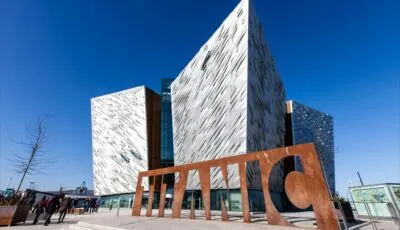
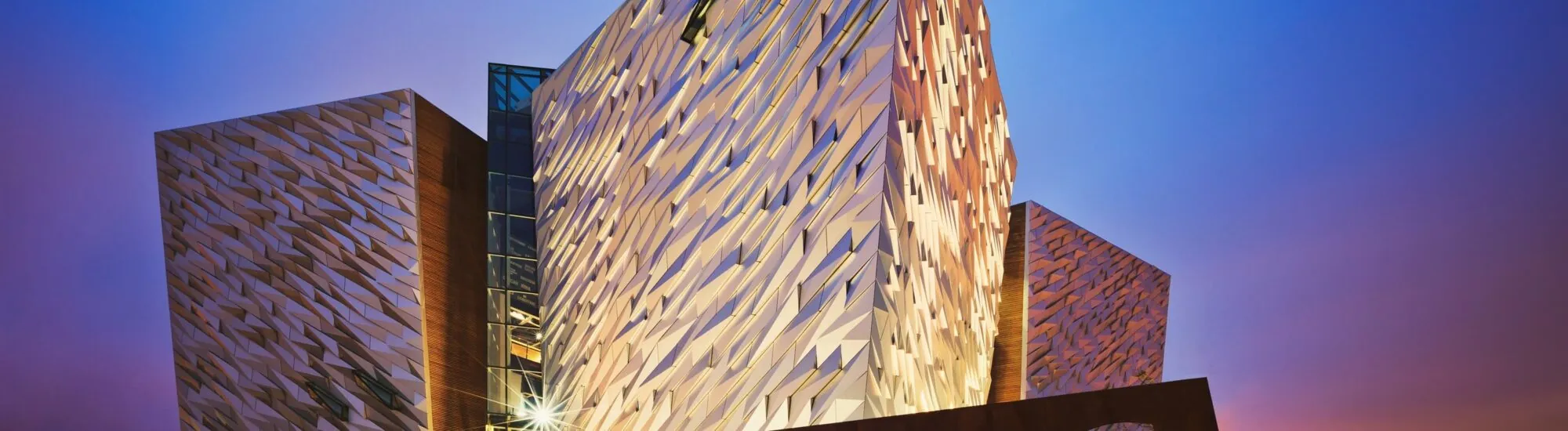
Opened on 31 March 2012 in the heart of the Titanic Quarter, the attraction occupies a spectacular building whose four façades evoke both ship bows and the edges of an iceberg. Its metallic silhouette rises just metres from the historic slipways where the Titanic and its sister ship, Olympic, were assembled.
Completely redesigned in 2023, the permanent exhibition now unfolds across ten interactive galleries. Archival documents, personal accounts, projections, reconstructions, models and audiovisual installations combine to create a narrative of remarkable scope. Admission also includes a visit to the SS Nomadic, the last surviving vessel of the White Star Line.
Deeply rooted in Belfast’s history, Titanic Belfast is now one of Northern Ireland’s most visited cultural attractions. It is an essential stop for understanding the fate of the liner, as well as that of the thousands of workers, engineers, sailors and passengers whose lives remain inseparable from its legend.
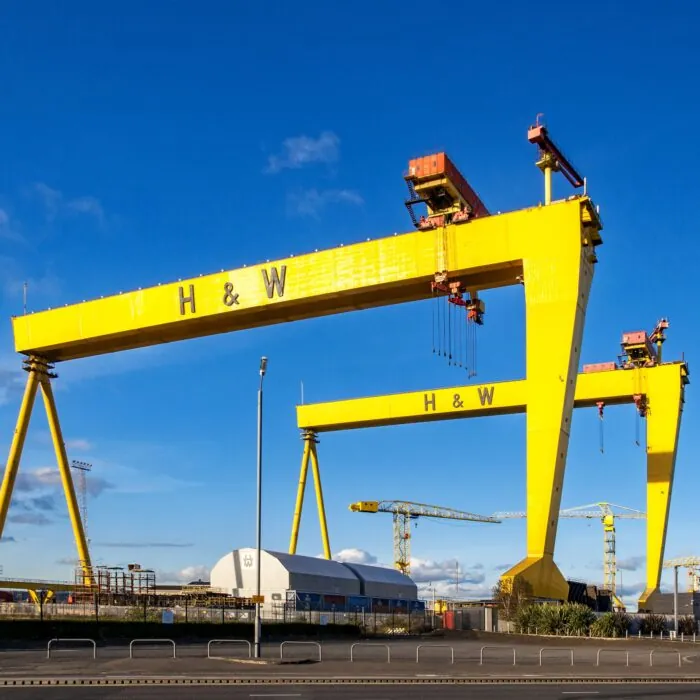
Titanic Belfast stands on Queen’s Island, in a former industrial area that has since been transformed into a cultural and tourist district. It was here, in the shipyards of Harland & Wolff, that RMS Titanic was designed, assembled and launched on 31 May 1911.
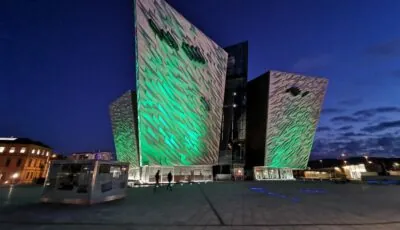
The contemporary building stands beside the former construction slipways of the Titanic and Olympic. Its height is comparable to that of the liner’s hull, while its angular façades, clad in aluminium panels, appear to change colour with Belfast’s light and weather.
The architecture does not seek to reproduce the Titanic literally. Instead, it evokes its power, scale and fate, somewhere between a monumental bow, an ice crystal and industrial heritage. Even before stepping through the doors, visitors are immersed in the atmosphere of the former shipyards.
The Titanic Experience is self-guided and follows a chronological route. The ten galleries cover Belfast’s transformation at the beginning of the 20th century, the liner’s construction, its launch, its interior fitting-out, its maiden voyage, the sinking and the disaster’s lasting consequences.
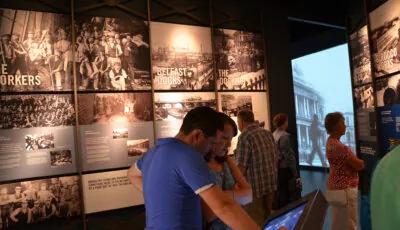
The visit begins in industrial Belfast in the 1900s. At the time, the city was experiencing spectacular growth thanks to its linen mills, factories, engineering works and shipyards. Harland & Wolff employed thousands of workers and was among the world’s largest shipbuilders.
This first section places the Titanic in its true context. The liner was not an isolated creation, but the culmination of immense industrial expertise and fierce competition between shipping companies to conquer the transatlantic routes.
One of the most immersive sections is dedicated to working conditions in the Harland & Wolff shipyards. Plans, photographs, tools and accounts convey the scale of the challenge involved in building a ship nearly 269 metres long.
The gallery includes the Shipyard Ride, an attraction that takes visitors through a reconstruction of the shipyards. The route evokes the noise of riveting, the heat of the workshops, work at height and the risks faced by workers.
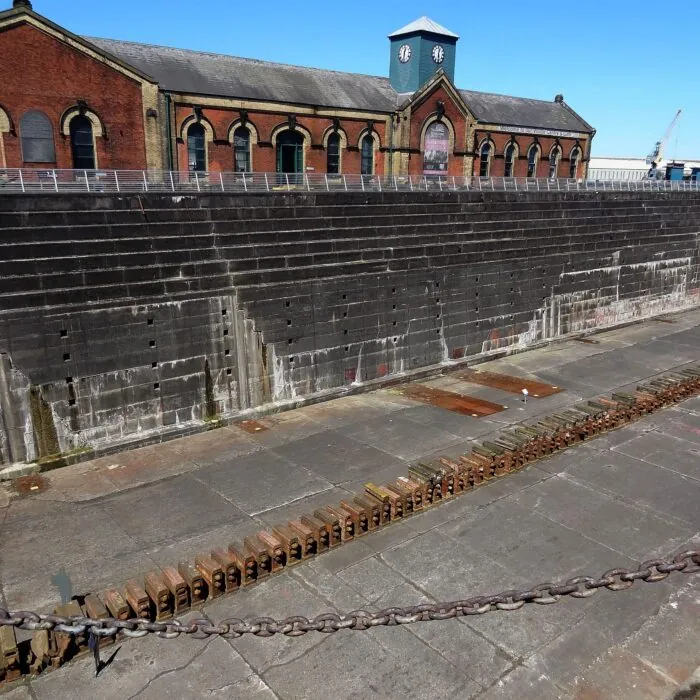
The Titanic was assembled on an open-air slipway before being launched into Belfast Lough on 31 May 1911. Contrary to a commonly held belief, it was not built in the Thompson Graving Dock. This vast dry dock, now known as Titanic’s Dock, was used primarily for fitting out, finishing and inspecting the vessel after its launch.
The Shipyard Ride has certain accessibility and safety restrictions. However, an alternative presentation allows visitors unable to board to discover this part of the exhibition.
The route continues with the Titanic’s fitting-out and life on board. Projections, computer-generated imagery, archival material and reconstructions evoke the cabins, lounges, dining rooms and spaces reserved for the different classes.
Titanic Belfast does not feature a full-scale replica of the entire liner. Instead, the museum favours a documentary and immersive approach, notably through a virtual tour that allows visitors to explore the ship’s decks, from the boilers to its most luxurious spaces.
A large illuminated model also reveals the Titanic’s internal layout. It highlights the considerable differences between the sumptuous first-class facilities, the comfortable second-class spaces and the more modest quarters occupied by third-class passengers, many of whom hoped to begin a new life in North America.
The famous replica of the Grand Staircase is not part of the permanent exhibition route. It is located in the Titanic Suite, an events space used in particular for receptions and certain Afternoon Teas.
After leaving Belfast for Southampton, the Titanic set sail on its maiden voyage on 10 April 1912. It called at Cherbourg in France, then at Queenstown — now the town of Cobh in County Cork — before heading for New York.
At 11.40 pm on 14 April, the ship struck an iceberg in the North Atlantic. Water flooded several watertight compartments, gradually dooming the liner. The Titanic sank in the early hours of 15 April 1912. More than 1,500 passengers and crew members died in the disaster.
The exhibition examines the chronology of the sinking, the distress calls, the launching of the lifeboats and the arrival of the Carpathia, which rescued the survivors, with restraint. Individual stories take centre stage, giving a face to both the travellers and the crew members.
Some episodes of the sinking have become famous, beginning with that of the musicians who are said to have continued playing to reassure passengers. There is little doubt about their courage, but accounts differ as to the pieces they performed and their final moments.
Likewise, the precise circumstances of Captain Edward Smith’s death remain unknown. Several contradictory accounts circulated after the disaster; it would therefore be inaccurate to state with certainty that he died at the wheel or on the bridge.
Where possible, the museum distinguishes established facts from legends perpetuated by newspapers, books and cinema. This historical caution is one of the route’s great strengths.
The visit then covers the investigations conducted in the United Kingdom and the United States, as well as the changes made to maritime safety rules. The number of lifeboats, ice monitoring and radio communications were among the areas subject to new regulations.
Another gallery examines the place the Titanic has come to occupy in popular culture. Films, novels, documentaries and family stories gradually turned the disaster into a global myth, sometimes at the cost of historical simplifications or inaccuracies.
The final section focuses on the discovery of the wreck in 1985 by a Franco-American team associated with Jean-Louis Michel and Robert Ballard. Underwater images show the ship resting nearly 3,800 metres below the surface of the North Atlantic.
Titanic Belfast displays historical items connected with the liner, its passengers and the shipyards. However, the attraction states that it neither acquires nor exhibits objects recovered from the wreck or its debris field, out of respect for a site regarded as a place of remembrance.
A Titanic Experience ticket also gives access to the SS Nomadic, moored in Hamilton Dock around 150 metres from the museum. Built in Belfast in 1911, this tender carried passengers between Cherbourg harbour and the great liners anchored offshore.
On 10 April 1912, the Nomadic transported first- and second-class passengers to the Titanic. Carefully restored, it is now regarded as the last surviving vessel of the White Star Line.
The visit allows visitors to explore its lounges, decks, crew quarters and eventful history. After its career as a tender, the Nomadic served during both world wars, then became a floating reception venue in Paris before returning to Belfast.
Allow an additional 30 to 60 minutes for this visit. The SS Nomadic’s opening hours are generally shorter than those of the main museum, so it is best not to leave it until the end of the day.
Behind the museum lie the former slipways on which the two liners were built. Their outlines are marked on the ground, allowing visitors to appreciate their exceptional dimensions.
This outdoor area is freely accessible. A walk to the slipways usefully complements the visit, particularly for understanding how the ships were assembled and then launched into the waters of Belfast Lough.
Located opposite the museum, the Titanic Hotel Belfast occupies the former headquarters of Harland & Wolff. The building notably housed the offices and drawing rooms where the Titanic, Olympic and other great ships were designed.
The former Drawing Offices have retained part of their historic architecture. They now house the hotel’s dining and reception areas. Even without staying there, it is possible to explore some of the public spaces by having a drink or a meal on site.
A little further into the Titanic Quarter, the Titanic Dock & Pump-House bear witness to the immense scale of Belfast’s shipbuilding industry.
Thompson Graving Dock is not the slipway on which the Titanic was built. It is the dry dock to which the liner was taken after its launch to receive certain equipment, undergo inspections and complete its preparation.
The Pump-House contained the powerful machinery used to empty the dock quickly. The site is a particularly interesting addition for enthusiasts of industrial architecture and maritime history.
The Discovery Tour is an outdoor guided tour lasting around 75 minutes. It explores the museum’s architecture, the former construction slipways and several historic points in the Titanic Quarter.
Equipped with an audio headset, participants discover the site’s history and the symbols incorporated into Titanic Belfast’s architecture. This tour can be taken independently of the main exhibition, though the two experiences naturally complement one another.
Those who enjoy Belle Époque atmospheres can book an Afternoon Tea in the Titanic Suite, beside the replica Grand Staircase. Tea, sandwiches, scones and pastries are served in surroundings inspired by the liner’s interiors, sometimes accompanied by live music.
Contrary to what was long advertised, Afternoon Tea is not held every Sunday as a matter of course. It is offered on selected dates, particularly during holidays and seasonal events. Advance booking is essential.
The programme and prices are published in the section dedicated to Titanic Belfast offers and events.
Allow between 1 hour 30 minutes and 2 hours 30 minutes to explore the Titanic Experience galleries properly. Add 30 to 60 minutes for the SS Nomadic.
A half-day is therefore ideal for enjoying the museum, the ship and the former slipways without rushing. With the Discovery Tour, Titanic Hotel and Thompson Graving Dock, it is easy to spend a full day in the Titanic Quarter.
The museum is particularly busy at weekends, during school holidays and in the summer season. Visiting early in the morning generally offers a quieter atmosphere.
Online booking is highly recommended. Entry is organised into timed slots, and some may sell out several days in advance.
Tickets bought online are generally cheaper than those sold on site. It is advisable to arrive around 15 minutes before the time shown on your booking.
Last admission is approximately 1 hour 40 minutes before closing. However, entering so late leaves little time to visit the SS Nomadic, which has more limited opening hours.
The experience is suitable for families. The interactive displays, the liner model and the Shipyard Ride make the route accessible to younger visitors. The sections devoted to the sinking are handled with restraint, but may upset more sensitive children.
Pushchairs are permitted in most areas and baby-changing facilities are available. Admission is free for children under 5, though a ticket generally needs to be booked for them.
Titanic Belfast is accessible to visitors with reduced mobility, with lifts, ramps and adapted toilets. Essential carers may be eligible for free admission, subject to the museum’s terms and conditions.
The SS Nomadic has also been adapted, although the ship’s historic layout may impose certain limitations. Visitors with particular requirements are invited to contact the attraction before their visit.
Multimedia guides are available in several languages, including French. Additional facilities are also available for some visitors who are deaf, hard of hearing, blind or partially sighted.
Titanic Belfast has a secure underground car park with around 520 spaces, open 24 hours a day. Parking is charged, and the maximum permitted vehicle height is around 2.10 metres. Accessible spaces are provided near the lifts.
The Galley Café offers lunch and snacks on site. It can be accessed without an exhibition ticket. A shop also sells books, reproductions, clothing and souvenirs dedicated to the Titanic, Belfast and maritime history.
Between industrial heritage and human tragedy, Titanic Belfast does more than tell the story of a shipwreck: it gives a voice back to the city, the workers and the passengers who made this vessel part of history.
Essential information to help you plan your visit, including key landmarks, access information, and booking options.
Queens Rd, Titanic Quarter, Titanic Quarter
54.608083, -5.909694
1h30
Compare tickets, guided tours, and excursions available through our partner platforms.