
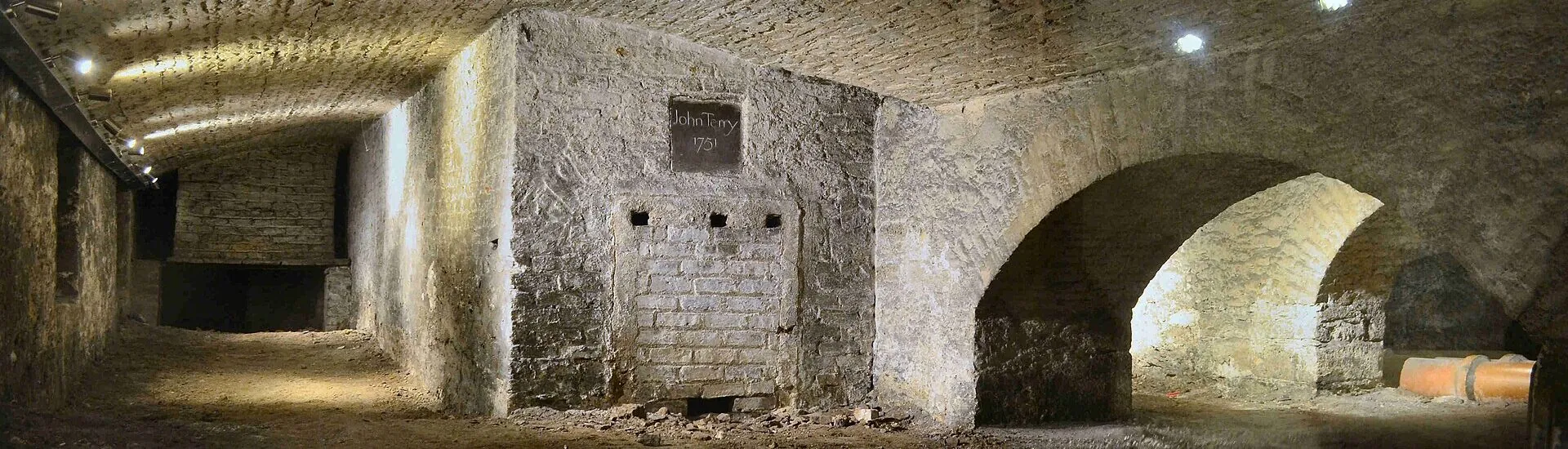
In the heart of old Cork, Triskel Christchurch is one of those places where several centuries of urban history overlap. Behind the façade of this former church, now part of the Triskel Arts Centre, lies a religious site whose origins date back to medieval Cork, when the city was still enclosed by its walls.
Christchurch is therefore not simply a cultural venue housed in a handsome Georgian church. The building is a valuable witness to Cork’s evolution, from the Anglo-Norman town to the modern city.
The former church stands on South Main Street, one of Cork’s most important historic thoroughfares. It is now part of the Triskel Arts Centre cultural complex, dedicated in particular to film, music and the arts.
A visit offers the chance to admire the architecture of the present church, but the site’s main appeal lies in its historical depth. Beneath and around the building, traces of earlier occupations remain, while the graveyard preserves funerary stones and monuments associated with several prominent Cork families.
Christchurch’s conversion has saved it from becoming a static monument. Concerts, cultural programmes and events now make use of this historic space, creating an interesting contrast between religious architecture and contemporary programming. Depending on the programme, the experience can therefore be very different from a straightforward heritage visit.
Following the Anglo-Norman capture of Cork in 1177, the urban centre was extensively reorganised. A stone church stood at Christchurch from at least the late 12th century, and the site appears in medieval sources. Situated on the main thoroughfare of the walled city, it then occupied a central place in Cork’s religious and civic life.
Early maps also reveal this importance. Christchurch appears on the earliest surviving maps of Cork, within a walled city organised around the islands of the Lee and what are now North Main Street and South Main Street.
The medieval building featured a tower, a bell tower and particularly thick walls. Side chapels are also recorded. However, this church did not survive intact through the upheavals of the late 17th century.
During the 1690 siege of Cork, the building was hit by artillery fire and badly damaged. The old church was finally dismantled in 1716. A few years later, it was replaced by the reconstruction that corresponds to the Georgian building visible today.
The church rebuilt at the beginning of the 18th century belonged to a Cork undergoing major change. The city was gradually beginning to expand beyond its old walls and reclaim the surrounding marshland. Yet Christchurch remained on its historic site, a fixed point within a changing urban landscape.
This continuity makes the site particularly interesting: although most of its medieval architecture has disappeared, the location retains several centuries of religious history. Part of the crypt may also preserve older elements.
Behind the church, the graveyard is another feature not to be overlooked. It preserves funerary slabs, gravestones and monuments from the 16th and 17th centuries, some still in their original positions and others grouped along the northern wall.
Several of Cork’s leading merchant families are represented here, including the Fagans, Skiddys and Roches. Parish registers preserved from the 17th century onwards are also a valuable source for understanding the city’s population.
Christchurch is particularly relevant on an itinerary focused on medieval Cork. Its location on South Main Street makes it easy to link with St Peter’s, the traces of the former walled city and other monuments in the city centre.
Above all, the site offers a very tangible way to understand that present-day Cork rests upon several successive cities. Behind the Georgian church and contemporary cultural centre, the medieval city that once occupied the islands of the Lee can still be discerned.
Want to extend your visit without having to rush around? Here are a few well-located places to stay near the must-see attractions.
Essential information to help you plan your visit, including key landmarks, access information, and booking options.
Tobin Street, Cork
51.8974, -8.4763