

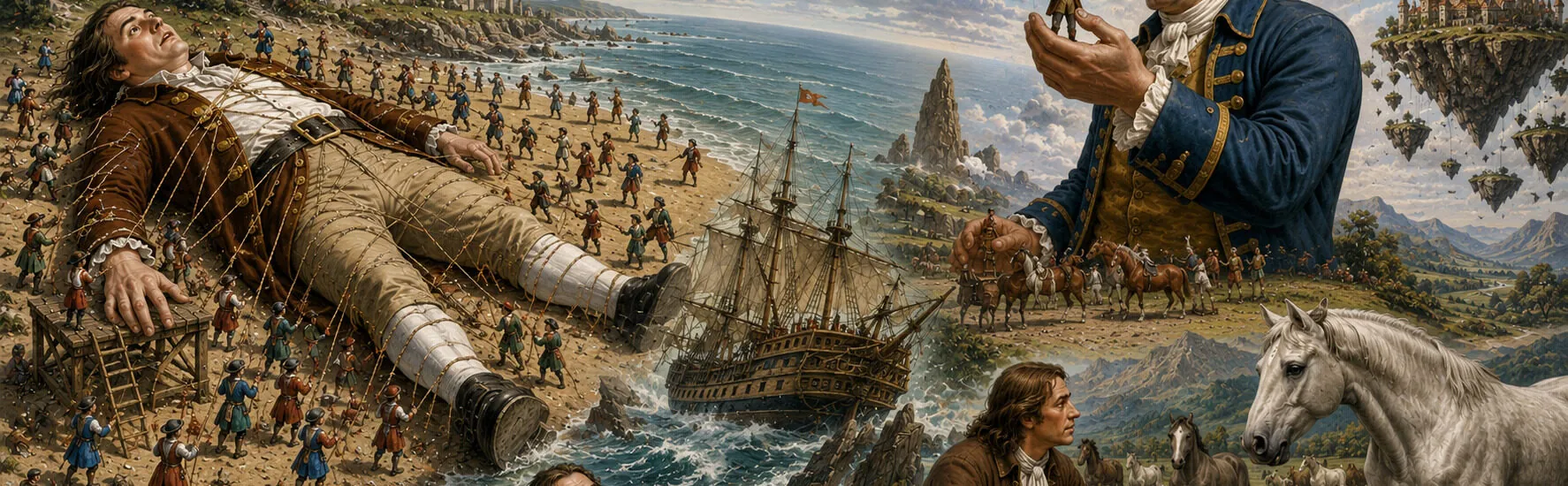
Men as tall as a finger, giants capable of holding a traveller in their hand, a flying island and horses infinitely more reasonable than humans: behind Gulliver’s fantastic adventures lies one of the fiercest books in literature. Its author, Jonathan Swift, was Irish. Born in Dublin, a student at Trinity College and later dean of St Patrick’s Cathedral, he drew much of the anger running through his work from the society and political tensions of his time.
Gulliver’s Travels tells the story of the extraordinary journeys of Lemuel Gulliver, an English naval surgeon whom shipwrecks and the whims of navigation carry to several unknown lands.
His first voyage is also the most famous. After his ship is wrecked, Gulliver wakes to find himself tied to the ground by a multitude of threads. Around him are the inhabitants of Lilliput, tiny beings measuring only around fifteen centimetres. Despite their size, these little people possess great ambitions, a complicated administration and a pronounced taste for absurd conflicts.
The traveller then discovers Brobdingnag, a country populated by giants beside whom he becomes a tiny creature himself. He also visits the flying island of Laputa, occupied by scholars so absorbed in their theories that they seem to have lost all contact with reality.
His final major voyage takes him to the Houyhnhnms, intelligent horses organised into an apparently rational society. Humans, known as Yahoos, are instead portrayed there as brutal, greedy and repulsive creatures. Suffice it to say that Jonathan Swift did not have boundless confidence in our species.
Jonathan Swift was born in Dublin on 30 November 1667. His parents were of English origin and belonged to the Protestant community settled in Ireland. He is therefore often described as an Anglo-Irish writer, an expression that reflects the political and cultural complexity of the island during the seventeenth and eighteenth centuries.
This detail does nothing to lessen the depth of his ties with Ireland. Swift spent much of his life there, studied there, served as a clergyman there and wrote several of his most committed works there. He died in Dublin in 1745 and was buried in St Patrick’s Cathedral.
His relationship with his native country was sometimes troubled. Swift long hoped to secure an important position in England and experienced his return to Ireland as a form of professional exile. Over time, however, he became one of the most formidable defenders of Irish interests against the decisions of the British government.
This position explains why he occupies such a distinctive place in the national memory. Jonathan Swift was not an Irish nationalist in the modern sense of the term. He remained an Anglican clergyman from the Protestant minority. Nevertheless, he denounced with unusual vehemence the economic exploitation of Ireland, the poverty of its population and the contempt with which London sometimes treated the island.
Jonathan Swift entered Trinity College Dublin in 1682, when he was fourteen. He graduated in 1686. His results were not particularly brilliant, but the university taught him, among other things, the art of debate and argument.
This training is significant when one knows what followed. All of Swift’s writing rests on his ability to adopt an apparently logical line of reasoning before taking it to the point of absurdity. In Gulliver’s Travels, as in his pamphlets, the reader must constantly wonder whether the narrator is serious or is leading them into a trap.
Trinity College preserves several traces of its former student. A marble bust of Jonathan Swift is installed in the Long Room of the Old Library. The university archives also hold his student records, considered the oldest known document directly attesting to his existence.
In 2026, on the occasion of the novel’s tercentenary, Trinity College is also presenting an exhibition entitled Gulliver at 300. Three centuries after the book’s publication, Swift has therefore, in a way, returned to the walls where he learned to handle ideas.
In 1713, Jonathan Swift was appointed dean of St Patrick’s Cathedral in Dublin. He held this position until his death, for more than thirty years.
The situation may seem surprising to a modern reader. How could the author of such an insolent satire hold such an important religious position? At the time, literary, political and ecclesiastical careers were nevertheless far less separate than they are today. Swift could preach from the cathedral pulpit before returning to his pamphlets and attacks on the powerful.
St Patrick’s Cathedral remains the main place of remembrance devoted to the writer in Ireland. Jonathan Swift lies beneath its flagstones, near Esther Johnson, known as Stella, a woman with whom he maintained a relationship that was as profound as it was mysterious.
Visitors can also discover his epitaph there, written in Latin in accordance with his wishes. It refers to the “savage indignation” that could no longer tear at his heart and invites passers-by to imitate, if they can, the man who fought for freedom.
The wording sums up the character rather well: a brilliant man, difficult to classify, often severe, but deeply outraged by stupidity, injustice and the abuse of power.
The countries visited by Gulliver do not directly correspond to Irish regions. Lilliput, Brobdingnag, Laputa and the land of the Houyhnhnms are imaginary places. It would therefore be misleading to claim that Jonathan Swift merely transformed Irish landscapes into fantastical kingdoms.
The connection with the island is above all political and intellectual. Swift was writing in an Ireland under the authority of the British Crown, subject to major economic restrictions and marked by deep social and religious divisions. He closely observed the mechanisms of domination, the privileges granted to a few and the very real effects of decisions made far from those who suffered them.
In Lilliput, political careers depend in particular on the candidates’ ability to dance on a tightrope before the emperor. The more feats they perform without falling, the more they can hope to obtain an important position. Swift thus mocks courtiers prepared to perform any contortions to win the favour of those in power.
The Lilliputians are also divided by a fundamental dispute: should an egg be broken at the big end or the little end? This grotesque quarrel allows Swift to ridicule the religious and political conflicts capable of setting peoples against one another over differences that are sometimes tiny.
The novel is therefore not a disguised representation of Ireland alone. It targets Britain more broadly, European monarchies, religious institutions, political parties and human nature. But Swift’s perspective was undeniably shaped by the particular position he held in Dublin, between British power and Irish realities.
With its fantastical islands and spectacular differences in size, Gulliver’s Travels contains all the ingredients of a great adventure story. The episodes in Lilliput and Brobdingnag lend themselves particularly well to illustrations, cartoons and adaptations for children.
Many editions therefore shortened the text, retaining only its most wondrous scenes. The political attacks, philosophical developments and darkest passages often disappeared along the way.
The original text is much less restrained. Swift writes about war, corruption, colonisation, fanaticism, the desire for power and disgust with the human body. Some scenes are frankly cruel, while others are deliberately repulsive. The author was not merely seeking to entertain: he wanted to make his reader uncomfortable and force them to look at the world differently.
It is precisely this double level of reading that explains the novel’s longevity. A young reader can follow the adventures of a man who becomes, in turn, a giant and a tiny creature. An adult discovers an attack on societies that consider themselves civilised while engaging in perfectly absurd behaviour.
Few writers can boast of having added several words to dictionaries. Jonathan Swift is one of them.
The term “Lilliputian” is now used to describe a person or thing of very small size. Conversely, “Brobdingnagian”, much rarer in English, describes something gigantic.
The word “Yahoo” also comes from Gulliver’s Travels. Before becoming the name of a web company, it referred in the novel to a primitive, violent and repulsive human creature. In English, the term can still describe a coarse or uncivilised person.
Swift even left an unexpected mark on computing. In the novel, the Big-Endians and Little-Endians argue over the correct way to break an egg. This quarrel inspired the English terms big-endian and little-endian, used to describe two ways of organising the bytes of digital data.
To understand how deeply Ireland nourished Jonathan Swift’s writing, one must read A Modest Proposal, published in 1729, three years after Gulliver’s Travels.
In this text, the author claims to have found a rational solution to the poverty affecting Irish families: selling their young children as food to the wealthiest people. The proposal is obviously monstrous. Swift does not put it forward to be taken seriously, but to denounce the inhumanity of a system that already treated the poor as merchandise or an economic burden.
The pamphlet adopts the cold language of calculations, statistics and profitability. The more reasonable the narrator appears, the more frightening his reasoning becomes. This method is typically “Swiftian”: pushing the logic of power to the point where it reveals its brutality.
In the Drapier’s Letters, published a few years earlier, Swift had also opposed the introduction into Ireland of a copper currency produced under conditions he considered disadvantageous to the country. These texts earned him immense popularity among part of the Irish population.
The man who had sometimes regarded Dublin as an imposed destination thus became one of the great critical voices of eighteenth-century Ireland.
Just a few steps from St Patrick’s Cathedral stands Marsh’s Library, opened to the public in 1707. Jonathan Swift knew this library well. He used it as a reader and served on its governing board.
The building has preserved its galleries, dark wooden shelves and old books. Visitors can even see “reading cages”, grilled spaces in which certain readers were seated to prevent the disappearance of the most precious books. A rather radical method of enforcing loan periods.
The institution holds various early editions of Gulliver’s Travels. Its Gulliver 300 exhibition, organised in 2026, bears witness to the worldwide spread of the text through Chinese, Ukrainian and Japanese publications.
For a traveller, Marsh’s Library above all makes it possible to rediscover the intellectual atmosphere of the city known by Swift. Here, the connection with the writer is not a tourist reconstruction: he really did walk through these galleries and consult the books kept on their shelves.
Swift’s traces are not limited to Dublin. In 1700, he was appointed vicar of Laracor, near Trim, in County Meath. He served in this small rural parish before becoming dean of St Patrick’s Cathedral.
A table he used to celebrate the Eucharist at Laracor is now preserved in Dublin Cathedral. This presence in County Meath serves as a reminder that Swift also knew the Ireland of small towns, the countryside and communities far removed from London’s political circles.
The direct link between Laracor and the writing of Gulliver’s Travels remains difficult to establish precisely. It is nevertheless certain that Swift’s Irish years, his religious functions and his observation of local living conditions helped shape his political outlook.
In Celbridge, County Kildare, Jonathan Swift’s name is associated with Esther Vanhomrigh, whom he called Vanessa. The young woman had met the writer in London and maintained a relationship with him whose exact nature continues to be debated.
Esther Vanhomrigh later settled at Celbridge Abbey. Swift visited her in Ireland and dedicated the poem Cadenus and Vanessa to her. The name “Vanessa” is also said to have been created by the writer by combining the beginning of her surname, “Van”, with a form of her first name, “Essa”.
However, caution is appropriate: no document makes it possible to claim that Celbridge Abbey directly inspired Lilliput or any of the lands visited by Gulliver. The estate belongs to Swift’s romantic biography, but not to a demonstrated geography of his novel.
The journey can begin at Trinity College Dublin, where Swift studied and where his bust is displayed in the Old Library. It continues on foot to St Patrick’s Cathedral, the place of his ministry and burial, and then to Marsh’s Library, located right next door.
In County Meath, Trim and Laracor evoke his years as a vicar. Celbridge, in County Kildare, preserves the memory of Vanessa and of a relationship that inspired several personal writings.
Further north, Armagh Robinson Library holds one of the most valuable documents connected with the novel: a copy of the first edition of 1726 containing handwritten corrections attributed to Swift. The author is said to have sought to restore certain passages altered or removed by his publisher, Benjamin Motte.
This route therefore does not lead to a supposed “real Lilliput”. It offers something more interesting: the chance to rediscover the places where Jonathan Swift studied, worked, wrote, loved, argued and shaped the merciless perspective expressed in his work.
The world has changed since 1726, but the faults observed by Jonathan Swift have remarkably stood the test of time. Political leaders continue to perform a few acrobatics to obtain a position. Groups still clash over tiny differences. Some experts devise solutions that look brilliant on paper but are completely disconnected from real life.
The strength of Gulliver’s Travels lies in this combination of imagination and intellectual cruelty. Swift constantly changes the scale of the world to shake his hero’s certainties. Among the Lilliputians, Gulliver considers himself all-powerful. Among the giants, he becomes insignificant. Faced with the Houyhnhnms, his very membership of humanity becomes embarrassing.
Behind the adventure, the book asks a dizzying question: what remains of our greatness when we simply change our point of view? This way of looking at the powerful through the wrong end of the telescope bears the mark of a writer trained in Dublin, a witness to the injustices imposed on Ireland and determined to use humour as a weapon.