Reservations are recommended
Powered by GetYourGuide


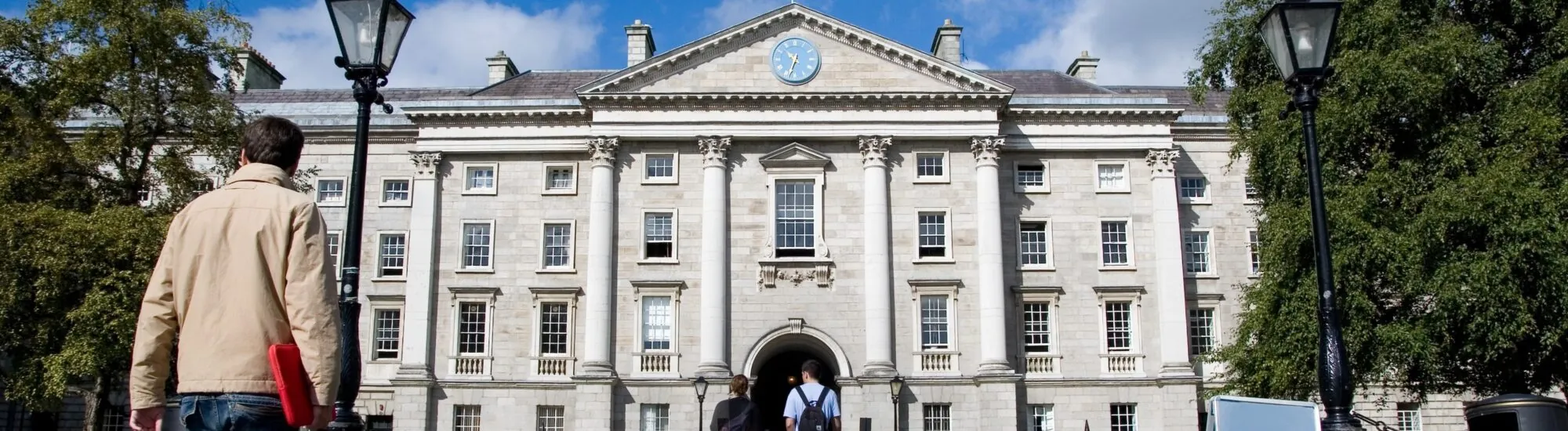
In the heart of Dublin, a stone archway opens onto an almost silent world. Beyond the bustle of College Green, manicured lawns, 18th-century façades and students crossing the squares beneath the gaze of philosophers carved in marble suddenly come into view. Trinity College Dublin is a city within a city: a 19-hectare university campus where more than four centuries of Irish history sit alongside contemporary research.
Founded in 1592, Trinity is Ireland’s oldest university still in operation. It now has around 22,000 students and remains Ireland’s highest-ranked higher education institution in several international rankings. Its campus is also one of Dublin’s most visited sites, notably thanks to the Old Library and the Book of Kells, an illuminated manuscript around 1,200 years old.
Access to the outdoor squares is generally free. A guided tour, however, offers a better understanding of the campus architecture, its intellectual influence and the sometimes turbulent episodes of its history. Trinity is not a static backdrop: visitors move through a working university, among libraries, lecture theatres and research buildings.
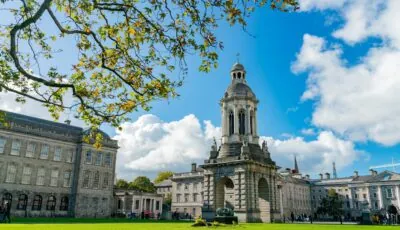
Trinity College Dublin – © Kit Leong
Trinity College Dublin was established by a royal charter granted in 1592 by Queen Elizabeth I of England. Dublin Corporation made available the grounds of the former All Hallows Priory, then located outside the city walls.
The institution was intended to educate Ireland’s administrative and religious elites under the authority of the English Crown. Its organisation was modelled on the universities of Oxford and Cambridge. Originally, its identity was closely linked to the established Protestant Church, in a country that was nevertheless overwhelmingly Catholic.
Trinity College is the sole college of the University of Dublin. In everyday usage, the two names are often used interchangeably, although they historically refer to two distinct institutions: Trinity is the college, while the University of Dublin is the degree-awarding university.
Today’s campus bears little resemblance to that of the 16th century. Most of the first buildings have disappeared. The grand squares and façades that now define Trinity’s identity were built or remodelled between the 18th and 19th centuries, when the university expanded eastwards.
During its first centuries, Trinity remained deeply shaped by its Protestant character. Catholics were permitted to enrol and graduate from 1793, but for a long time they remained excluded from certain scholarships, posts and academic distinctions.
In 1873, most religious tests were abolished, except those directly connected with the teaching of theology. Another obstacle nevertheless remained: between 1871 and 1970, the Irish Catholic Church required its faithful to obtain permission before attending Trinity. This measure helped to limit the presence of Catholic students for many years.
Women were admitted for the first time in 1904. Ten years later, they already accounted for around 16% of students. Their integration nevertheless remained gradual: they were not permitted to live on campus until 1972. In 2021, Linda Doyle became the first woman appointed provost, or president, of Trinity College Dublin.
Trinity’s position opposite the former Irish Parliament and close to Dublin Castle placed it at the centre of several historical episodes. During the Easter Rising of 1916, the university was occupied by soldiers and members of its Officers’ Training Corps, who defended the campus against the rebels.
Trinity College escaped the major destruction that affected several areas of central Dublin. Its history during this period nevertheless remains complex: some of its students and alumni served in the British Army, while others took part in the Irish independence movement.
Theobald Wolfe Tone, one of the leading figures of late 18th-century revolutionary nationalism, studied at Trinity. The institution also educated Henry Grattan, Edmund Burke and several presidents of Ireland, including Mary Robinson and Mary McAleese.
Few European universities can claim such a rich literary heritage. Jonathan Swift, author of Gulliver’s Travels, Oscar Wilde, Bram Stoker and Samuel Beckett all studied at Trinity.
Samuel Beckett taught there briefly before leaving the university to devote himself to writing. He received the Nobel Prize in Literature in 1969. Oscar Wilde, meanwhile, studied classics there before going on to Oxford.
Trinity also distinguished itself in science. The mathematician William Rowan Hamilton developed quaternion theory there. Physicist Ernest Walton, first a student and later a professor at the university, shared the 1951 Nobel Prize in Physics for his work on the artificial disintegration of the atomic nucleus.
Today, Trinity has around 22,000 undergraduate and postgraduate students. Its courses cover arts, humanities, law, business, science, engineering and health sciences.
The main entrance to Trinity College is on College Green, opposite the former Irish House of Parliament, now occupied by the Bank of Ireland. Once through the great archway, Dublin traffic seems to fade away abruptly.
Visitors emerge into Front Square, also known as Parliament Square. This vast paved square forms the monumental heart of the campus. It is surrounded by the Chapel, Examination Hall, Dining Hall and several historic residential buildings.
Two statues flank the entrance: those of Edmund Burke, the 18th-century philosopher and politician, and Oliver Goldsmith, writer and playwright. Both were Trinity students.
The campus is a place of study and work. Some squares may be closed during examinations, ceremonies or university events. Lecture theatres, modern libraries and residences are not freely accessible to the public.
At the centre of Front Square stands the Trinity College campanile, built in 1853 to designs by architect Charles Lanyon. With its Corinthian columns and carved dome, it is one of the campus’s most photographed landmarks.
A superstition holds that students who walk beneath the campanile as the bell rings will fail their exams. To avert this fate, they must touch the foot of the statue of Irish politician George Salmon before completing their studies.
George Salmon was provost of Trinity from 1888 to 1904. Fiercely opposed to the admission of women, he is said to have declared that they would enter the university only “over his dead body”. In an irony of history, he died a few months before their official admission.
On either side of Front Square, two almost symmetrical buildings face one another: the Chapel and Examination Hall. They were designed in the late 18th century by architect William Chambers.
The Chapel, consecrated in 1798, is still used for services and ceremonies. It now serves a university community far more diverse than that of its construction period.
Examination Hall, also known as the Public Theatre, is used for graduation ceremonies, formal examinations and various events. Its interior is not freely open to visitors, but it may be included on certain guided tours or opened for special events.
Built between 1853 and 1857, the Museum Building is one of the campus’s finest buildings. Its architecture draws on Lombard Romanesque and Byzantine styles, with arcades, carved capitals and particularly elaborate interior decoration.
The stones used came from different parts of Ireland. Coloured marbles from Cork, Kilkenny, Galway and Connemara form a genuine geological inventory of the country. The carvings depict animals, plants and figures inspired by the natural sciences.
The building still houses university departments. Its hall can generally be seen when access is permitted, but visitors should remain quiet and discreet.
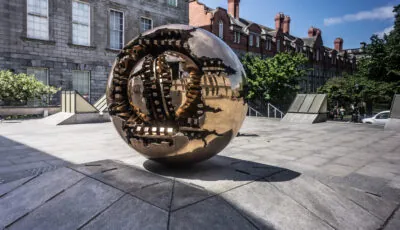
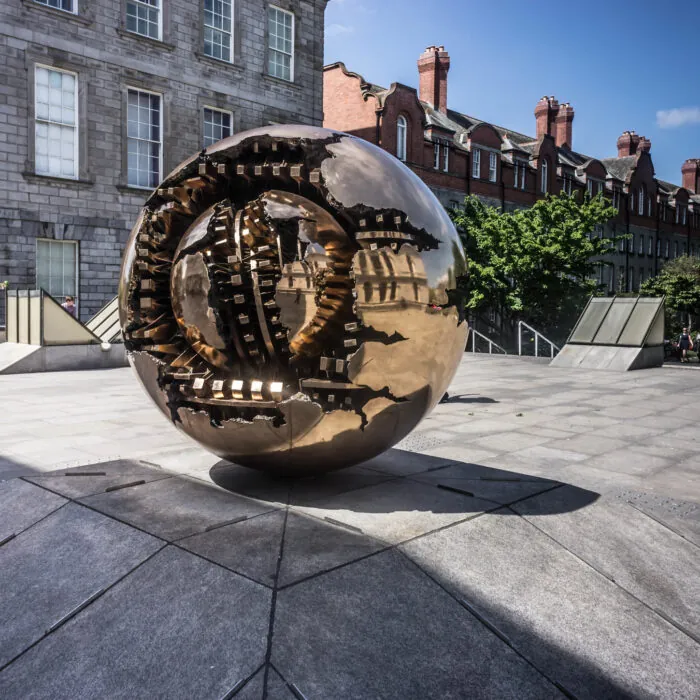
Sphere Within Sphere at Trinity College Dublin – William Murphy – cc
In front of the modern libraries stands Sfera con Sfera, or Sphere Within Sphere, a work created in 1982–1983 by Italian sculptor Arnaldo Pomodoro.
The smooth surface of the globe appears to open up, revealing an inner mechanism of cogs, cracks and geometric structures. The work suggests both the fragility of civilisations and the complexity concealed behind appearances.
Other versions of this sculpture can be seen in several prestigious locations, including the Vatican and outside the United Nations headquarters in New York. At Trinity, the sphere has become a familiar meeting point for students.
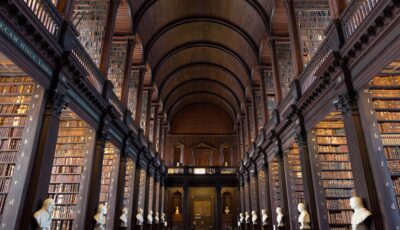
The Old Library at Trinity College Dublin – © VanderWolf Images
Access to Trinity’s outdoor squares is generally free, but visiting the Old Library and the Book of Kells requires a separate ticket. It should not be confused with Trinity Trails, the guided campus tour.
Built between 1712 and 1732, the Old Library houses the famous Long Room, a hall almost 65 metres long. Its upper gallery and barrel vault were added in the 19th century to increase storage capacity.
Contrary to a frequently repeated claim, the Long Room was not used as a filming location for the Harry Potter series. Its architecture may evoke a fictional library, but no instalment of the series was filmed there.
In 2026, the Long Room looks significantly different from the version seen in many older photographs. As part of a major restoration project, around 200,000 books have been removed from the shelves to be dusted, catalogued and conserved. The operation will also modernise the building’s protection against fire and environmental damage.
The room remains accessible, but much of its shelving is temporarily empty. Gaia, a light installation by artist Luke Jerram depicting the Earth from NASA imagery, currently occupies the central space.
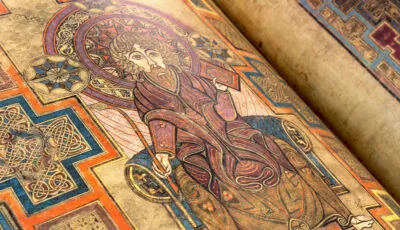
The Book of Kells – Gerhard Huber – cc
Created around the year 800, the Book of Kells contains the four Gospels of the New Testament in Latin. Its exact place of creation remains debated. It may have been begun on the Scottish island of Iona, then continued or completed in Kells, County Meath, after Viking raids.
Its vellum pages are covered with interlace, human figures, fantastical animals and Christian symbols. Some letters become compositions of almost microscopic intricacy.
Contrary to another widespread belief, the Book of Kells illuminations do not rely on extensive use of gold leaf. The monks achieved luminous effects through their mastery of pigments, colours and contrasts.
The manuscript is displayed in a dimly lit case to limit the effects of light. Two pages are generally visible: one showing an illustration, the other a passage of text. The displayed folios are changed several times a year for conservation reasons.
The number of visitors allowed around the display case at any one time is limited. You may need to wait a few minutes, even with a reserved ticket.
Among the Old Library’s treasures is a medieval harp made of willow and oak, known as the Brian Boru harp. The name is misleading, however.
Brian Boru died in 1014 at the Battle of Clontarf, while the instrument was probably made in the 14th or 15th century. It therefore cannot have belonged to him.
Nevertheless, this harp remains one of the oldest surviving Irish instruments of its kind. Its shape inspired the official emblem of the Irish State and the motif found on euro coins minted in Ireland.
The full Book of Kells Experience continues in the Red Pavilion, a temporary building less than a minute from the Old Library.
Several digital installations explore the creation of the manuscript, the conservation of the collections and the history of the Long Room. The Book of Kells 360 exhibition enlarges the illuminations, allowing visitors to examine details that are difficult to see in the original display case.
Another sequence, The Long Room Reimagined, digitally recreates the library and its collections. This section helps visitors understand the scale of the conservation work now under way.
Please note: some reduced-price tickets provide access only to the Book of Kells and the Old Library, without including the Red Pavilion’s digital exhibitions. Check exactly what your ticket includes before booking.
Trinity Trails is Trinity College Dublin’s official guided tour. It lasts around 45 minutes and is led by students or former students of the university.
The route covers Front Square, the campanile, the main historic façades and several aspects of university life. Guides discuss famous alumni, Trinity traditions and the campus’s transformations.
Tours are offered in English and, depending on schedules and availability, in French, Spanish, German or Italian. They do not automatically include entry to the Old Library and the Book of Kells.
A combined option pairs the campus tour with the Book of Kells Experience. Allow around two hours for the full visit.
It is generally possible to enter the historic campus free of charge and walk through its squares during public opening hours. This walk allows visitors to see Front Square, the campanile and the exteriors of the main buildings.
Access may nevertheless be restricted during examinations, ceremonies, official events or certain busy periods. Trinity remains a working university, so not every room is open to visitors.
The Old Library, the Book of Kells, the Red Pavilion and guided tours require a paid ticket.
Between the Old Library and Examination Hall stands an octagonal building known as the 1937 Reading Room. It is preceded by the Hall of Honour, inaugurated in 1928 in memory of Trinity members who died during the First World War.
The memorial pays tribute to 471 students, staff members and alumni of the university who died during the conflict. The Greek name Niké, goddess of Victory, appears on the façade.
The octagonal reading room was completed in 1937 and opened by Éamon de Valera, a former leader of the Easter Rising and then head of the Irish government. The gesture carried a historical irony: in 1916, Trinity had been defended against the rebels to whom de Valera belonged.
The building is reserved for researchers and postgraduate students. It is not a visitor attraction. However, some scenes from the 1996 film Michael Collins were filmed there.
Like many old institutions, Trinity has its stories of tunnels, secret passages and forgotten cellars. Some underground spaces do genuinely exist, including service tunnels linking several buildings and libraries.
The passage between the modern libraries primarily serves practical purposes. It is not a mysterious tunnel open to visitors. Other stories mention a passage beneath Grafton Street linking the provost’s house to St Stephen’s Green, but no solid public evidence confirms this account.
The supposed hidden wine cellar beneath Front Square is also part of student folklore. Cellars and storage spaces naturally existed beneath certain buildings, but tales of stolen bottles, secret meetings and ammunition transported during the 1916 Rising are difficult to document.
These spaces are closed to the public. Exploring them without permission would be both prohibited and dangerous.
A self-guided walk through the main squares takes around 30 to 45 minutes. The Trinity Trails tour also lasts approximately 45 minutes.
Allow around 45 minutes for the ticket limited to the Book of Kells and Old Library. The full experience, including the Red Pavilion exhibitions, takes longer. The option combining Trinity Trails and the Book of Kells Experience lasts around two hours.
If you would like to photograph the campus, take a guided tour and explore the Old Library at your leisure, allow half a day.
Trinity College is very busy between May and September, particularly in late morning and at weekends. A reserved entry slot at opening time generally offers a quieter atmosphere.
Tuesdays, Wednesdays and Thursdays are often less busy, especially between November and February. The weather also affects visitor numbers: the Old Library attracts more visitors on rainy days.
Book your slot online, particularly for the Book of Kells. Buying a ticket in advance does not eliminate all waiting, but it guarantees entry at your chosen time when availability becomes limited.
Personal photography is generally permitted in outdoor spaces. Restrictions may apply in the exhibitions, particularly around the Book of Kells, in order to preserve the manuscript and keep visitors moving.
Respect signs and staff instructions. Drones, commercial photography and certain professional equipment require permission.
The campus hosts classes, examinations and research every day. Avoid blocking entrances, photographing students intrusively or entering restricted buildings.
Much of the campus and the Book of Kells Experience is accessible to visitors with reduced mobility. The cobblestones of Front Square may nevertheless make some journeys less comfortable.
Adapted routes, lifts and accessible toilets are available in visitor areas. Assistance dogs are welcome. The 1937 Reading Room, however, is not satisfactorily accessible and is not open to ordinary visitors in any case.
Visitors with particular needs can contact the Book of Kells Experience team before their visit on +353 1 896 2308 or at [email protected].
The Long Room is no longer filled with books as it appears in historic photographs: around 200,000 volumes have been removed as part of the restoration work. Gaia temporarily occupies the room.
The Book of Kells pages are changed several times a year. It is therefore not possible to guarantee that a particular illumination will be on display during your visit.
Finally, a Book of Kells ticket does not necessarily include a guided tour of the campus. To discover the university, the Old Library and the manuscript, explicitly choose a combined option.
Essential information to help you plan your visit, including key landmarks, access information, and booking options.
53.343808, -6.254574
1 heure
Prices vary according to date, time, ticket type and demand. Some tickets do not include the Red Pavilion. Always check the product details on the official Trinity College ticket office.
Compare tickets, guided tours, and excursions available through our partner platforms.