
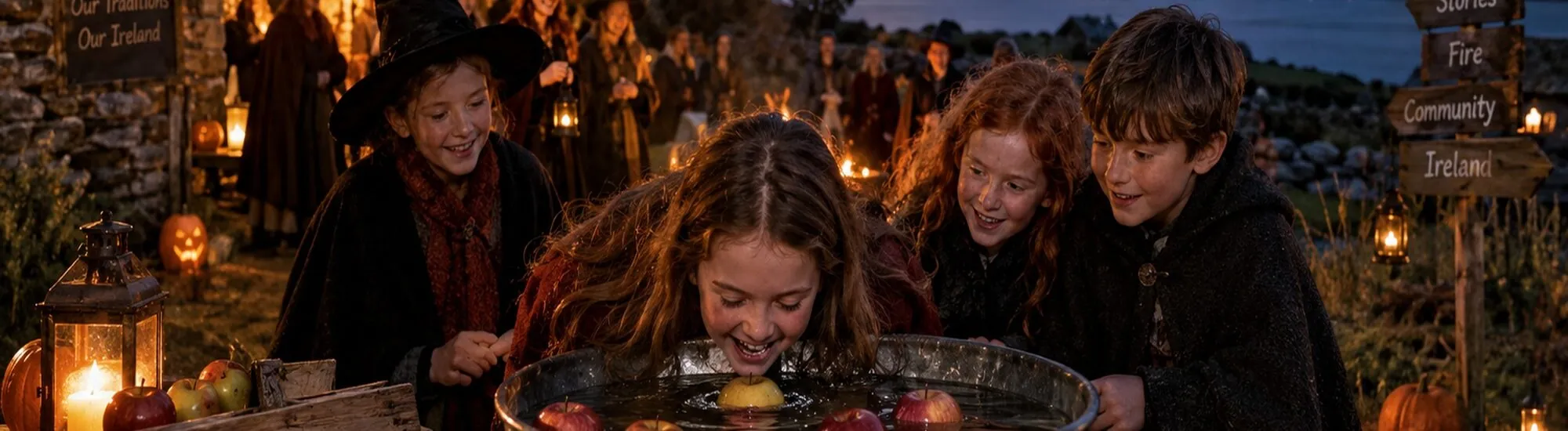
Halloween in Ireland was never just about costumes and sweets. Long before modern trick-or-treating, Oíche Shamhna brought families together for apples, nuts, fortune-telling and games that were equal parts entertainment and mischief.
Samhain marked the beginning of winter in the traditional Irish calendar. Folklore collected across Ireland records feasting, disguises, practical jokes and divination on 31 October. Apples and nuts, plentiful after the autumn harvest, became natural props for household games.
In the simplest version, an apple was hung from a string and players tried to bite it with their hands behind their backs. Folklore archives also describe an older spinning cross fitted with apples and candles. It is historically interesting, but the candle version should not be recreated today. A hanging apple provides more than enough chaos.
Some Irish folklore sources even call Halloween Snap-Apple Night, showing how closely the game became associated with the festival.
Apples floated in a basin of water while players attempted to catch one using only their teeth. Versions appear in folklore accounts from different parts of Ireland. For a modern gathering, individual bowls or freshly changed water make the tradition considerably more hygienic.
Two nuts could represent two people and their behaviour near the fire was interpreted as a clue to the couple’s future. Other divination games used beans, saucers or household objects. Nobody should mistake them for reliable relationship advice, but they reveal an important side of Irish Halloween: the future was part of the fun.
A blindfolded player selected from saucers containing symbolic objects. Meanings varied by place and period: a ring could suggest marriage, while other objects represented prosperity, travel or darker outcomes. Local variation is essential here; Irish folklore was never governed by a single Halloween rulebook.
Báirín breac, or barmbrack, remains one of Ireland’s best-known Halloween foods. Historically, objects hidden inside could predict a person’s fortunes. The ring became the star: finding it traditionally suggested marriage ahead. Modern barmbracks often preserve the ring tradition, but hidden objects are a choking hazard and require obvious care around children.
Some customs involved choosing a cabbage in the dark and interpreting its appearance as a clue about a future spouse. Others promised prophetic dreams. Strange today? Absolutely. But these rituals reflected very real concerns about marriage, harvests and prosperity in rural communities.
Irish folklore also records disguised guisers visiting houses, performing and receiving food or treats, alongside plenty of nocturnal pranks. These customs help explain the deep Irish roots within modern Halloween, although today’s festival developed through centuries of Irish, British and North American exchange.
Travellers encounter Irish Halloween through folklore collections, museums, storytelling and major celebrations such as Derry Halloween. Yet the old spirit needs surprisingly little staging: apples, barmbrack, stories after dark and relatives willing to look ridiculous are a remarkably authentic starting point.