
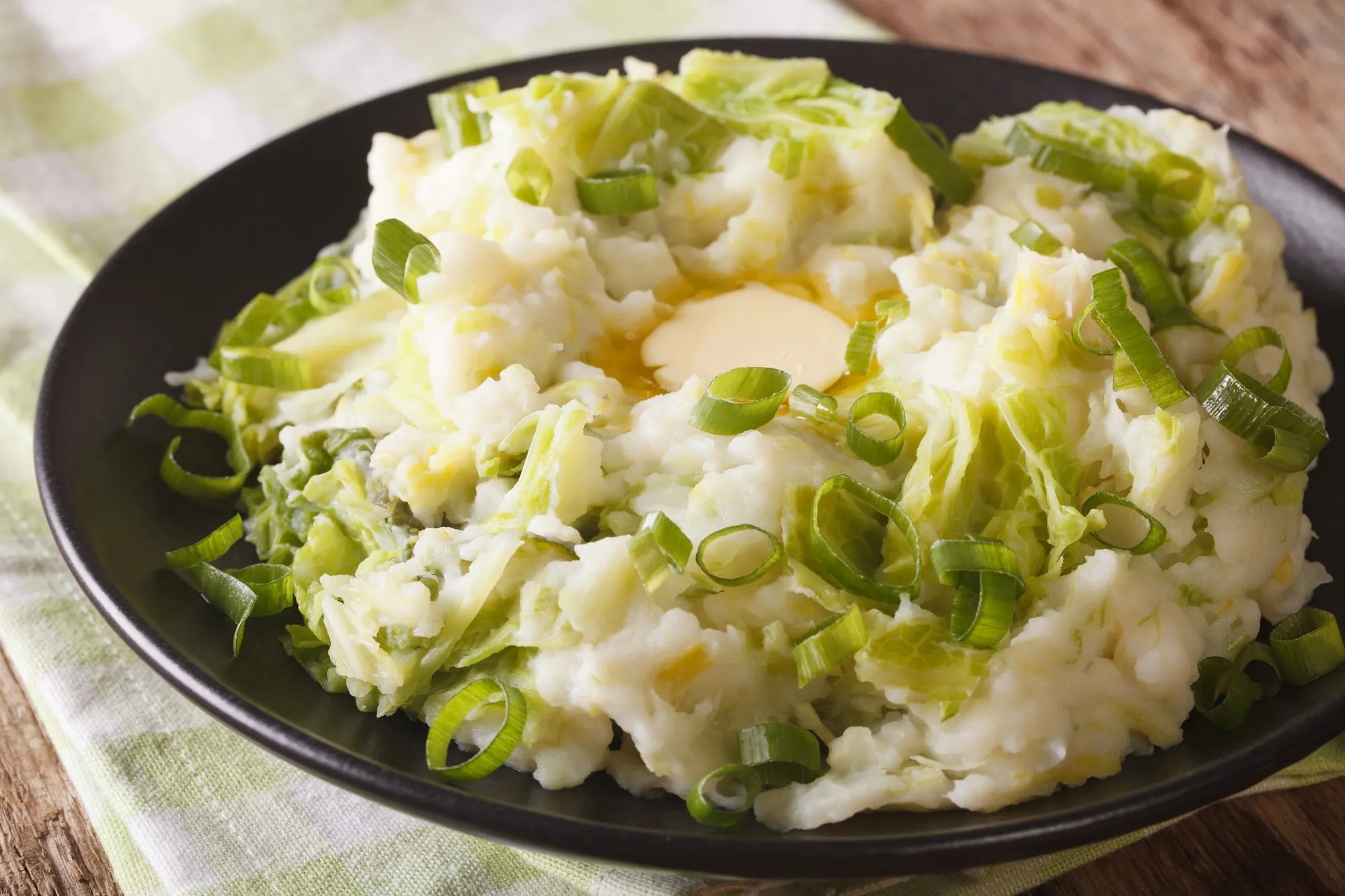
At the centre of the still-steaming mash, a knob of butter slowly melts, disappearing into the potatoes and cabbage leaves. Colcannon makes no attempt at sophistication or surprise. Its richness lies in a handful of simple ingredients brought together to create one of the most comforting dishes in Irish cuisine.
This speciality combines mashed potatoes, cabbage or kale, milk and a generous amount of butter. Spring onions, leeks or chives may be added, depending on the region and family tradition.
Long associated with Halloween and autumn meals, colcannon also tells the story of a rural cuisine able to turn everyday produce into a generous dish. It is now served as an accompaniment to meat, sausages or a stew, but can also make an excellent vegetarian meal.
Colcannon is a thick mash incorporating cooked cabbage and butter. The vegetable used may be green cabbage, curly cabbage, Savoy cabbage or kale.
The basic recipe does not have a strictly fixed composition. Some families add spring onions, while others prefer leeks, chives or gently sautéed yellow onions in butter.
Milk softens the potatoes without turning the dish into a loose purée. Butter provides most of the creaminess and should remain noticeable when the dish is eaten.
Colcannon is often presented as a complete dish. In modern Irish cooking, however, it is commonly served as a side dish, particularly with Irish bacon, ham, sausages or a slow-cooked dish.
The name is generally linked to the Irish expression cál ceannann. The word cál means cabbage or kale, while the second part may refer to a white head, in reference to a head of cabbage.
This etymology is frequently repeated, but its exact linguistic origin remains debated. It is therefore safer to present it as the most common explanation rather than an absolute certainty.
The word appears with several spellings in historical documents, including coel callen. Its present form gradually became established in Irish English.
One of the earliest known written descriptions appears in the diary of Welsh traveller William Bulkeley. On 31 October 1735, while staying in Dublin, he mentioned a dish called coel callen.
The preparation he discovered combined boiled cabbage, potatoes and parsnips. The ingredients were mixed together and served as an accompaniment to a roast shoulder of mutton.
His account is particularly interesting because he specifies that the dish was eaten throughout the kingdom on Halloween night. The connection between colcannon and autumn festivities was therefore already established in the early 18th century.
The recipes subsequently evolved. Parsnips generally disappeared, while milk and butter came to occupy a central place. The principle, however, remained the same: combining locally available vegetables to create a nourishing dish.
From the 17th century onwards, potatoes gradually became an essential food in Ireland. Productive, nourishing and suited to small plots, they occupied a considerable place in the diet of rural families.
Cabbage and kale withstand the Irish climate well and can be harvested late in the year. Combined with potatoes, they made it possible to prepare a hot, filling and relatively economical dish.
Colcannon should not, however, be reduced to a cuisine of deprivation. Milk, cream and, above all, butter could transform this rustic preparation into a festive dish. The knob of butter placed in the centre was even one of its chief pleasures.
Its recipe varied according to harvests, household means and the produce available. This flexibility explains why so many versions are regarded as traditional.
There is no single answer. Some Irish recipes use green cabbage or Savoy cabbage, while others consider kale to be the most traditional ingredient.
Savoy cabbage has a tender texture and mild flavour. It is particularly well suited to those trying colcannon for the first time.
Kale has a more vegetal flavour and a slightly firmer texture. Its thick stems should be removed before it is finely shredded and cooked.
Green cabbage is a simple and economical option. Avoid cooking it for too long, so that it retains its colour and does not develop an overly pronounced sulphurous flavour.
The best choice therefore depends on the vegetables available and the texture desired. Both cabbage and kale can produce an authentically Irish colcannon.
Potatoes high in starch give the best results. They mash easily and absorb the milk and butter without becoming elastic.
In Ireland, the Rooster variety is often recommended. In France, a potato suited to mash, such as Bintje, Agria or Caesar, will work perfectly.
Very waxy varieties are less suitable. They are more resistant to mashing and can produce a dense or slightly sticky texture.
The milk should be hot before it is added. Cold liquid would sharply lower the temperature of the potatoes and would not be absorbed as easily.
Do not use a blender or food processor with blades to mash the potatoes. Excessive processing releases the starch and produces a sticky texture. A potato ricer or a simple potato masher is enough.
The cabbage should retain a little texture. Overcooking would make it dull, watery and too strong in flavour.
Finally, do not reduce the amount of butter too drastically. Colcannon relies on a very simple balance: the potato provides texture, the cabbage freshness and the butter indulgence.
Both preparations are considered traditional. Family recipes adapted to the vegetables grown locally and available at mealtimes.
Kale was particularly useful in autumn because it tolerates cold weather and can remain in vegetable gardens after the first frosts. This seasonality explains its strong association with Halloween colcannon.
Headed cabbage and Savoy cabbage nevertheless appear in many old and contemporary versions. Claiming that either recipe is wrong would be to overlook the diversity of Irish home cooking.
In Ireland, colcannon is among the foods traditionally associated with Halloween, alongside báirín breac and apples.
31 October marked the end of the harvest season and the beginning of the dark half of the year. Potatoes and cabbages were then plentiful, making colcannon a natural dish for the family meal.
Halloween was also a time for omens. Various objects could be hidden in the mash to symbolically foretell the future of the person who found them.
This custom turned the meal into a game of divination, particularly for young adults seeking to learn about their romantic or financial future.
The objects and their meanings varied according to regions and families. A coin generally foretold prosperity, while a ring could promise an imminent marriage.
A button sometimes indicated that the person who found it would remain single. A thimble served a comparable purpose in certain traditions concerning young women.
Other versions mention a piece of cloth associated with poverty, or a small stick predicting an unhappy union. These meanings did not form a uniform code throughout Ireland.
This custom should no longer be recreated by placing small objects directly in food. Coins, rings and buttons pose a risk of choking, swallowing or injury. To evoke the tradition safely, use cards placed beneath the plates or separately wrapped objects handed out before the meal.
Colcannon chiefly combines potatoes with cabbage or kale. Irish champ, on the other hand, mixes mashed potatoes with finely sliced spring onions.
Both dishes generally contain milk and plenty of butter. Their boundaries can become blurred, however, as many colcannon recipes also include spring onions.
Champ remains particularly associated with Ulster, while colcannon is known throughout Ireland. These specialities belong to the same family of potato-based home-cooked dishes.
Colcannon traditionally accompanies Irish bacon, ham and various cuts of pork. Its mildness perfectly balances salty or smoked meats.
It can also be served with sausages, an Irish stew, Guinness-braised beef or roast meat.
For a vegetarian meal, serve it with a poached or fried egg, pan-fried mushrooms or roasted vegetables. A lightly sharp salad will provide a pleasant contrast to the butter and potato.
Leftovers can be shaped into patties and browned in a frying pan. Add a little flour if the mixture is too soft, so that the patties hold their shape.
Colcannon is best eaten immediately after preparation, when the mash remains light and the butter has only just melted.
It can nevertheless be kept for around two days in the refrigerator in a sealed container. Allow it to cool quickly before refrigerating it.
To reheat it, use a saucepan over a low heat with a little milk and a knob of butter. Stir regularly to prevent the mash from sticking.
A microwave is also suitable, provided the container is covered and the mash is stirred several times. Colcannon should be reheated until piping hot throughout.
Colcannon may be served in gastropubs, restaurants specialising in Irish cuisine and certain establishments serving local produce. It is more likely to appear in autumn, around Halloween, or as an accompaniment to a meat dish.
You should not, however, expect to find it in every pub. Many establishments serve plain mash, chips or roast potatoes rather than genuine colcannon.
When the dish appears on the menu, check whether it is presented as a side dish or a complete preparation. Some contemporary versions add bacon, cheese, cream or herbs, taking them slightly away from the most understated recipe.
What are the ingredients in colcannon?
The recipe is based on potatoes, cabbage or kale, milk and butter. Spring onions may be added.
Is colcannon vegetarian?
The basic recipe is vegetarian. Some versions, however, contain bacon or are served with meat.
When is colcannon eaten in Ireland?
It can be eaten all year round, but remains particularly associated with autumn, winter and the Halloween meal.
Is colcannon made with cabbage or kale?
Both versions are traditional. The choice depends on the region, the family and the vegetables available.
What is the difference between colcannon and champ?
Colcannon contains cabbage or kale, while champ is mainly made with spring onions.