An archaeological discovery announced in early September 2026 could profoundly alter what was thought to be known about Ireland’s earliest inhabitants. In eight caves in the south-west of the country, an international team says it has identified engravings, traces of ochre and charcoal, and finger markings that could date back at least 15,000 years.
If confirmed, this dating would make these traces around 5,000 years older than the earliest evidence of human presence generally accepted in Ireland until now. The scenario put forward by the researchers is based on the existence, during the last Ice Age, of a vast expanse of land, now submerged, between Wales and south-east Ireland.
Eight caves in south-west Ireland at the heart of the discovery
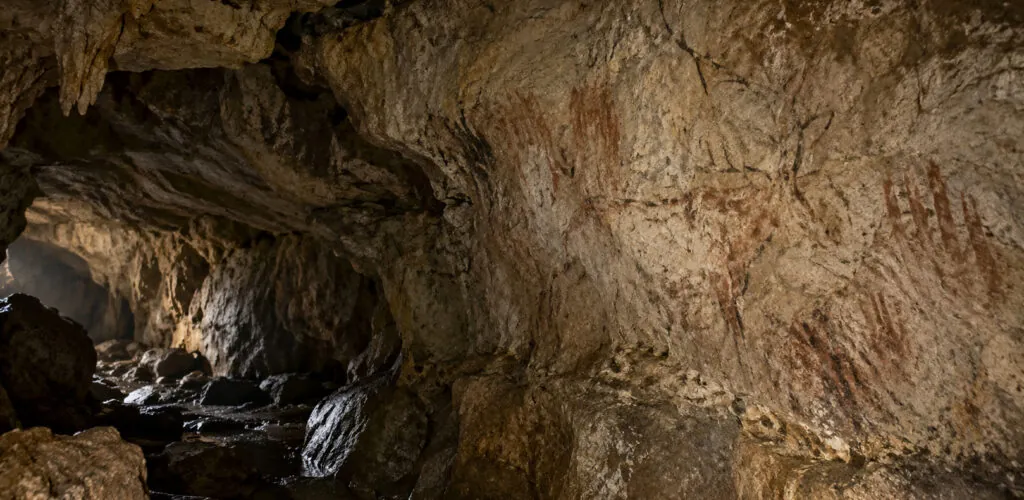
Engravings and pigments interpreted as prehistoric art
The project, coordinated by researcher George Nash, is examining possible links between prehistoric populations in south Wales and Ireland. To focus their research, the scientists used a computer model fed with data from known caves in Wales. This work identified 28 potentially promising cavities in south-west Ireland.
Eight of them have yielded what the team interprets as very ancient rock art: lines engraved in the rock, traces of pigment, finger markings and possible animal depictions. Among the suggested forms is a silhouette that the researchers interpret as a mammoth.
The precise locations of the caves have not been made public. The team wishes to prevent damage, looting or an influx of visitors to sites that are still fragile and under study.
Human presence in Ireland far older than previously thought?
A hypothesis that could push back the known timeline by several millennia
Until now, the earliest recognised evidence of human presence in Ireland dated back around 10,500 years. The newly identified traces in the caves could therefore push this timeline back by around five millennia.
This interpretation must nevertheless be approached with caution. The researchers refer to evidence that may date back at least 15,000 years, but the full significance of the discovery will depend on further analyses and confirmation of the dating. In prehistoric archaeology, assigning an engraving or pigment to a specific period requires robust, corroborating evidence.
An ancient land bridge between Wales and Ireland
When the Irish Sea had not yet taken its present form
At the heart of the hypothesis is the much lower sea level during the last Ice Age. At that time, part of the seabed now covered by the sea would have been above water. The researchers believe that a land or semi-land corridor may have facilitated travel between present-day Pembrokeshire in Wales and south-east Ireland, particularly towards the Rosslare area.
This vanished landscape may have consisted of plains, grassland and environments favourable to the movement of large animals. Groups of hunter-gatherers may then have followed their migrations and moved westwards.
Why this discovery matters for Ireland’s history
A possible new chapter in Irish prehistory
If the dating is confirmed, this discovery would not simply change the date when the first humans arrived on the island. It could also alter how archaeologists understand exchanges, migrations and the ability of hunter-gatherer populations to travel across north-west Europe at the end of the Ice Age.
It would also strengthen the idea that Ireland, often regarded as a peripheral region settled late, may have been integrated much earlier into mobility networks linking the British Isles and continental Europe.
Further caves may yet be discovered
Wexford, Waterford and Cork could also hold surprises
The researchers themselves believe that the current discoveries are probably only a beginning. If human groups did indeed reach south-west Ireland from the east, it would be logical to find further traces along their route, particularly in the counties of Wexford, Waterford and Cork.
The archaeological potential could therefore be considerable. Further survey and dating campaigns will be needed to determine whether these eight caves are isolated cases or the first evidence of a far more extensive human presence.
A spectacular discovery, but one still being validated
What we know so far
The announcement is significant enough to draw attention far beyond Ireland, but it should be viewed with the usual degree of caution required in archaeology. The researchers have identified traces they consider very ancient and potentially Palaeolithic. Dating them to at least 15,000 years ago could substantially push back the known history of settlement on the island, but the work still needs to be consolidated.
For Ireland, the stakes are immense: these caves could open a window onto an almost entirely unknown period of its human history, long before the megalithic monuments that have made sites such as Newgrange and Loughcrew famous.