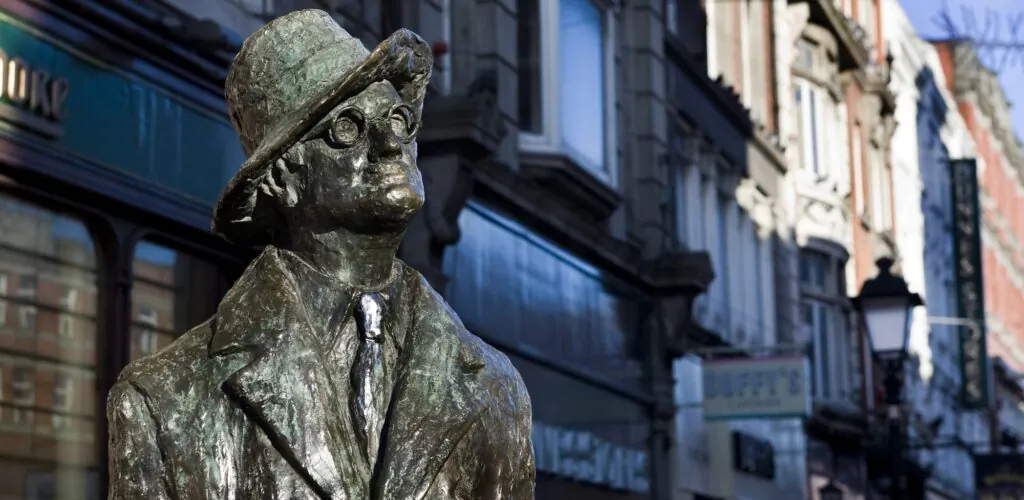
James Joyce has never been an easy author to pin down. Confounding to some, brilliant to others, he remains a name that never leaves literary conversations. When we think of his style, we imagine a labyrinth of thoughts, sentences stretching without full stops, and fragments of consciousness that become music. It’s no coincidence that so many modern writers still cite him as a guiding compass.
Zlibrary shares a common goal with Library Genesis and Anna’s Archive – free access to knowledge. This principle echoes an idea dear to Joyce himself, who believed in everyone’s right to explore language and build their thoughts without barriers or dogma. The universe he offers in “Ulysses” or “Finnegans Wake” opens like a living library, a place where every word is a door to push open.
Stream of Consciousness as a Tool for Truth
One of Joyce’s greatest contributions to modern literature is undoubtedly his use of the stream of consciousness. For a long time, novels followed neat, orderly narratives. With Joyce, mental disorder becomes the heart of the story. What a character thinks becomes just as important as what they do.
In “Ulysses,” Leopold Bloom’s thoughts drift between the trivial and the profound, as if Joyce wanted to say that the ordinary always hides an ocean of ideas. This technique has since influenced novels worldwide. Even today, writers who want to show what a character truly feels turn to this method. It gives fiction a form of truth that is rawer and more naked.
Three Traces of Joyce in Modern Literature
Behind the curtain of contemporary novels, traces of the Dublin master often appear. These influences aren’t always obvious but weave an underground web between the pages. Here are three concrete ways Joyce continues to shape today’s words:
A Fragmented Structure That Defies Straight Lines
More and more authors reject classic beginnings and endings. They prefer to plunge the reader into the heart of disorder. This choice recalls how “Finnegans Wake” refuses linear storytelling to explore a world that is dreamed rather than told. By blurring the tracks, Joyce opened a path for those who want to write outside the lines. Whether in Valeria Luiselli’s novels or David Mitchell’s stories, this desire to fragment time and break narration emerges, creating something more organic, closer to the real chaos of life.
Language as a Playground for Experimentation
Joyce wasn’t afraid to twist words, invent them, or make them sound differently. This love for playing with language has been passed down to a new generation of authors. Joyce’s English mixed with Latin, French, and pure invention. Today, this freedom inspires those who reject fixed language. Writers like Ali Smith or Eimear McBride adopt this way of breaking syntax to create a reading experience that is more visceral and daring. Language is no longer just a tool; it becomes living material.
Rooted in Universal Everyday Life
Despite its complexity, Joyce wrote about simple things. A man walking in Dublin, an ordinary meal, a woman dreaming in her bed. This attention to everyday details has become a source of inspiration. Writers like Karl Ove Knausgård or Rachel Cusk follow this tradition. They transform banality into literary material. They show that the ordinary can contain all the complexity of a classic novel without needing a spectacular plot.
Joyce’s legacy, therefore, lies not only in his brilliant ideas but in this different way of seeing the world that continues to fuel today’s stories. He planted seeds that still sprout in the margins as well as in bestsellers.
An Ever-Active Memory in Today’s Narratives
It’s not just a matter of style or structure. Joyce’s texts contain a way of exploring identity, time, and memory that continues to illuminate the most recent works. In Joyce’s writing, every moment holds the weight of the past and the echo of the future.
Perhaps that’s why his novels resonate so much with current concerns. In a world where individuals are torn between many narratives, between their own story and those of others, this way of thinking about the flow of consciousness becomes a way to inhabit the world. Authors like Teju Cole or Annie Ernaux continue this line by exploring their personal memory within an expanded, almost collective framework.
Joyce’s echo thus crosses continents and languages. He has never been frozen in a museum. He is alive because he always invites us to seek, doubt, and invent anew. We may read him less to understand than to feel what literature can be when it stops being a demonstration and becomes a full experience.