Spike Island unveils a new exhibition on a secret mission that was meant to change Ireland’s destiny
In Cork, a new exhibition revisits the remarkable mission of the Aud on the eve of the 1916 Easter Rising
A cargo of German weapons, a disguised ship, a mission carried out in utmost secrecy and an operation intended to support an uprising against British rule: this summer, Spike Island immerses visitors in one of the most extraordinary episodes in Irish history.
The famous former prison island in Cork Harbour is presenting a new exhibition dedicated to the Aud, a vessel closely linked to the events that preceded the 1916 Easter Rising.
Entitled The Aud: “Special, Secret and Dangerous Mission”, the exhibition marks the 110th anniversary of the 1916 mission. It is complemented by a second space dedicated to the shipwreck and its underwater history.
For travellers visiting Cork or Cobh this summer, the new exhibition offers another reason to take the boat to Spike Island.
A secret mission at the heart of Irish history
German weapons intended for the 1916 rebels
To understand the exhibition, it is necessary to return to the spring of 1916.
As the First World War raged across Europe, Irish nationalists were preparing an uprising against British rule.
Against this backdrop, a clandestine operation was organised to bring a substantial cargo of weapons and ammunition to Ireland from Germany.
The vessel used for the mission was in fact the SS Libau, a German ship carefully disguised to resemble a Norwegian vessel named Aud.
Its mission was particularly sensitive: to reach the Irish coast without arousing suspicion and deliver weapons to the forces preparing the uprising.
The SS Libau poses as the Aud
A disguise intended to deceive the British authorities
The ruse was worthy of a spy novel.
The SS Libau sailed under the guise of a neutral vessel in order to cross waters under surveillance during the First World War.
But the mission did not go as planned.
The ship was eventually intercepted by the British and taken to Cork Harbour. Its captain then decided to scuttle the vessel rather than allow its cargo to be recovered.
The wreck still lies in the waters off County Cork, making this story today a political, military, maritime and archaeological subject.
Why is Spike Island connected to the Aud?
The ship’s crew were imprisoned there
The choice of Spike Island to host this new exhibition is far from incidental.
After the Aud was intercepted in 1916, members of its crew were held on Spike Island before being interned in Great Britain.
The island was then an important British military installation at the heart of Cork Harbour.
More than a century later, the exhibition therefore revisits a story that partly unfolded in precisely the place where visitors now stand.
Two rooms telling the story of the Aud
Archives, artefacts, photographs and testimonies
The new exhibition is installed in the Shell Store on Spike Island and occupies two complementary spaces.
The first part, The Aud: “Special, Secret and Dangerous Mission”, examines the operation’s preparation, its course, the interception of the ship and the consequences of its failure.
The exhibition brings together, in particular, artefacts, historic photographs, archival documents, personal testimonies, films and documents relating to the crew.
The exhibition was developed by Spike Island’s curatorial team on the basis of new research. Descendants of crew members also contributed to the project by sharing photographs, family mementoes and documents.
The wreck of the Aud explored underwater
A second exhibition explores heritage invisible from the shore
The second part is probably the most original aspect of the new exhibition.
Entitled The Aud: Submerged History, it explores what became of the ship after it sank.
Underwater photographs of the wreck and material from archaeological research offer an insight into this maritime heritage, which now lies beneath the waters of Cork Harbour.
The exhibition presents the ocean as a form of archive: more than 100 years after the events of 1916, the physical remains of the mission are still present on the seabed.
Descendants of the crew took part in the project
A military story told on a human scale, too
Spike Island has not confined itself to recounting the military aspects of the operation.
The curators also worked with the families of several crew members.
Fred and John Schmitz, grandsons of Friedrich Schmitz, provided family mementoes, photographs and private footage showing the recovery of the Aud’s anchors in 2012.
Jennifer Meyer Husson, granddaughter of Christian Meyer, also shared family documents and mementoes.
These contributions give the exhibition a more intimate dimension and make it possible to discover the men behind this secret operation.
A story directly linked to the Easter Rising
An operation that preceded the Dublin uprising by a few days
The story of the Aud takes on its full significance when placed in the context of the 1916 Easter Rising.
The uprising broke out in Dublin a few days after the failed delivery of weapons.
Although the uprising was militarily crushed, the events of Easter 1916 quickly became a defining moment in the history of Irish independence.
The Aud mission was thus one of the most remarkable international episodes associated with this period: in the midst of the First World War, Irish events were already part of a political and military dynamic extending far beyond the island’s borders.
Why visit Spike Island in 2026?
Far more than a former prison
This new exhibition complements an already particularly rich visit.
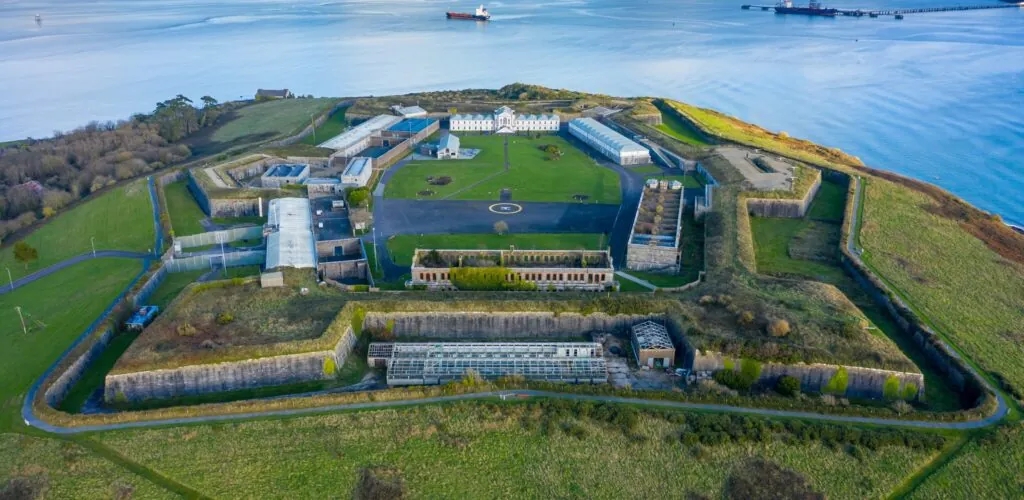
Located in the middle of Cork Harbour, Spike Island has served in turn as a religious site, a military fortress and a prison.
In the 19th century, it was home in particular to a vast convict prison. The island subsequently continued to fulfil various military and penal functions before the modern prison closed permanently in 2004.
Today, visitors can explore the island’s former military buildings, cells, exhibition spaces and trails while enjoying spectacular views across Cork Harbour.
Visitors arrive by boat from Cobh, which is an integral part of the experience.
Is the exhibition free during Heritage Week?
It is included in the Spike Island admission ticket
The exhibition dedicated to the Aud is featured in the programme for National Heritage Week 2026, taking place from 15 to 23 August.
However, an important distinction should be noted: the exhibition does not mean free entry to Spike Island.
There is no additional charge to visit the exhibition, but it is included in the standard admission price for Spike Island.
During Heritage Week, the exhibition is open at the following times:
- Saturday 15 August: 11am to 5.30pm;
- Sunday 16 August: 11am to 5.30pm;
- Monday 17 to Friday 21 August: 12pm to 4.30pm;
- Saturday 22 and Sunday 23 August: 11am to 5.30pm.
The exhibition itself is scheduled to run on Spike Island from June to October 2026. It is therefore not necessary to visit the island during Heritage Week alone to see it.
How to visit Spike Island from Cobh
A boat trip in the heart of Cork Harbour
Spike Island is located in Cork Harbour, opposite the town of Cobh.
The visit begins with a boat crossing from Cobh before arriving at the island and its historic buildings.
It is recommended that visitors check boat timetables and availability before their visit, particularly during the peak summer season.
For a stay in Cork, the excursion can easily be combined with a visit to Cobh, renowned for its maritime heritage, St Colman’s Cathedral and its history of major transatlantic crossings.
A new reason to discover Cork Harbour
When a tourist attraction becomes a true place of remembrance
With this exhibition, Spike Island above all succeeds in bringing together several layers of Irish history in one place.
Visitors discover the story of a German ship disguised for a clandestine operation, of a crew imprisoned on the island, of the 1916 Rising and, finally, of a wreck that has now become part of Ireland’s underwater archaeological heritage.
A 110-year-old story that thus finds new resonance just a few metres from the cells and buildings where some of its protagonists were held.