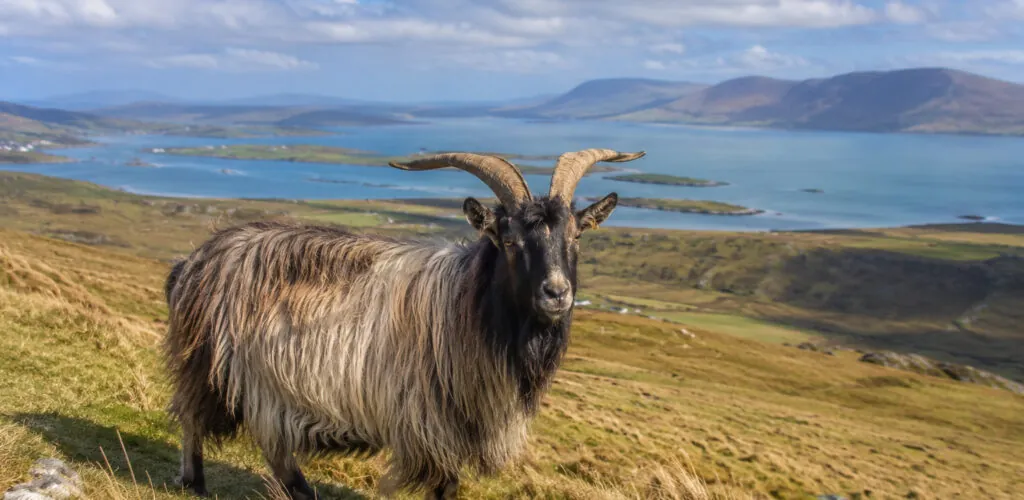
It has long horns, a thick coat able to withstand Irish rain, and a history stretching back several millennia. Yet the Old Irish Goat nearly disappeared altogether.
In County Mayo, a handful of enthusiasts are now trying to save this breed, which is closely tied to the island’s rural landscapes. Nor is the animal simply a living witness to the past: it now plays a role in protecting certain Irish natural areas.
During National Heritage Week 2026, the Old Irish Goat will be back in the spotlight. An evening devoted to its ancient DNA is being held on Friday 21 August in Mulranny, on Mayo’s wild coast.
An Irish goat inherited from a very ancient past
The Old Irish Goat has adapted to the island’s landscapes over centuries
Its appearance is hard to miss. A thick coat, an sometimes impressive beard and long horns give some individuals an almost prehistoric look.
The Old Irish Goat is a hardy breed shaped by the harsh conditions found on the island. It has, in particular, a thick cashmere-type undercoat, protected by a longer, weather-resistant outer coat.
This feature enables it to withstand the cold, damp and rapid weather changes typical of western Ireland.
It is also able to move across rough terrain and feed on relatively sparse wild vegetation, where some modern domestic breeds would be far less at ease.
A breed thought to be almost lost
Ancient goats rediscovered in the Mulranny mountains
The Old Irish Goat’s recent history is almost one of rediscovery.
The Old Irish Goat Society was initially established in the Burren, County Clare, in 2006. But it was in Mayo that the conservation project would truly gather momentum.
In 2012, goats displaying the characteristics of the ancient Irish type were identified within a herd living in the mountains around Mulranny.
Specialists then began studying the animals, and genetic analyses were undertaken to gain a better understanding of their origins.
A conservation population was gradually established. From spring 2013, a new generation of kids was born as part of the conservation programme.
Why their DNA now interests researchers
A special talk being held in Mayo on 21 August
It is precisely this genetic history that will be highlighted during National Heritage Week.
On Friday 21 August 2026, the Old Irish Goat Society is hosting an event in Mulranny entitled Ancient DNA of the Old Irish Goat.
The event is intended to explore what genetics can reveal about the history of this population and, more broadly, Ireland’s animal heritage.
The event will take place from 8 pm to 9 pm at the Old Convent in Mulranny, County Mayo.
It is a scientific development that takes on particular significance given how uncertain the survival of this ancient population was for so long.
These goats have become allies in the fight against fires
An ancient animal serving a very modern challenge
It is probably the most surprising aspect of the story.
Saving the Old Irish Goat is not simply about preserving a breed in a sanctuary. Its natural characteristics are now being used to manage certain landscapes in an environmentally friendly way.
The goats eat scrub, ferns and various plants that can take over heathland.
By controlling this vegetation, they can help reduce the amount of combustible material on the ground and thus contribute to fire prevention in certain environments.
This technique is known as conservation grazing.
In Howth, goats protect heathland near Dublin
A herd has been reintroduced to Howth Head
The project has even reached the Dublin area.
In 2021, an initial herd of 25 Old Irish Goats from the national Mulranny herd was introduced to Howth Head, in Dublin Bay’s biosphere reserve.
The area had experienced several scrub fires. The aim was therefore to reintroduce a natural form of land management that had once been common in these landscapes.
The goats eat gorse and ferns in particular, helping to keep certain areas more open and reduce the build-up of flammable vegetation.
The project even combines this age-old method with particularly modern technology: a virtual fencing system makes it possible to manage the areas in which the herd roams.
They can also tackle invasive plants
A trial against Gunnera in western Ireland
The Old Irish Goat has another particularly valuable skill when it comes to protecting landscapes.
In western Ireland, goats have been used to combat Gunnera tinctoria, a huge invasive plant from South America sometimes known as “giant rhubarb”.
The plant can form extensive stands and strongly compete with local vegetation.
During a trial project launched in 2021, the goats ate Gunnera leaves and stems. The experiment was then continued to study the potential of this natural method for controlling the invasive species.
Rather than relying solely on machinery or treatments, land managers can therefore make use of the natural feeding behaviour of a breed perfectly suited to the terrain.
Can you see the Old Irish Goat while travelling in Ireland?
Yes: a centre in Mulranny is dedicated to the breed
Good news for travellers: this story is not confined to the pages of books.
The Old Irish Goat Centre welcomes visitors in Mulranny, County Mayo, directly on the Wild Atlantic Way.
The centre offers the chance to meet the animals, discover their history and understand the programme established to preserve the breed.
Interactive displays and a short documentary also explore the links between these goats, Irish landscapes and old rural practices.
In summer, the centre states that it is open daily from 10 am to 4 pm, from July to September. However, it is advisable to check opening hours before travelling.
Mulranny, between Westport and Achill Island
An easy stop to include on a Mayo road trip
The village of Mulranny lies on the Mayo coast, between Newport and Achill Island.
Its location is particularly appealing for travellers exploring western Ireland: the village is crossed by the Wild Atlantic Way and also lies on the route of the Great Western Greenway.
A visit to the Old Irish Goat Centre can therefore easily be combined with a day on Achill Island or a stay around Westport.
The centre is based in Mulranny, Co. Mayo, and the society advises planning your visit in advance if you wish to meet the goats.
Can you also see the goats in Howth?
Yes, but they are working animals, not a tourist attraction
Travellers staying in Dublin may sometimes spot the herd on Howth Head from the walking trails.
However, one essential rule must be observed: these goats are part of an ecological management programme and should not be approached as though they were domestic animals.
The Old Irish Goat Society asks walkers to keep a minimum distance of 30 metres and, above all, to keep dogs on leads near the herd.
The best place to see the animals up close and understand their history therefore remains the centre in Mulranny.
A survivor turned protector of Irish landscapes
When heritage conservation meets nature protection
Ultimately, the story of the Old Irish Goat is about far more than a threatened animal breed.
It shows how an almost forgotten part of rural heritage can regain a role in contemporary Ireland.
Long associated with small farms and the sparse landscapes of the west, this hardy goat is now used to protect biodiversity, control certain invasive species and limit the accumulation of vegetation that could fuel fires.
In Mulranny, visitors can now look these animals in the eye. Behind their long horns and thick coats lies a remarkably living part of Ireland’s natural history.