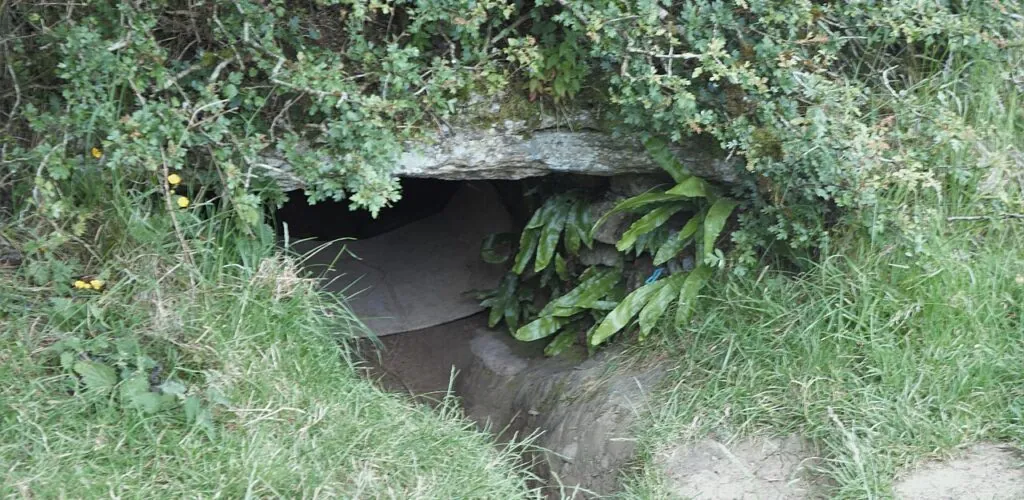
In the quiet pastures of County Roscommon, a simple grassy rise conceals one of the most mysterious landscapes of ancient Ireland. At Rathcroghan, once the royal centre of Connacht, a new archaeological trail now takes walkers on a journey of almost 13 kilometres between burial mounds, ceremonial enclosures and mythological tales. Along the route lies a place with a striking name: Oweynagat, the ‘cave of the cats’, often described in tradition as a gateway to the Otherworld. It is a walk through more than five millennia of history, at the source of the legends of Samhain.
At Rathcroghan, a new trail crosses an ancient kingdom
Thirteen monuments along a 12.9-kilometre loop
You need to look closely at the landscape to guess all that it contains. At first sight, Rathcroghan looks like the most peaceful Irish countryside: stone walls, fields, sheep and gently rolling ground. Yet the area is home to a vast archaeological complex, known as Cruachan Aí, associated with the power of the rulers of Connacht.
The Rathcroghan Looped Archaeological Trail now offers a new way to explore this territory. Marked with black arrows, the circular route links thirteen remarkable monuments. It leads in particular to the earthworks of Rathcroghan Mound, a vast ceremonial mound, and the surroundings of Relignaree, a landscape associated with ancient funerary traditions.
Rather than a single site surrounded by barriers and information boards, visitors discover a true historic landscape here. The remains have retained their place in the terrain and in local memory. That is precisely what makes this walk so distinctive: the monuments do not appear around a street corner, but in a meadow.
Oweynagat: why is this cave called the ‘gate of hell’?
The cave of the cats, a supposed passage to the Otherworld
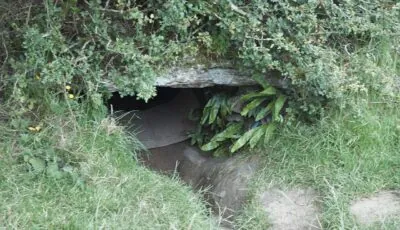
Rathcroghan’s most intriguing place does not, however, resemble a monumental landmark. Oweynagat, whose Irish name Uaimh na gCat means ‘cave of the cats’, has a low entrance, partly constructed with ancient stones. Its discreet appearance contrasts with the extraordinary place it occupies in Irish stories.
In medieval literature and folklore, this opening is associated with the Síd, the supernatural world inhabited by deities, fantastical beings and forces beyond human control. The famous ‘gate of hell’ is therefore an expression inherited from traditions and reinterpretations of the site: it describes neither a uniform religious belief among the ancient Celts nor a mysterious geological phenomenon.
The cave is particularly associated with the Mórrígan, a powerful and ambivalent figure in Irish mythology, often linked to war, sovereignty and omens. According to the tales, the visible world and the Otherworld could come dangerously close here. It is these stories, rather than the cave’s actual depth, that have shaped its reputation.
What is the link between Oweynagat and the origins of Halloween?
Samhain, the night when the boundaries between worlds fade
Oweynagat’s reputation is inseparable from Samhain, an ancient festival marking the transition into the dark season. In Irish traditions, this was a time when the boundary between the living and the supernatural world symbolically grew thinner. Ghosts, creatures and mythological figures then filled popular tales, long before the costumes and pumpkins of modern celebrations.
Rathcroghan is now presented as one of the key places associated with these traditions. But to say that the entire Halloween festival was invented in this single cave would oversimplify a far longer history. Today’s customs are the result of successive developments, involving Gaelic seasonal festivals, Christian influences and transatlantic popular traditions.
What is striking here is the meeting of a real place and an imagination that has travelled through the centuries. To explore the story further, travellers can find out how to pronounce Samhain and discover the place of the Aos Sí in Irish beliefs.
A walk among largely preserved remains
Rathcroghan’s heritage is written into the landscape
Rathcroghan ranks among the most important royal landscapes of prehistoric and medieval Ireland. Its monuments bear witness to burial practices, gatherings and forms of power that followed one another over millennia. Archaeologists study an exceptional assemblage of mounds, enclosures and structures here, much of which has not undergone extensive excavation.
The new trail makes it easier to understand the relationships between these remains. A mound is no longer simply an isolated feature: it can be understood by looking at the other traces of human activity scattered across the fields. This context is essential to grasping the importance of ancient Irish royal capitals such as Tara, Emain Macha and Rathcroghan.
The walk crosses a living agricultural landscape rather than a fully developed archaeological park. Visitors should follow the marked route strictly, respect the animals and private property, and avoid climbing on fragile structures outside authorised paths.
How do you follow the new Rathcroghan trail?
Starting point, difficulty and precautions for walkers
The loop starts and finishes at the Rathcroghan Mound car park, a few kilometres from the village of Tulsk. The official description published by Sport Ireland gives a distance of 12.9 km, an estimated duration of three hours and a moderate rating. The route is marked with black arrows and has little overall ascent, but ground conditions can change quickly after rain.
Good waterproof footwear, clothing suitable for windy conditions and enough water are recommended. This is not an urban route: grassy sections can be wet, and services are scarce between stages. Dogs are not permitted on the trail, an important rule in these grazing pastures.
One point deserves particular emphasis: Oweynagat’s presence on the route does not mean that you can freely enter the cave. Access to the interior is restricted for safety reasons, particularly because of risks related to air quality. Some information from the centre mentions guided visits depending on the season, so it is necessary to seek direct confirmation before planning to enter the cave. The trail itself allows visitors to discover the surrounding archaeological landscape without passing through this entrance.
Why start at the Rathcroghan Visitor Centre?
Understanding the legends before walking in the footsteps of ancient kings
Located in Tulsk, the Rathcroghan Visitor Centre is an excellent first stop. Its interpretation spaces place the monuments in the history of Connacht, while its guided tours help distinguish archaeological discoveries from legends handed down in texts.
The visitor centre is not located at the start of the walk itself: you must make your way separately to the Rathcroghan Mound car park. This distinction avoids much uncertainty when planning the outing. Guided tours are subject to their own arrangements, separate from self-guided walking.
At Rathcroghan, the most surprising thing is ultimately not the search for a supernatural gateway. It is discovering that beneath seemingly ordinary pastures lies one of ancient Ireland’s richest landscapes, where archaeology and imagination continue to echo one another.