In the early hours of 16 November 2026, a walk on Ballyheirnan Beach, on the Fanad Peninsula in northern Donegal, takes a distressing turn. Lying on the sand is a male minke whale measuring around five metres, already dead, with its head and pectoral fins caught in ropes. Two unidentified floats remain attached to the lines. Reported immediately to the Irish Whale and Dolphin Group (IWDG), the discovery highlights a danger largely invisible from shore: the ropes linking fishing pots beneath the surface of the Atlantic.
A five-metre whale found on a Donegal beach
A discovery made during an early-morning walk
On Monday 16 November, Darren Roche is walking on Ballyheirnan Beach, also known as Baile Uí Thiarnáin, at Ireland’s north-western tip. He finds the body of a whale and immediately notices the ropes wrapped around it. He contacts the Irish Whale and Dolphin Group, the Irish organisation that records and studies cetacean sightings and strandings.
Volunteer David McGloin visits the site to document the scene. Initial observations identify a male measuring around five metres, belonging to the species Balaenoptera acutorostrata, better known as the minke whale. Its head and the front part of its body are tangled in ropes, with two improvised, unmarked buoys still attached. The animal is thought to have been dead for some time before being discovered on the shore.
The presence of this equipment makes the possibility of entanglement particularly concerning. According to the IWDG, the minke whale most likely became caught in lines linking pots used to catch shellfish. However, the organisation does not claim to know with certainty what happened in its final moments. Without further forensic evidence, the observed entanglement must be distinguished from a definitive determination of the cause of death.
How can fishing ropes trap a whale?
Underwater lines that form real arches
To understand this scene, it is necessary to picture the seabed off the Irish coast. Crab and lobster fishers use submerged pots, sometimes linked together by ropes known as groundlines. When these lines float above the seabed, they can form large loops or arches in the water column.
A whale diving to feed may then strike a rope and find it caught around a fin, its tail or its mouth. As it tries to free itself, it may tighten the knots, drag fishing gear with it and expend a great deal of energy. For a minke whale, relatively small compared with larger whales, serious entanglement can prevent it from returning to the surface to breathe and lead to drowning. Animals that remain able to surface can also suffer injuries or die from exhaustion.
This is not about holding all fishers responsible. The IWDG points out that many of the businesses involved are small coastal operations. The challenge lies precisely in maintaining maritime activities while reducing the risks to mammals travelling through the same waters.
Why does this stranding concern Irish specialists?
A documented risk that could extend northwards
The case goes beyond a single minke whale. Research carried out with Atlantic Technological University and the Marine Institute has examined interactions between large whales and pot fisheries in Ireland. Researchers identified a substantial risk of entanglement for minke whales, particularly in the south and south-west of the island, where many cetaceans encounter intensive fishing activity.
But sightings of large whales are also becoming more frequent in northern and north-western Ireland. Donegal, too, has significant pot-fishing activity. Scientists therefore fear that exposure to this risk may extend further into these northern waters. The Ballyheirnan stranding alone cannot quantify a regional trend, but it illustrates what specialists are seeking to measure.
The IWDG also cites a Scottish study published in 2022, based on interviews with fishers, which estimated several dozen whale entanglements each year within the area studied, with particularly high mortality among minke whales. These figures concern Scotland and should not be presented as an annual total for Irish coasts.
Ropes that sink rather than float: a promising solution
A Scottish trial closely followed in Ireland
A relatively simple technical approach could help limit such incidents. Rather than using floating ropes between pots, some Scottish fishers have tested negatively buoyant lines, designed to remain close to the seabed. They therefore form fewer arches that could catch a diving whale.
As part of trials conducted with the Scottish Entanglement Alliance, 61 sets of pots were fitted with these lines for around fifteen months. Technical feedback was generally positive regarding the handling of the ropes and their use on board, despite certain limitations in rocky areas close to shore. According to observations reported by the IWDG, the equipment also appeared less prone to tangling than floating ropes.
This is not yet a miracle solution or a system deployed everywhere. Its value lies in offering a practical response to a complex problem, bringing together researchers, conservation organisations and marine professionals. Irish authorities and associations are following these trials to better assess their potential in the island’s waters.
The minke whale, a discreet regular in Irish waters
A marine mammal travellers may sometimes spot
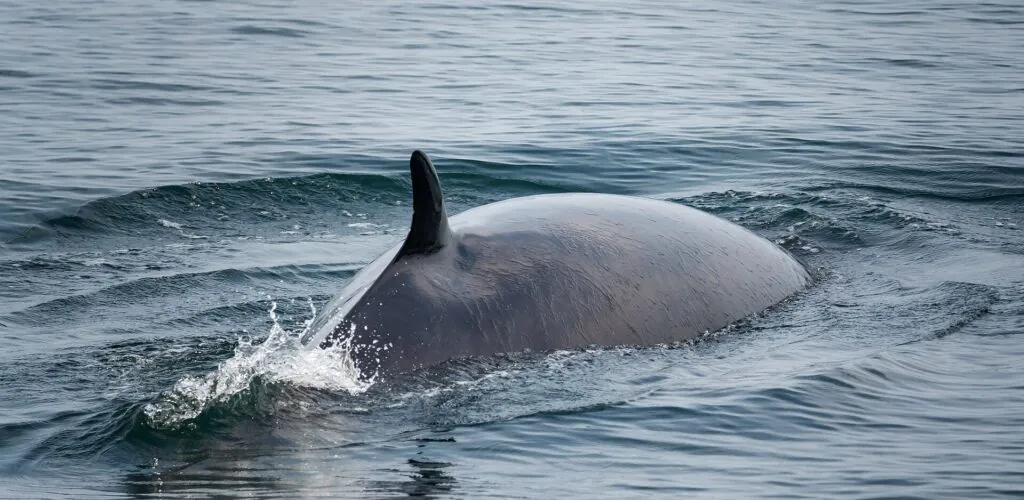
The minke whale is one of the cetaceans most regularly seen around Ireland. Its slender shape, pointed snout and small dorsal fin set it apart from larger whales. Like all marine mammals, it must return to the surface to breathe, even when feeding underwater.
Encountering this species can be an unforgettable moment on a wildlife-watching trip conducted with respect for animals. South-west Ireland remains renowned for marine excursions, particularly around Whale Watch West Cork. These outings naturally offer no guarantee of seeing a whale: they depend on the season, sea conditions and the animals’ behaviour.
Donegal is also attracting the attention of cetacean enthusiasts. The waters of Donegal Bay have recently hosted remarkable sightings, including two orcas particularly well known to observers. A beluga from Arctic regions was also filmed there in October 2026. These separate events should not be confused with the minke whale found at Ballyheirnan.
What should you do if you find a stranded whale in Ireland?
Alert specialists and keep your distance
A stranding can occur on a beach accessible to walkers, as the Donegal discovery showed. If the animal is alive, do not attempt to return it to the water yourself: handling a cetacean weighing several hundred kilograms or several tonnes can cause serious injury to both people and the animal. It is essential to keep dogs and onlookers at a distance and contact specialists.
The Irish Whale and Dolphin Group has a stranding reporting service. Precise details of the location, the cetacean’s apparent condition and any visible ropes can help responders. If it is a carcass, you should also avoid approaching or touching it: qualified teams will be able to carry out the necessary observations.
The walker at Ballyheirnan followed this instinct, enabling the IWDG to document the stranding quickly. It is a response that highlights how knowledge of the oceans also depends on observations made from land.
In Fanad, spectacular scenery meets the Atlantic’s fragilities
A different way to see Donegal’s wild coast
The beaches of the Fanad Peninsula rank among the most striking landscapes in north-west Ireland. Between dunes, coves and cliffs, the Atlantic can at times appear untouched, far from major shipping routes. Not far away, Fanad Head overlooks the entrance to Lough Swilly, one of the great panoramas of the Wild Atlantic Way.
Yet offshore depths along this coast are home to intense human activity, whose installations remain invisible from the shore. The minke whale found in November 2026 reveals this delicate coexistence between fishing and the movements of marine mammals. Behind the spectacle of whales off Ireland’s coast, it also serves as a reminder of the dangers these animals may encounter just metres below the surface.