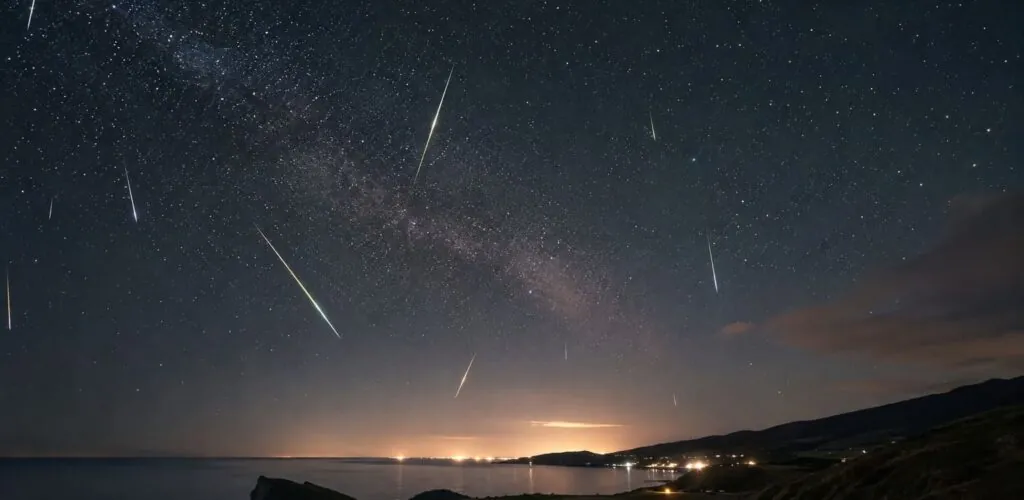
Ireland’s skies could offer one of the year’s finest spectacles on the night of 12–13 August 2026. The Perseids will reach their peak, with particularly favourable conditions thanks to the almost complete absence of moonlight.
The Perseids peak on the night of 12–13 August
A highly anticipated meteor shower
Just hours after the solar eclipse on 12 August, eyes will once again turn to the skies over Ireland. The Perseids will reach their peak activity on the night of Wednesday 12 to Thursday 13 August 2026.
Under ideal conditions, this meteor shower can reach a theoretical rate of around 100 shooting stars per hour. In practice, the number actually visible will depend greatly on the weather, light pollution and the viewing location.
Why 2026 is shaping up to be particularly favourable
The New Moon falls at the ideal time
The standout feature of the 2026 event is the presence of a New Moon on 12 August. The night sky will therefore be much darker than in years when the Moon brightly illuminates the heavens.
The absence of moonlight will make it possible to see more meteors, especially the fainter ones. In rural parts of Ireland with clear skies, conditions could be excellent.
What time can you see the Perseids in Ireland?
The best time will be in the middle of the night
The Perseids are visible for several weeks, but their activity becomes particularly intense around 12 August.
The night of 12–13 August will therefore be the most interesting. The first shooting stars may appear as soon as the sky becomes sufficiently dark, but conditions should improve as the night goes on.
The higher the constellation of Perseus rises in the sky, the greater the chances of seeing meteors.
Where can you see the most shooting stars in Ireland?
The key is to get away from city lights
To make the most of the Perseids, the most important thing will be to find a dark spot away from urban lighting.
Kerry, Connemara, Mayo and Donegal offer many particularly favourable areas. The Kerry International Dark Sky Reserve is among the best places in the country for observing the night sky.
Wild Nephin National Park in Mayo, parts of the Burren and rural areas of Connemara are also very good options.
From Dublin, Cork, Galway or Belfast, it is best to get away from the city centres to reduce light pollution.
Can you really see 100 shooting stars an hour?
A theoretical figure that depends on conditions
The figure of 100 meteors per hour represents a theoretical maximum calculated under perfect conditions.
In reality, an observer will generally see fewer meteors. Under clear rural skies, however, several dozen shooting stars per hour are still possible around the peak.
Some Perseids can also be particularly bright and leave a trail visible for several seconds.
Do you need equipment to see the Perseids?
No telescope is needed
Good news: no astronomical equipment is required. The Perseids can simply be observed with the naked eye.
A telescope or binoculars would actually be unsuitable, as their field of view is too narrow.
The most effective approach is to get comfortable in a dark place, with a reclining chair or a blanket, then allow your eyes to adjust to the darkness for around 20 minutes.
Where do the Perseids come from?
Dust left behind by Comet Swift-Tuttle
The Perseids appear when Earth passes through a trail of dust left by Comet 109P/Swift-Tuttle.
These tiny particles enter Earth’s atmosphere at very high speed and burn up, producing the famous streaks of light.
The meteors appear to come from an area near the constellation of Perseus, which is how they got their name.
An exceptional night just after the solar eclipse
Two major astronomical phenomena within a few hours
12 August 2026 is shaping up to be particularly spectacular in Ireland.
In the early evening, a major solar eclipse will be visible across the country, with more than 94% of the Sun obscured in several regions.
Then, a few hours later, the night sky will take over with the Perseids at their peak.
If the weather remains favourable, visitors in Ireland will therefore be able to witness two remarkable astronomical phenomena on the same day.