

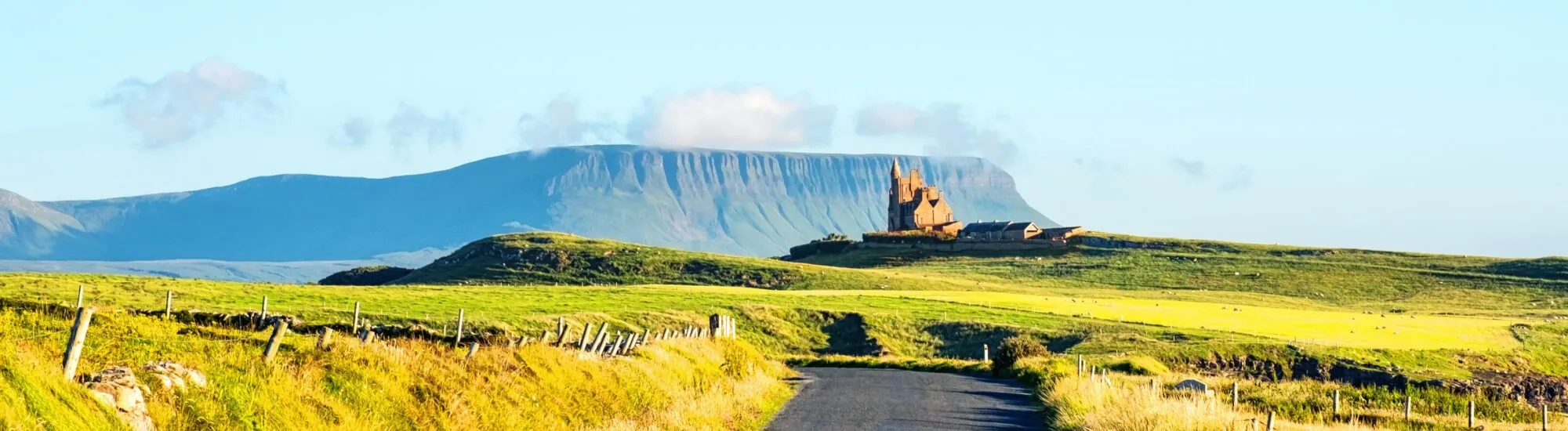
Perched on high ground on the Mullaghmore peninsula, Classiebawn Castle forms one of County Sligo’s most striking sights. Its silhouette stands out between the Atlantic Ocean, wind-swept pastures and the distinctive outline of Benbulben. When light breaks through the clouds, its honey-coloured stone gives the castle the appearance of a residence from a Gothic novel.
Classiebawn Castle is, however, a private property closed to the public. There are no tours, tickets or authorised access to the gardens. The castle must be admired from Mullaghmore’s roads and public areas, without going through the estate gates. This distance does nothing to diminish the spectacle: indeed, it adds to the monument’s mysterious aura.
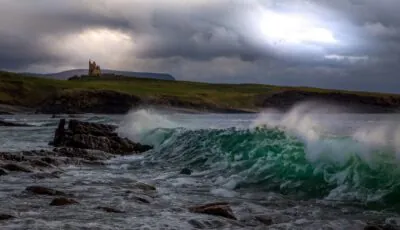
Classiebawn Castle in Mullaghmore – © Bruno Biancardi
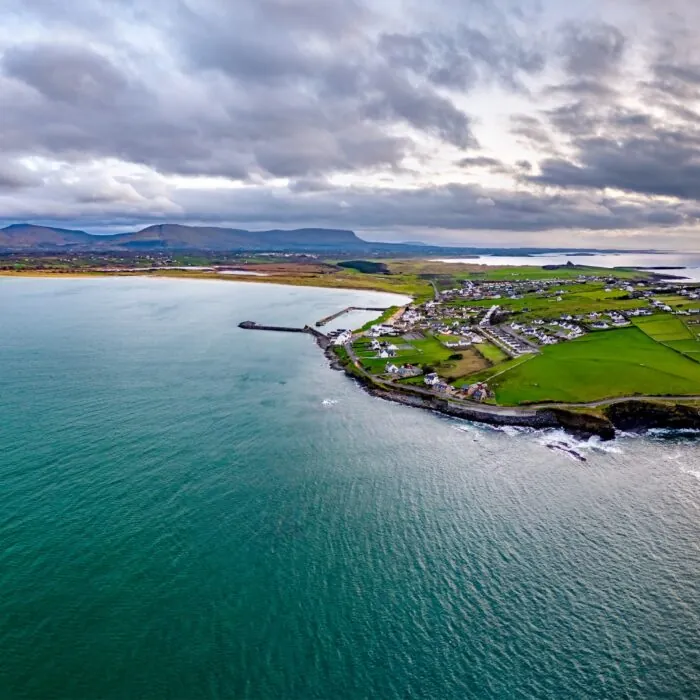
Classiebawn Castle stands on the Mullaghmore peninsula, in north County Sligo. Set on a promontory overlooking the Atlantic, it can be seen from several stretches of the coastal road that circles the peninsula.
Its tall central tower, gables and conical-roofed turret stand out clearly in the landscape. Behind the castle, the bulk of Benbulben sometimes appears, its rocky plateau forming one of the most recognisable horizons in the west of Ireland.
The monument should not be regarded as a visitor attraction open to the public. The estate roads, gardens and the castle interior are private. The gates and main drive may therefore not be used, even to take a photograph.
Classiebawn Castle was commissioned in the 19th century by Henry John Temple, third Viscount Palmerston. An influential politician, he served as Foreign Secretary and twice held office as Prime Minister of the United Kingdom.
The Temple family then owned a vast estate in north County Sligo. These lands had once belonged to the Gaelic O’Connor Sligo family before being confiscated in the 17th century and granted to Sir John Temple. Over the generations, the property passed into the hands of his descendants.
At its height, the estate associated with Classiebawn is said to have covered up to 10 000 acres, or around 4,000 hectares. Its area was subsequently considerably reduced, notably as a result of land reforms and changes of ownership.
Lord Palmerston also had Mullaghmore harbour developed and commissioned several buildings for the local community. He died in 1865 without seeing the castle completed. The residence was finally finished in 1874 under the direction of his son-in-law and heir, William Cowper-Temple, the future Baron Mount Temple.
Classiebawn Castle was designed by James Rawson Carroll, a Scottish-born architect based in Dublin. He adopted the Scottish Baronial style, a form of historicist architecture particularly popular in the United Kingdom during the Victorian era.
This style draws its inspiration from Scotland’s old fortified residences. At Classiebawn, it can be recognised in the tall vertical tower, pronounced gables, parapets and corbelled turret. The building was never a medieval fortress: it is a 19th-century country house designed to evoke the authority and romance of ancient castles.
The residence has several levels arranged around a five-storey central tower. Its irregular volumes, slate roofs and tall chimneys reinforce its monumental appearance. Ireland’s National Inventory of Architectural Heritage assigns it national importance and highlights its exceptionally well-preserved condition.
Some of the materials were brought by boat from County Donegal. The castle combines stone walls with more finely worked surrounds, whose warm tones take on an almost golden colour in the evening sun.
In the 20th century, Classiebawn Castle passed by inheritance to Edwina Mountbatten, granddaughter of Evelyn Ashley, one of the estate’s former owners. Edwina and her husband, Louis Mountbatten, set about modernising this still relatively isolated residence. They had electricity and running water installed, among other improvements.
Louis Mountbatten was an admiral of the Royal Navy, the last Viceroy of India and the first Governor-General of independent India. After his wife’s death in 1960, he continued to stay regularly at Classiebawn during the summer.
Contrary to what some accounts claim, there is nothing to establish that he disliked the castle. The often-quoted remark about the residence’s austere character came from his biographer Philip Ziegler, who considered it devoid of charm while acknowledging the exceptional beauty of its setting.
On 27 August 1979, Louis Mountbatten set out to fish off Mullaghmore aboard his boat, the Shadow V. A bomb planted by the IRA exploded shortly after the vessel departed. Mountbatten and three other people were killed in the attack.
The tragedy drew international attention and remains one of the best-known events of the Troubles. On the same day, eighteen British soldiers were killed in two explosions in Warrenpoint, Northern Ireland.
In Mullaghmore, the memory of the attack remains associated with the harbour, the bay and Classiebawn Castle. This history should be approached with sensitivity, as it still touches the memories of the families and communities concerned.
Classiebawn Castle is not open to the public in 2026. There are no guided tours, admission tickets or opening hours. The estate remains a private property used as a residence.
It is forbidden to go through the gates, walk up the drive or enter the fields to get closer to the building. An open gate does not constitute permission to enter. Flying a drone over the property also raises issues of safety, privacy and aviation regulations.
The castle is sufficiently visible from outside to be appreciated without intruding. A telephoto lens makes it possible to observe its architectural details while remaining in public areas.
The best views can be found along the Mullaghmore Head coastal loop. This small public road circles the peninsula between the village, harbour and western coast. Depending on your position, the castle can be photographed with the Atlantic, pastureland or Benbulben in the background.
The panorama changes constantly with the weather. In the morning, the light can illuminate the eastern façades. Later in the day, the stone takes on warmer tones while the hills are covered in shadow. After a shower, breaks in the clouds often produce the most spectacular contrasts.
Parking requires care. The road is narrow and serves homes as well as farms. Use only places where your vehicle does not obstruct traffic, a private entrance or the passage of farm machinery.
The Mullaghmore Head route is worth exploring even when the castle disappears behind the hills. The road follows a rocky coastline exposed to the power of the Atlantic, with views across Donegal Bay and the mountains of north County Sligo.
Mullaghmore is world-renowned among surfers for its giant waves. Winter swells can create impressive breakers offshore, reserved for experienced and supervised athletes. Visitors should watch the spectacle from a safe area, well away from cliffs and wave-swept rocks.
The village also has a long sandy beach, a small harbour and several places to eat in season. A walk allows you to enjoy the outline of Classiebawn at different times of day without attempting to reach the estate.
Classiebawn Castle lies at the heart of a region particularly rich in scenery. Benbulben dominates the surrounding area with its tabular silhouette carved by glaciers. Several viewpoints offer fine views of it, but ascents should be made only via authorised routes suited to the weather conditions.
Further east, the Gleniff Horseshoe road forms a spectacular loop at the foot of the Dartry Mountains. It passes through a deep glacial valley where Diarmuid and Gráinne’s Cave is found, associated with one of the great legends of Irish mythology.
The grave of William Butler Yeats is in Drumcliffe, at the foot of Benbulben. The poet had a deep connection with the landscapes of Sligo, which feature in much of his work. To the north, Bundoran and Donegal’s beaches offer further opportunities for walks along the Atlantic.
Want to extend your visit without having to rush around? Here are a few well-located places to stay near the must-see attractions.
Essential information to help you plan your visit, including key landmarks, access information, and booking options.
Cliffony, Mullaghmore, Mullaghmore
54.455095, -8.469321
30 minutes